Thursday, 26 December 2019

Realities of Time


If you are new to the Band, this post is an introduction and overview of the point of this blog that needs updating. Older posts are in the archive on the right. Shorter occult posts and reflections on reality and knowledge have menu pages above.
Comments are welcome, but moderated for obvious reasons. If you don't see it right away, don't worry. We check a couple times a day and it will be up there.


Picture: R.C. de Winter, The Carousel Of Time, 2009 


The last few posts have been pretty specific - time to get more speculative again. The Silmarillion posts got us thinking about time - in particular its relationships to representation and ontology. One thing that book did so well was capture the move across time, level of reality, and narrative mode at the same time [click for the post]. And thinking about time makes us aware just how much the fallen world interfere with our understanding it. Breezy tales about uncomplicated time travel, memory holing facts for fake Histories!, and fostering infantile state of perpetual year zero all distort our relationship with time. So time is obviously important to the servants of the lie, and that means it would be wise to pay attention to it. Because that also means it will have been inverted in the authorized narratives for a lot longer than we've been around around to consider them.


Jim Warren Studios, From Hell to Eternity

It won't be surprising to observe that the globalist beast system has distorted our relationship to time in the same way that it has other fundamental aspects of the reality we live in. 


Two big reasons to look at what we can know about time and how we can know it jumped out right away. Also not surprisingly both related to the larger pattern of satanic inversion. The first involves the split between the modern auto-idolatry of secular transcendence and the realities of what we can know and how we can know it.


Ian Barber, Timeless, photograph

The luciferian philosophy of be your own god do what thou wilt is based on denying Logos or existential truth, which has to pretend that the logical necessities of ontology aren't necessary. Fortune-cookie level fake "profundities" like 'time is a flat circle' keep you trapped in base materiality, unaware and unable to figuratively look up and consider Logos. It's a mind trap -  horizontal hamster wheel would be wordier, but more accurate.


The second is that a big part of Postmodern Thought! depends on misunderstanding misrepresentations of time. The interpretation of "Relativity" is a good example. The mathematical model tells us that time moves relative to things like speed. Observing that time appears interconnected with other material conditions of reality is the opposite of "meaninglessness". It is based on mathematical order - just not the one we perceive directly. If anything, it tells us that our sensory impressions fall short of abstract precision. Readers understand that there is no conflict - both are "true" in their appropriate ontological frame of reference.


violscraper, Time and Tide

But idiot Postmodernists take this as "proof" that ontology is subjective. Seriously. The chain of thought is literally that retarded. 


So there is value in thinking through why the physical relativity of time has abstract-level mathematically absolute zero ontological relevance at all. But framing the question "What is time?" raised an even more fundamental issue for the reality-secular transcendence split. What do we mean when we ask what something is? Call it the Clinton question. Are we asking for a description - what it looks like or how it acts - or are we seeking more fundamental meaning on an ontological level?


Victo Ngai, Pocket Watch

This isn't dorm room philosophizing. The answer will determine how we allow ourselves to see reality.


Often when we ask what something is, we are looking for an identifying description or definition and/or an explanation of purpose or construction. This is generally the case when talking about
human creations.


What is a warehouse? can be answered different ways depending on context, but will be some blend of appearance, construction, and function. 


But is gets more complicated with fundamental questions about the reality around us. When we ask questions like what is time - or being, reality, the universe, the meaning of any of it - we are looking for some kind of first or prior principle. 

And that moves us into ontology. 


Start with an observation: looking for the true or essential nature of something involves reducibility. Because it is taking complex individuated manifestations - things in the world - and reducing the complexity to more universal explanatory principles. This also makes sense from the perspective of the vertical ontology that the Band has been tracing out.


Defining what something is ontologically reduces complex material expressions to simpler abstract ones. But it is also a step "higher" towards truth. Quotes because height is a metaphor. Spatial relations don't apply above the material. 

As we move towards truth things simplify by necessity - they have to to get to the absolute unity of ultimate reality.  This is the technical term for the inconceivable- in-itself bedrock foundation of all that can be. God in Western thought. 

Abstractions are multiple, but but simpler and clearer than the temporal reality that they express. 

Like mathematics.


Or angels. 


Gustave Doré, engraving for Dante's Paradiso


Essential meaning - what something is in an ontological sense - involves reducibility because it moves up the ontological ladder towards the transcendent unity of God. Seems self-evident. But it's something of a problem for Flatland


That's our term for the demoralized incoherence of modern secular transcendence. That collective post-Enlightenment delusion that metaphysical things have material causes. 

Flatlanders want to understand the reality around them as well, only they can't look up. They have no Logos - vertical in this case, or any other kind - so they have no path to first principles. 


Flatlanders can't do this. Everything has to be constrained within the de-moralized material level of reality. 

This is what leads them to the real whoppers of secular transcendence - 

like teleological materialist history and the presence of eternity within the temporal.


The idiocy of secular transcendence should have been instantly obvious - a subset can't create it's set nor a child its parent. But vanity and greed are powerful, and the modern commitment to Flatland so strong that reason doesn't matter to many.


They're broken and they can't look up. 


Insisting that transcendent meanings are found in secular material reality stops Flatlanders from answering ontological questions. If they want to be intellectually coherent, they can't even acknowledge an ontological prior exists. So when you look at "meaning" in a modern secular context, all you really get is endless description. This is important because it is a fundamental fake principle of secular transcendent Thought! that description pass for ontological meaning.


Consider this really basic question for the sake of discussion - what is reality? Or a little more practically, where does reality come from or what is matter made of? Then think how unable a materialist, de-moralized modern perspective is to even address this. It can't get past description because it is material-level knowledge, and the material world is known empirically. That is, observationally. That is, description. Other forms of knowledge necessarily rise to the forbidden heights of ontology.

Start at the beginning - with the act of asking the question. Just putting "what is matter" into words is transforming what you are personally curious about into a standardized symbolic form. That is, description.


The Panel of Hands, El Castillo Cave, Spain, about 40,600 years old

As far as we know, written language evolved from visual symbols and pictograms. It's obvious - if you had to cooperate with someone who didn't speak your language, you'd start by figuring out ways to communicate. Common terms for things and so forth. 

We only have to emphasize this because a huge part of Postmodernism was the collective delusion that words don't refer to things. 


Postmodern linguistics were founded on the premise that language signifies or communicated negatively, not positively. The Structuralist "epiphany" that a word isn't meaningful because it designates something, it is meaningful because it is different from every other element in the linguistic system, Because it isn't every other word. 

It's really that retarded and we don't want to get into it again. Click for an older post breaking this down in a characteristically harsh way. If you want a Philosopher's Name, it is most associated with a fraud from those early posts - Saussure. 


Retarded enough that we don't even have to appeal to history for it to vaporize. Just consider how new words are added to a system based on relational differences...  Poof.

Non-retarded Empirical reality indicates that language is semiotic - it is a man-made sign system intended to refer to things other than itself, and it develops slowly and somewhat unpredictably over time. It isn't a simplistic set of labels, though labeling is part of it. It is an organic product of collective history and experience. It's more accurate to say that language refers to concepts - not just "things" but all the complicated interactions and relations between them and how they're represented. A conjunction is a concept.  A shade of red is a concept. You are a concept. Language is a symbolic shorthand for the fullness of our experience of existence. Where everything is translated into a conceptual medium in order to transmit it to other people.


This is why language is always imprecise. On the personal level - everyone who read "language" conceptualized it slightly differently. And on the cultural level, in that different languages express different attitudes and mindsets. They developed down in different material contexts with different relationships to reality. 


Why the notion of subjective linguistic filtering somehow became radical is one of the great mysteries of the 20th century. Right up there with "literary criticism" deciding language doesn't denote things. Think how you try and overcome the limitations of language in real life - more nuance, analogies, rhetoric. Better description. It is so self-evident that language is denotative that the acceptance of the inverse in authorized culture is just more evidence that the institutions are unfit for purpose.


Language isn't limited because it is founded on some faux-mystical abyss of "difference". It is limited because it isn't what it represents. 


This is where the imprecision comes from. It's inherent is symbolism of any kind. No matter how much description you pile up, a sign system ever becomes the same thing as the thing described. You can get endlessly closer without ever attaining a perfect replica of the experience. Because it is a material phenomenon and the material world is finite and fallen - a darkling glass. There is no perfection down here. Flatland is material only - a horizontal hamster wheel instead of a ladder to anywhere.


If you're trapped in the material all you have are material accounts of material things. And that's just dealing with the language. 

This isn't "Postmodern", "radical", or "discourse". It's communication. It works because there is enough common ground and flexibility that the differences don't preclude sufficient information transfer. But it isn't "perfect" either.

You can see the limits inherent is sign systems.


Simply posing the question has brought at least two layers of descriptive subjectivity your thought into language and language itself - into the equation before we've even started to form an answer.

Now we have to address the question. Set aside the limits of signs systems and subjectivity for now. How does a Flatlander address the question what is material reality? By continually describing matter and energy.We can dramatize it - call it the dialog of secular transcendence.


Endlessly reframing, parsing, and describing and getting no closer to what it is. Just ever more precise detail until slamming into limits of discernment with no logically-necessary endpoint. Like Zeno's paradox.


It's a lot less paradoxical when you realize division doesn't stack subtractions the way multiplication does additions. 


Modelling something - qualitatively or quantitatively - requires a better understanding of it's workings - a better description - than a surface scan. It is an interative process of finding quantifiable patterns and relationships within datasets that are themselves symbolic translations of material phenomena. When done well, it can predict outcomes and identify solutions and efficiencies. But it isn't is the same as grasping it ontologically.  But when you don't have ontology, describing is all you can do.


This is not a rejection of modeling as a concept. Modeling is important as a material process for material outcomes. We just can't get to essences or ontological priors - let alone origins - by trying to build models of fallen, entropic empirical things. 

This can be a confusing distinction because modeling also involves reducibility. The reduction is that the model is less complex than the reality that it represents. It's semantic, not ontological. Descriptive, not determinative. 

Flat and secular transcendent rather than vertical and logos-facing. 


But this is Flatland, and in Flatland, semantic, descriptive secular transcendence is all there is.


Hence the bizarre modern idea that being able to describe pre-existing material phenomena in a symbolic language somehow connotes ontological Truth. It's incoherent when you think it through - that people don't is a sign of how distorting Flatland has become.  It's more comfortable to simply accept things that literally make no sense rather that roil the placid waters of delusion. Because it's the delusion that brings the stuff, and, if you're really lucky, the prestige...


François Le Moyne, Narcissus Falling in Love with his Reflection, 1720. oil on canvas, Paris, Musée du Louvre.


We know that the material world is finite and fallen, and we are temporal and subjective. It's why there is no ontological certainty here. But the Flatlanders need to limit everything to the material and pretend to deal with properly metaphysical subjects. It is no surprise to us that their fake material absolutes fail over and over - we know that positing material absolutes is terminally inane. But is it existentially traumatic for them.

Consider a less simple question than what reality is. Like relativity - one of the central planks of the modern, de-moralized world view. Both in physics and as the more broad attitude towards culture and morality of Postmodern globalism where everything is relative.


According to the recursive echo chamber of the NPCs, this was cause for a "crisis of confidence" that "upended man's place in the universe" and similar b.s. 

It didn't really. Like  deconstruction - it blew up auto-idolaters' simplistic fake schema by showing that they fail as descriptions. 


We are not interested in disputes over authorship or Einstein's perverse personal life, nor the specific strengths and weaknesses of the theory. The information is so intrumentally mediated, so far removed from experiential reality, so unverifiable, that it resembles a game of abstract pattern-matching more than anything else. 

It even features an observatory named "Keck". So there's that. 


What matters here is that the theory describes and predicts certain things better than the models that it replaced. But it "explains" nothing essential. Nothing about the prior existents of which material reality is necessarily a subset. It is a descriptive translation of observed reality into a quantitative metaphor that describes the material world more or less well. It simplifies in that reduces the complexity of the subject to imperfectly-fitting equations with no bearing on what the subject is or where it came from. It may be accurate, but it is ontologically irrelevant. 

Translating and describing is all you can do in the material world. And that is never coherent.


Euclidean geometry, Cartesian space, and Newtonian physics do a fine job of describing material reality on the personal level. Relativity and quantum mechanics do better jobs near the limits of discernment - accounting for things that we don't experience directly, but know through instruments and mathematical logic. 


As we leave the world of direct experience and move towards the limits of discernment, the models of reality become more complex, counter-intuitive, and bizarre, before disappearing from view. None of them are compatible. And this is only surprising because of the power of the glamour - the mental indoctrination into the fake thought-prison of secular transcendence - to teach nonsense is truth.


John Martin, The Valley of the Shadow of Death, 1829, wash on paper. private collection

Readers know material reality is knowable empirically up close and gets murky as you move further out. As should Christians - if they haven't followed Churchian frauds away from God to worldly things. In the finite/fallen world, the limits of discernment are just the darkling glass and valley of shadow in a different allegorical language. 


The larger issue is that Christians need to take their own metaphysics more seriously and stop dancing for globalism. It's satanic. Relativity and quantum mechanics are only "destabilizing", and nihilism producing if you are a Flatland moron that can't look up.

Of course mathematical models become incoherent and unreconcilable - they have an abstract perfection that ontologically exceeds the conditions of material reality. They represent too high a standard, figuratively thinking, for fallen material reality and human intellects.


This means that the incoherences and discrepancies in the models are not limitations in the math, but artifacts of the fundamental nature of material reality and our place in it. 

There is no reworking of the calculations that is going to bring us to the essence of the calculation - just endless refinement of the necessary gap between the models and material reality. 


Think about that for a moment - we can't Flatland our way to the essence, origins, or meaning of the material reality around us. All we can do is calculate ways that that material reality fails to conform to abstract quantification. How the fallen, finite world we exist in falls short of the literally metaphysical perfection of mathematical relationships. In other words:


Read that again, because it sort of short-circuited us for a bit.

Of course there is no path to origins or ontological priors of any kind in the secular transcendence of Flatland. Think about it - using mathematical nomenclature to imperfectly model this valley of shadow in the hope of stumbling onto first principles is no more plausible than trying to determine someone's parentage by digitizing a cartoon avatar.


None of this is a swipe at the complexity of the math. The question is, does the intricacy of the the numerology matter when the operating assumptions are this conceptually askew?


If you want to know what something is, you have to be able to look up.


It's metaphysics.


This is relevant to the issue of time because time is one of those fundamental issues like the nature of matter or the origin of the universe. So speculation about what time is are either ontological or descriptive - either they look up for essential meaning or spin round and round empirically in Flatland. There are no other options.


Micha Arkhipoff, On the Shores of Time Lost, oil

Most definitions are descriptive - time as a sort of sequential movement, causality, events, or perceptions. We're struck within it, so we map and describe the condition of being subject to time - temporality or time-boundedness. 


mariana-a, She saw the time passing by (new), drawing

Because we can't look outside of time, there is noting concrete to relate or contrast it to. 

We can't really conceive of the eternal or the timeless - we can use words to describe the opposite of what we perceive time to be, but have no path beyond that.


The Band has no idea what time is in an ontological sense. Looking at it from the outside, it is obvious that we have to account for it on at least two levels. Time as a physical condition of the material world and time as a subjective experience.

This is an old distinction in Western thought. We can see the basic distinction in the writings of St. Augustine - click for the argument we're summarizing here.


Steve K, Let There Be Light, 2013.

Time exists objectively because it came into existence when God created the universe ex nihilo and precedes humanity temporally. 


Titian, Allegory of Prudence, 1565–1570, oil on canvas, National Gallery, London

But time is understood by human consciousness subjectively. Augustine describes three states - the present, the memory of the past, and the anticipation of the future. Think of them as past, present, and future as they appear in the present moment.

This complicated painting combines the traditional three ages of man with this notion of time as past, present, and future. This theme may be symbolized by the animal heads and is clear in the inscription, "from the experience of the past, the present acts prudently, lest it spoil future actions". Memory, present, anticipation. Just as Augustine wrote. 


Both appear to be sequential, but are not the same. We are not that interested in the subjectivities of individual time consciousness. You can read Proust for that - and become very aware of your own dwindling time on this earth while doing so. It is enough to observe that we don't perceive time consistently. Not as individuals and not compared to each other. Like all our perceptions, it's a reminder of the subjective filter that covers everything we do.

Physical time is more pertinent here because that is the aspect of material reality that we are trying to make sense of. The it in the sentence 'we all perceive it differently'. And as is the case with material reality in general, what it is isn't precisely clear.


Brigit Byron Coons, Timeless, 2009

There is a difference between how how time appears to act in our direct experience and under more unattainable or theoretical conditions. Relativity and quantum theory tell us that time is not independent of the other aspects of material reality, but part of it. Extreme speeds and gravitational forces appear to influence the rate at which time passes. Time-translation symmetry appears to break under specific conditions. 

Just like reality in general, we are running into limits of discernment as we try and push deeper into the nature of time. 


Consider - in everyday life, time flows along, constant, and unidirectional. Easily measured by inexpensive devices. But the further we stretch our perceptions with more sophisticated instrumentation and even more complex theoretical models, the more it deviates from direct experience. The deeper we probe, the less intuitive and clear time is. This is the same pattern we noticed in the allegory and entropy posts - as we look further, the picture gets more confusing and impossible to resolve.

We recognize this now as a limit of discernment.


Kevin Best, Vanitas, still-life photograph,

 None of this is radical from a Western Christian perspective unless you've sold your faith for fancies. Why wouldn't time and material reality be interrelated - they were created at the same time. To say that Creation is temporal is to say temporality is of Creation - it is the condition of the material world. 

On this, relativity and Augustine would agree. 


But relativity is Postmodern, the fearful squeak. It's immoral. Of course it is. It's a description - imperfect, but accurate enough in some ways - of a fallen, immoral material world in an abstract mathematical language that it can't hope to conform to. This is only cause for fear if you believed abstract certainty can be found down here. Think of relativity as an allegory and it looks like that familiar lack of objective certainty of the darkling glass and the valley of shadow. What we are seeing - once again - is that empirical reality does not conform to the unworldly precision of mathematical modeling. If we want ontological priors, these are the wrong tools in the wrong place.


Even the more radical theories of non-linear time are largely ontologically irrelevant. Suppose there is some Looking Glass technology that let us glimpse the future. So what? Think it through the simulation analogies that are popular with the brights these days. Imagine creation as a video game or virtual life. 

Does getting to see three screens ahead somehow undo the temporal sequencing of the game design? 


Simulation theory does raise interesting patterns that are worth considering. On one hand it's just the latest in a long string of projections, where people use the most complex technology of the day for as an analogy for metaphysics.


God as Architect/Builder/Geometer/Craftsman, Frontispiece of Bible Moralisee, 1220-1230, illumination on parchment, Austrian National Library

In the Middle Ages, God was presented as an architectural designer, since geometry and architecture were the most advanced example of creation. 


Clocks: a watch-maker seated at his workbench with a long-case and a bracket clock behind him, diagrams of movements above his head, 1748, engraving, Wellcome Library

In the Enlightenment, the fine craftsmanship of a timepiece was the pinnicle of design, so God was the divine watchmaker. 


Now it's advanced computing and AI - any surprise that brights have suddenly decided that God is now a programmer? 


The pattern is simple - humans can perceive the constructed nature of creation, but ultimate reality is by necessity beyond them. So they project the most advanced engineering that they can think of and describe it as a better version of that. It isn't wrong metaphorically, though God is no more likely to resemble a programmer than a medieval stonemason. If thinking in terms of simulation helps break people from the materialist straitjacket, then there is some value there.

But look past the surface pattern of projection to the notion of creation being projected. The medieval builder is an active and willful designer - like the constant presence of God in medieval culture. The watch is an impersonal perpetual motion machine - mechanistic, cold, and woefully conceptually inadequate for the complexities of empirical reality. Like the Enlightenment. A simulation is somewhere in the middle - something that seems to run on its own like a watch, but where the designer can interfere like the builder. It's a narrative. And seeing that helps understand time in an ontological way.


To be coherent, a narrative has to have some sense of internal time - the alternative is cynical Modernist gibberish like the "cyclical" Finnigans Wake. 

This is how the book opens. The end continues into this opening to create a closed loop. The book literally goes nowhere. 

And it's always worth a grim chuckle to revisit the abject garbage clogging up our culture.


The author is not bound to rigid temporality - so long as there is a coherent structure tying the overall narrative together, it is possible to break the linear sequence situationally.  It doesn't even have to be time travel - foreshadowing and flashbacks present information out of strict temporal order that actually furthers and enriches the narrative.

Now here's where the metaphor becomes ontological - no matter how much narrative time jumps around, you still read the book in sequential order. That deserves a quote graphic for emphasis and clarity:


There's the analogy: material reality appears to behave like an artificial narrative. Put aside the technology and "simulation" is just a hypertext narrative told in a digital medium. Within the narrative construct, temporal sequencing is not rigid. Theoretically speaking, time is relative to other material conditions. But the nature and parameters of the simulation impose a meta-direction that isn't accessible to characters on the inside.

Take a common "reality" simulation game like Skyrim The Elder Scrolls for example:


Time elasticity and manipulation within the narrative level of the simulation...


... are constrained and directed by the built-in parameters of the simulation...


... are constrained and directed by the nature and limits of the medium.


The analogy becomes ontological when we use the levels of "reality" above a narrative simulation to conceptualize the metaphysics of vertical Logos. The parallel isn't exact, but it is close enough at a glance to see the strength of the metaphor:


Game play unfolds within simulation parameters, much like the material and abstract levels in reality. It's weakest at the ultimate reality level, though it tightens up if you include the programmers, engineers, and other makers of the game system.


One benefit of a good analogy is that it lights up something about the subject that was not as clear before. This doesn't explain, but it does help us understand why material temporality or space-time can appear fluid - everything from relativity to mandala effects - but reality itself doesn't collapse or unravel. Time within a narrative simulation can do whatever the simulator narrates or creator permits... within the narrative simulation.  But if you can look up, there are parameters to the simulation and conditions beyond those that are indifferent to the vagaries of plot. The meta-direction and it's Creator are utterly indifferent to our perceptions of material temporality.


Victor Bregeda, Inspiring Moments of Narration, oil on canvas

Just as the characters in a story can't change the page order in the real novel. 

But that's what Flatland more or less wants to do. It is trapped in material temporality with no path to the ontological - the turning of the pages, or the run sequence of the simulation - to continue our metaphor. 


This means that epistemologically, it requires faith to go from the recognition that ontology has to exist to a specific moral code. Grasping that there is a page order or run sequence doesn't elevate your discernment beyond the limits and distortions of a fallen material world. Flatland can't bring material existence into alignment with metaphysics through Logos because its blind faith - secular transcendence - can't even admit metaphysics can exist.

Now this is too speculative to put much weight on, but consider:


Prophecy plays a huge role within the narrative - that is, information about future events before they happen. The unity of the Christian Bible is based on the Old Testament foreshadowing the New. Yet there whole thing is coherent from beginning to end - prophecy and revelation are folded into the meta-narrative.


Gustave Doré, The Prophet Amos, 1865, engraving for Amos 1:1: The words of Amos, who was among the herdmen of Tekoa, which he saw concerning Israel in the days of Uzziah king of Judah, and in the days of Jeroboam the son of Joash king of Israel, two years before the earthquake (KJV).

Biblical prophecy differs from scientific versions - it uses divine inspiration, not looking glass technology to glimpse the future. 

But look at the pattern. The material representation of Christian Truth is a narrative describing a vague fallen Creation with the possibility that information can move out of strict temporal sequence. 

A simulation. 


Any deeper understanding of time depends on what the authorship of Creation "means". And that boils down to faith, because this is the only access we have to this ontological level. As time-bound beings we can't conceptualize timeless Being. But if we want to stick to patterns we can see, the Bible is a narrative simulation. Where information can come out of sequence and we all freely choose among the options, but temporality has a clear beginning and end. And ts ties into moral direction - Logos, Providence, God's will - the divine plan for Creation as it plays out in the world of human experience.

Both the individual and universal existence have purpose. The soul seeks salvation within a universe that follows divine order. They are teleological -  an ultimate endpoint that they are drawn towards.


Giotto, The Last Judgment, 1307, fresco, Scrovegni Chapel, Padua


From a Christian perspective, time is the causal chain that this divine meta-narrative - God's plan for us and for Creation - plays out on. Internal temporal inconsistencies and all. Reality is teleological - it is sequential in that it has a beginning and end. It's just that that's not visible to material beings within its span. It's ontological. You have to be able to look up to see it.

Here's a thought:


"Time" is the framework in which the teleology of Creation unfolds. "Temporality" is how we see it.


George Grie, Dreamscape Reality, 2012


Wednesday, 18 December 2019

Looking Closer at the Pope's Satanic Throne [PST ©]


If you are new to the Band, this post is an introduction and overview of the point of this blog that needs updating. Occult posts - posts on the history and meaning of occult images - have their own menu page above. All  posts are in the archive on the right. 
Comments are welcome, but moderated for obvious reasons. If you don't see it right away, don't worry.


One of the Band's most popular posts took a look at the pope's serpentine audience hall and satanic throne. See Infogalactic on the Paul VI Audience Hall in the Vatican, and some photos. We didn't break any new information but observed how upside-down the symbolism was related to serpents in the Bible. Click for the post. Since then, we've come a long way in recognizing corruption and inversion in modern globalism and the underlying rejection of basic truths about reality. So the throne is worth a closer look - for that reason and because it remains mind-blowingly awful.

Just a refresher. Not only is this not "photoshopped", it's from an official US Government site.


U.S. Department of Defense, U.S. Defense Secretary Leon E. Panetta attends an audience with Pope Benedict XVI at the Vatican in Vatican City, Jan. 16, 2013. 


Start with what brought the Pope's Satanic Throne (PST ©) back to mind. We recently saw a link that highlighted something that we hadn't noticed when we first looked at this monstrosity.


Cut Fazzini's Resurrection in half, and replace the left half with the mirror image of the right. And it gets clear why the figure is so discomforting. 

Consider that it took Fazzini over a decade from the commission in 1965 and completion in 1977. The original was done in polystyrene and fumes from the burning plastic gave Fazzini a blood clot. The point is it wasn't something done spontaneously. It was carefully planned.


So there's that.

And this got us thinking more about the PST in particular, and not the whole hall.


In the first post, we noted that the guy behind the commission seemed shady from what we could see on-line, but didn't find the sort of "proof" that could show sleepwalkers how fundamentally wrong this statue is. No talking head proclaiming it on the authorized nightly transmission, or a feature in the Times. Seeing the manipulation of the design got us thinking about the artist - who also has very little info available on him. So this is a good opportunity to show how to make connections and identify patterns of evil when there aren't t.v.-style "uncoverings" or smoking guns.


Look at patterns - how things play out or influence each other in similar or parallel ways. 

The way these all look different, but are all clearly chess. There are patterns that give it away.


When it comes to spotting perverse or evil secrets - the occult in a modern world - look for the inversion of what is real in some way. Those moments when up is down or down is up. The coward or weakling is the hero and so forth. There are countless ways for this to happen on every level from basic observations to complex logic. Science got it's reputation by making observations then drawing conclusions. Science! inverts that by ignoring observations and making up fake narratives that serve globalist political aims. It's the complete opposite, but claims the same name and traditions. It happens over and over in venue after venue, but the inversion is consistent.

But what is constant is that when you see the truth being inverted - something pretending to be its opposite - you know immediately that this is "off". How or why is not always obvious, but you know to look again. And that's when the links appear.


Pericle Fazzini, Bronze Crucifix, 1974, 120 x 93 x 31 cm, bronze, Vatican Museums

A link like Pericle Fazzini, an Italian modernist of the post-World War 2 era and the sculptor strangely chosen to cast the PST. According to the Minnesota and North Dakota chapters of the Patrons of the Arts in the Vatican Museums who raised $14,850 to fund the the restoration of this hunk of crap, "this wonderful cross" was completed at the same time as the PST. It's a cross without Jesus battered by wind, but with the Shroud somehow on it. His inscription on the back reads: Always, the wind blows and slams against your embedded cross, dominating time in this land. The wind makes to beat and stagger it like a coat hanger." 

Not exactly a Christian message of reassurance and salvation. Though it's doubtful the people at the center were Christian either.


In this post, we will connect two things - the PST and the de-moralized modernism forced on post-World War Two "culture". This is a huge topic, so we're keeping it short by limiting it to the throne, and patterns we've already seen in older occult posts [but you can click for a reminder how connected the total social upheaval of the war and the degredation of culture were]. The point is to see the relationships in things around you that are made out to be random happenstance. Like how bringing in modern art like Fazzini's was not just a sign but a public admission that the impostors in the Church have inverted the it's basic fundamental values into something perverse and wicked. But that means connecting some patterns.

Start with a definition - in this case de-moralization. We have to come up with new terms because we are thinking in different ways and the terminology isn't always there. There are posts on de-moralization if you are interested, but it just means the loss of objective moral standards in society.


Aaron Douglas, Aspiration, 1936

In the West, the mix of Christian metaphysics and logic that allows us to make moral distinctions and avoid evil. We use the hyphen to distinguish it from the usual meaning of demoralization as loss of morale. The two are related - Logos-based morality keeps morale up - but the Band uses de-moralization specifically for the lack of moral principles in our materialist modern world. 

Like a celebration of "freedom" where the "city on the hill" is a factory and high-rises. It isn't a spiritual struggle at all, and the only moral principle is the pursuit of stuff. Maybe prestige too. 

David Ameil, An American Dream, collage on canvas 

Always wondered about those "aspirational" shots of distant, often Art Deco-y cities. What do you do when you get there? 

What makes piling up block-like structures appealing on a human level anyway? How do vague floodlight effects make it more so? And how does scrabbling in the shadows of huge soulless structures built by others connote personal achievement? 


This is a really important thing to keep note of. De-moralization is one of the main ways that this modern globalist beast system keeps you trapped and cut off from your higher spiritual nature. In a recent regular post, the Band was trying to describe a concept of history like the one in The Silmarillion - or the Bible for that matter - that moves through time, and crosses levels of reality. Call it complete history - one that considers the origins as well as counting years. We don't have this word because modern society is de-moralized - we don't even have the language to deal with the metaphysical aspects of history.


There has to be a metaphysical aspect to history because the physical has to start. 

Or else it's truly infinite, and infinity as a concept is essentially metaphysical. Turtles all the way down.


And somehow, this de-moralized reality manages to be occult too - lots of dark secrets, only they're presented as ok because they aren't "supernatural". When things like like creation ex nihilo or spirit possession are just wonders of Science! you can pretend that they don't raise metaphysical questions by necessity.


At which point it becomes obvious that the entire modern "system" - the whole fake, de-moralized, materialist web of literally impossible claims about the nature of reality - is itself the inversion. 


Since there obviously is an order or Logos to reality, there is also objective morality. It starts with aligning with what is. Truth on the most abstract level. Put in more practical terms - aligning with what is real. Make it personal - with what is true as we can know it as limited, time-bound creatures in a reality that is bigger than we are. The opposite is to pretend what we wish were true was. The way small children blur desire with reality.


Mick Porez, the american dream, collage
This is how we get to fake, de-moralized modern cultural inversion. Since it has turned its back on what is true, it can project any illusion that serves it's programmers. And we get the moronic web of media delusion that masquerades as something real and makes the protoplasm quiver. 


When will and desire replace logos and observation as the foundation of moral social order, we have that same basic satanic inversion - be your own god, do what thou wilt, its all relative - that keeps coming up. That we are somehow the authors of reality rather than figments of it. And the motivations are always the same - greed, vanity, prestige, stuff, twisted appetites, and power.


So what does the pattern of fake de-moralized mass culture have to do with the PST?


...besides the general problem with removing morality and metaphysics from a culture and society built on them. That should be obvious. 

This only becomes the "American Dream" when illusion has replaced reality. Self-pleasuring lack-jawed sleepwalkers aren't exactly models of spiritual discernment. 


There are at least two more specific connections - we will note them, then look at how they work together to lead to a conclusion.

1. The sculptor of the throne was an Italian modernist - basically an inverted, feral animal culturally, and a witless globalist tool politically.


Pericle Fazzini, Sibilla, 1947, bronze, version in Middelheim Museum and 1961 cast for Kiel, Germany

Sibyls were seers from ancient Greece - the Classical subject matter that 19th century academies loved. The distorted appearance - steatopygous proportions, deformed head, and lewd pose are direct attacks on beauty. Modern artists and institutional gatekeepers force demented ugliness into spaces most associated with cultural wisdom and beauty. 


Demented isn't just rhetoric. Look at the face. 

Modernism attacks culture through inversion. That's what reveals it as satanic. Things that are virtuous are debased, while the debased is elevated - all in the name of "freedom". Busting out of "the rules". A vicious infantile tantrum that was jacked and directed by the truly evil. 

If reason is a virtue, then madness is the modern inversion. When you think in terms of patterns - this is the same thing as Science! pushing the subconscious and psychoanalysis. It's all part of a larger attack on logic, Thar is, Logos. The connection between the human and truth.


2. The ultimate client is the Church - the piece is installed at the heart of the papacy. And the Church has always used art to express its identity - an identity based on mediating the Biblical promise of salvation according to it's own dogma. It's important to emphasize that this isn't our observation - it is the Church's own claim.


Eduard Burgauner, Christ Handing the Keys to St. Peter, around 1899, Parish church of Kastelruth, Castelrotto, Italy 

The Catholic notion that the Church alone sets correct doctrine and holds the keys of salvation is a theological argument, and not one that the Band has the interest or expertise to wade into. The important thing is that the Church itself stakes its claim to religious authority on the dogma that it continues Jesus' mediation between earth and heaven. That is, the maintenance of God's word. 

It is understandable that superficials might change over time, but the entire purpose of the organization - by it's own dogma - is to maintain spiritual consistency beneath changing superficials. To resist moral and social entropy - the tendency for complex human systems to change and corrupt over time. 


This was always an ideal - historically impossible, but something to aspire to. At the very least, the Church was expected to at least try and align with fundamental Christian principles over the self-idolizing whims of vain and fallen creatures. We realize that that has not been the case for some time. But we are thinking in terms of general directions, and the big patterns tell us Modernism as a social movement is diametrically opposed to the Church's fundamental reason to exist.

Before we even consider a single detail, we can see that there is no possible common ground between de-moralized materialism and fake Progress! and spiritual custodianship  and fundamental truth. They are mutually exclusive. Modernism is by definition "not the Church". It defines itself as the rejection of spiritual or moral fundamentals - the very things the Church claims to exist to maintain. For the Church, "modernizing" is literally self-erasing - by it's own terms.


Frederick Wilson for Tiffany Studios, Angel of the Resurrection, 1903-1904, stained glass, lead, Indianapolis Museum of Art

We don't have to listen to a single rationalization or rhetorical appeal to know that "modernizing" the Church is impossible and that anyone proposing it is by necessity a liar. We can see it. 

Consider the angel - one of the most common subjects in the history of Western art. It has a lot of roles, but some sort of supernatural beauty, purity, holiness, goodness, or other sign of God's messenger is implied. 


Marina Petro, Angel, miniature oil painting

Nothing wrong with abstract angels - the're sort of abstract by nature. This simple figure blurs into the atmosphere around it like an impression. But the airy purity and inherent beauty and goodness still come through. 

Abstract art doesn't have to be twisted and inverted. It's just that modernism is inherently twisted and inverted and modern art exists to twist and invert tradition. The lesson, as always, is that intentions matter, and we will know these by their fruits. Petro's angel is abstract, but consistent with what angels are. 


Pericle Fazzini, Angelo, 1979, bronze, museo Torrione della Battaglia, Grottammare, Italy

And a Modern abstract angel by our pal Fazzini. It's typical of modern abstract art in the way it uses the simpler, less realistic form to debase rather than accentuate. The Pedro is simplified to show the luminous airy nature of a spiritual being. The Fazzini is twisted, deformed, almost demonic, with nothing heavenly or airy about it beyond the broken wings. It's inverted. 

"Abstract" is a cue to look closer. Then the intention becomes obvious. And the moral direction


You can see it.


To repeat: before we hear one rationalization or rhetorical pitch, we know that choosing a modernist artist to design the papal throne is diametrically opposed to the essence of the Church. Not to mention almost 2000 years of religious art in theory and practice. It is inversion. So when the form strikes us as monstrous and wrong, we are seeing something that is monstrous and wrong on the most simple basic levels of what Church and de-moralized modernism mean. We could joke about a severed goat's head on the pope's altar, but the truth isn't far off.

That mirrored image... Now with color highlights:


The mirroring and highlighting drives home the point. But it isn't as if the unmodified statue is particularly Christian. It looks even more sinister in a way.


For most of its history, the Church has been a major producer of arts and an important source of information for researchers. This is why the lack of detailed information about The Resurrection on the internet, and how vaguely misleading  what info there is, such a red flag.

Like describing this thing as"Christ rising from a tomb in the Garden of Olives, while the earth is shaken by an enormous storm." No mention of Jesus mind you, and no acknowledgment of Fazzini's own description of "the great" statue: ''Suddenly there came to me the idea of Christ preaching peace for 2,000 years, and the place where He prayed for the last time: the olive grove of Gethsemane... I had the idea of depicting Christ as if He were rising again from the explosion of this large olive grove, peaceful site of His last prayers. Christ rises from this crater torn open by a nuclear bomb; an atrocious explosion, a vortex of violence and energy.''


It's almost like it's embarrassing...

Pointing out that the Church has always been an art world leader is meaningless without context. And actively deceptive if the meaning of the art has inverted from what it was. It is true that the Church has produced spectacular works of art whenever it has had the security and resources to do so. We just need to consider the basic patterns.


Transfiguration of Jesus, 565, mosaic, Monastery of St. Catherine, Mt. Sinai

The point of traditional Church art is deceptively simple. To teach and inspire. Like this grand mosaic depicting Jesus' transfiguration in a way that explains what it is - the mandala shows his divine nature - in a format appropriate to the magnitude of the event. It can teach doctrine, and inspires with its size and appearance. 


Thomas Kinkade, The Forest Chapel, 1999, oil on canvas

But this covers an incredible range of possibilities. Kinkade captures the sense of spiritual community in this fantastical setting. The basic idea was to promote the Church and its theology by presenting it as a glimpse of heaven on earth. Material beauty and splendor as a foretaste of God's kingdom and the glory of salvation. 


Religious art also depicts suffering, but always as a way to guide and inspire the faithful. What you don't see is despair and degradation for its own sake. Even the most  gory crucifix is intended to remind you of what Jesus endured for you and fortify your own ability to use faith to get past the challenges of your own life.  And the idea of a church that is repellent, degenerate, or somehow ugly is completely opposite the basic purpose of church art.


Santa Maria Maggiore, 432-440, Rome
The Church always used the styles of the day - like an ancient Roman basilica - but for a positive message. The Church as the glorious gatekeeper between you and the glory of Jesus' sacrifice and salvation. It's an invitation to come in and connect to the path that has been opened to you.


The Church was the center of the art world for so long because it had the most prestigious appointments for the best artists. This is because in a reality-facing society, religious art is the most valued. Michelangelo was hired to paint the Sistine Chapel ceiling because of his talents, but it was getting the Sistine Chapel and other major religious contracts that made him "Michelangelo". Traditionally, the fame, the talent, and the beauty and profundity of faith worked together. A logos-based economy.


Sistine Chapel interior by Michelangelo and other artists, 1482- 1540s.


The central place of religious subjects in the art world began to change in the Renaissance, though there was a last Baroque flowering of "historically significant" religious art.


Gianloranzo Bernini and others, decorations inside St. Peter's, 1620s-1660s. 


Different style, but still beauty, splendor and the light of divine salvation. But after this period we get Enlightenment and then Modernity, and religious art steadily drifts apart from the secular materialism that comes to dominate official art.


Hyacinthe Rigaud, Louis XIV, 1701, oil on canvas, 277 × 194 cm, Musée du Louvre, Paris

By the time we get to the "Sun King" - seriously - in his red shoes, the "center of the art world" moved to Paris and its secular Academies.

The reality is that the idea of a center of the art world is retarded self-stroking by the parasites that make up institutional modern "culture". It's just influential,because it allows the narrative engineers to impose one story in history.  Search the internet for art timelines, and you learn that religious art disappears pretty much after the Baroque. 

The idea is to make you think that de-moralization is some kind of progress and to not consider your place in reality. It's not that the Church stopped using art. Protestant and Orthodox art become more common as well. It's that "official" art went in the Modern direction of de-moralization and cultural destruction and the Church preferred the spiritual message that its very existence was to maintain. 


Of course modern Art! and Church art move in separate directions. They had to. They're diametrically opposed.

Compare the great spaces up above to the Paul VI Audience Hall. The hall isn't a church, but it's tightly connected to one. Think about the fundamental moral direction implied in aesthetic. 


Yeah. About that...


So what does the Church say about art? There's a long history - click for a nice summery of the Catholic position over the centuries. It's quite consistent, as you'd expect. Reading it, you'd think nothing really changed since since Michelangelo. Just look as some recent samples:

Here's a piece from the Roman Missal, printed in 2002. The missal is a collection of texts for the Mass, so it is written specifically for that context. The images it is referring to are on or around the altar of a church - where the Mass is performed. Fazzini's Resurrection isn't in a church, so focus on the general attitude to religious art. Quotes from the Missel in this font (emphasis ours).


Juan Carreño de Miranda, The Foundation Mass of the Trinitarian Order, 1666, oil on canvas, Louvre Museum 

"318. In the earthly Liturgy, the Church participates, by a foretaste, in that heavenly Liturgy which is celebrated in the holy city of Jerusalem toward which she journeys as a pilgrim, and where Christ is sitting at the right hand of God; and by venerating the memory of the Saints, she hopes one day to have some part and fellowship with them.

It starts with the relationship between the Liturgy - ritual communion with God - and God. This doesn't address art directly, but sets the table by asserting that the Church gives a hint of heaven to come. In plain English, the idea is that Church is morally aligned with God and heaven. 


Continuing to read, the Missel tells us that religious art is in keeping with tradition and provides assistance to devotion. Note the emphasis on accurately reflecting the "mysteries of faith" - that is, the body of doctrine and dogma that defines what the Church is:

Thus, images of the Lord, the Blessed Virgin Mary, and the Saints, in accordance with the Church's most ancient tradition, should be displayed for veneration by the faithful in sacred buildings and should be arranged so as to usher the faithful toward the mysteries of faith celebrated there... Generally speaking, in the ornamentation and arrangement of a church as far as images are concerned, provision should be made for the devotion of the entire community as well as for the beauty and dignity of the images.


Giotto, The Resurrection and Noli me tangere, 1304-06, fresco, Cappella Scrovegni, Padua. 

Here's an old Resurrection painting that's consistent with the Bible story - angels and sleeping soldiers at the empty tomb, Jesus' meeting with Mary Magdalene - and there is a sense of miracle and triumph in the bright, clear arrangement. 

The liberties Giotto does take - combining the scenes into one, Jesus' little flag - are done to reinforce the  positive message of triumph over sin and death. You know, the "good news" that the Gospels are named for.

James R. C. Martin, Resurrection Morning, 2003, pastel

Perhaps your taste is more modern. James Martin's simple pastel also combines the Resurrection and meeting with the Magdalene, but in an abstract picture of limited colors. Note how the same sense of holiness and triumph over death comes through despite the radically different style.


Note the continued emphasis on devotion, and the idea that the images have beauty and dignity. Just a reminder: this is from their own Missel.

Of course, one might object, claiming that the Missel specifically liturgical and that an audience hall is intended for functions connected to the Church that aren't liturgical in nature.


Like the Vatican's annual "star-studded" Christmas concert.

At a certain point, commentary on these images becomes sort of pointless.


So what about the current Catechism? Or letters from beloved Pope John Paul II? Let's take a look with some other pictures of the Resurrection that turned up in a simple internet search of the Vatican's huge art collections.

The Catechism tells us plainly that Christian iconography expresses in images the same Gospel message that Scripture communicates by words. Image and word illuminate each other... In other words, religious art is consistent with the scriptural message. The themes are the same - what is different is the medium of communication.


Pinturicchio, The Resurrection, 1494, fresco, Palazzo Apostolico, Vatican 

Painted for a pope's private rooms - Alexander VI is shown kneeling to the left.  The artist makes it clear that this is a triumph over death from the tomb, and uses old symbols like the flag and mandorla. The message is clear.


The quote included in the Catechism from St. John Damascene - the 8th century Doctor of Christian Art - shows how traditional this attitude to imagery is.


Pietro Perugino, San Francesco al Prato Resurrection, 1499, oil on panel, Pinacoteca Vaticana, Rome

"The beauty of the images moves me to contemplation, as a meadow delights the eyes and subtly infuses the soul with the glory of God". Similarly, the contemplation of sacred icons, united with meditation on the Word of God and the singing of liturgical hymns, enters into the harmony of the signs of celebration so that the mystery celebrated is imprinted in the heart's memory and is then expressed in the new life of the faithful.

Familiar symbols and the intent to inspire. The perfect symmetry and Jesus' flawless body after the Passion capture the supernatural purity and holiness of the Resurrection.


Let's see what Pope John Paul II said in an Apostolic Letter:Veneration of Holy Images an Apostolic Letter.

"The believer of today, like the one yesterday, must be helped in his prayer and spiritual life by seeing works that attempt to express the mystery [of faith] and never hide it.... Authentic Christian art is that which, through sensible perception, gives the intuition that the Lord is present in his Church, that the events of salvation history give meaning and orientation to our life, that the glory that is promised us already transforms our existence. Sacred art must tend to offer us a visual synthesis of all dimensions of our faith". 


Raphael design, woven in Brussels, The Resurrection, unveiled 1519, tapestry, Vatican Museums Tapestries Gallery

It needs to be clear, morally and theologically accurate, and inspiring. Like the tapestries designed for the Sistine Chapel. It is obvious that Jesus is triumphant and purified. 

This was hung in the Sistine Chapel in 1531, and moved to the Tapestries Gallery in the 1830s


So when the Church is suddenly blathering about its traditional commitment to the arts to justify opening a modern gallery in the Vatican museums or installing a satanic monstrosity in the papal audience hall, you know they're lying somewhere. Because there is inversion.

Modern artists don't care about clarity, accuracy, or inspiration. Modern art tears down - deconstructs - traditions, standards, and ultimately reality in a giant blast of do what thou wilt. Church art tries to bring a timeless message of Logos to the present day - external references and responses that Modernism was based on removing from art altogether. It isn't necessarily deliberate, although is usually was. It is inherent in the basic patterns of form and materials over meaning and reference - beauty of any kind. They are opposite forces - modernism seeks to destroy the traditions that are definitional to the Church.


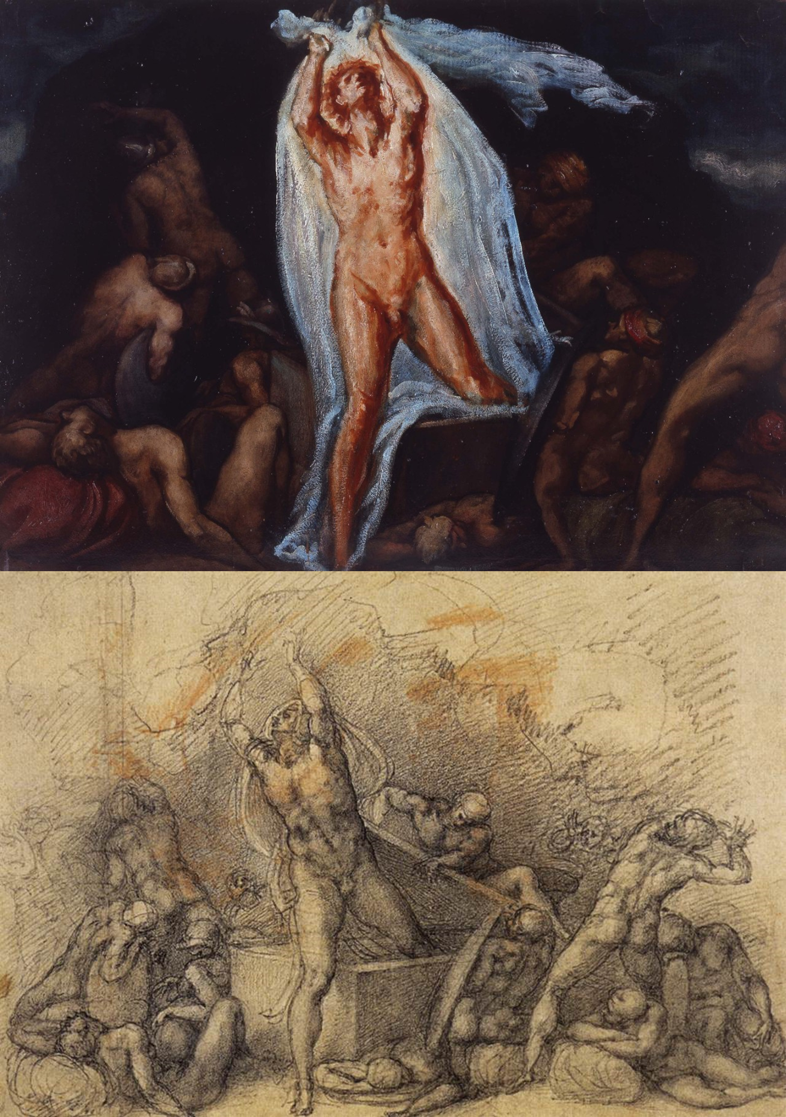
Emile Bernard, Résurrection, 1924-1925, oil on paper, Vatican Museum; Michelangelo, The Resurrection, between 1520 and 1525, black chalk, Windsor Castle  

Bernard was a French modernist that uncharacteristically turned to religious subjects late in life. Here he is reacting to a Michelangelo drawing. He isn't trying to be subversive - it's that Michelangelo's shadows and emotional force is more important than the meaning of the event. The Michelangelo drawing was a private meditation - never used for anything. Bernard turns the Resurrection as spiritual event into an opportunity to study personal feeling and artistic form. Also note how the figure of Jesus has lost the herculean power that he has in Michelangelo's personalized vision. Not to make too much of style - Michelangelo is clearly a more talented draftsman. 

Modern de-moralized solipsism and the attack on heroism in a nutshell. And Bernard appears to have been legitimately religious.


But the Bernard is much less disturbing than this:


Pericle Fazzini, detail of The Resurrection, Nervi Hall, Vatican

This is the head of Jesus for a Resurrection . What can this teach or inspire? 
  • usher the faithful toward the mysteries of faith?
  • provision for the beauty and dignity of the images?
  • infuse the soul with the glory of God?
  • express the mystery [of faith] and never hide it?
  • the intuition that the Lord is present in his Church


If this inverted modern garbage actually is being used in the "traditional" way, that means it is intended to teach and inspire. Consider the whats for a moment. This isn't us making something up. It's simply the objective pattern. Church art has an observable historical purpose and message, modernism is defined by a set of contrary principles, and the two are mutually exclusive. That's it.  The rest is details.


So who is Fazzini? The short answer is a typical post-World War Two modernist. He was born in Grottamare in 1913, won national recognition at the Roman Quadrennial Exposition of 1935 and joined the modernist group Fronte nuovo delle arti at their first exhibition in Milan in 1947. It is important to realize that the post-War decades played out differently in Europe than in America. First, the raging prosperity of the cathode generation didn't hit in the same way. Italy was far less affluent and consumer-driven in the 40's and 50's than America.


AA.VV., Il fronte Nuovo delle Arti, Nascita di una avanguardia, Venice, 1997

And the Fronte nuovo delle arti. 

This doesn't scream the timeless spiritual message of the Church. 

What we get in Italian modernism is an emphasis on "fixing" society - basically total commitment to de-moralized left-wing "humanitarian" politics and one-world globalism. The larger idea is that the War was so morally abhorrent that the only way to escape the burden of collective guilt is to strive to create a utopia on earth. And then we are right into Secular Transcendence - that luciferian belief that our will can supersede reality. 

That is, Progress! 


So for anyone claiming to be modern, progressive, sophisticated, intellectual, cultured, forward-thinking, all the rest had two choices. Marxism or "freedom" - meaning atheist progressive utopia just without the Marxist politics. What is forbidden is anything connected to truth, beauty, or historical identity.


The Rock'em Sock'em Robots of mid-20th century collective delusion:

Just as distracting and equally real. 


Fazzini was the on the Starfleet non-Communist side of utopianism. From the Fronte nuovo delle arti manifesto of 1946: "to give their observations and their separate creations in the world of the imagination a basis of moral necessity and to bring them together as expressions of life." This notion of moral necessity is not the morality of the Church. It is the luciferian master of reality morality of the "well-meaning" utopian. These incoherent clowns moved in different directions, but they were generally motivated by their commitment to the inverted nonsense principles of the pre-War modernisms.


Auguste Rodin, The Thinker, modeled 1880, cast 1910, bronze, Metropolitan Museum of Art. 

Fazzini's big inspirations are Rodin and Picasso. 

Rodin was a modernist darling for emphasizing the material of his sculpture over the illusion of reality. This is the "truth to materials" idiocy that generations of modern artists repeated like a lobotomized mantra. 

The difference is that Rodin was also an excellent sculptor. His forms can be strained and twisted, but there is skill there.


Pablo Picasso, Seated Woman, 1929, bronze; Head of a Woman, 1932, plaster; Man with Lamb, 1943, bronze, MOMA, New York

If you like word magic, think how "Picasso" became synonymous with artist. Like "Einstein" and genius. 

Here's some genius that Fazzini was looking at. 


Now you can start to see why Modernism and religious art can't be brought together in a way that is respectful to the meaning of both. Again - we don't have to consider any details or specific arguments to know that Modern Art and the art of the Church are mutually contradicting. The patterns leave no other alternative. Modern church art is a contradiction. Materialism with no path to transcendence.

The model for Fazzini's statue looks less openly Satanic, but utterly fails in terms of clarity, accuracy, or inspiration.


The Resurrection in a cloud of nuclear destruction is the opposite message to the clear triumph over death that is the Christian significance. And why is the Resurrected Jesus maimed and twisted? More like the suffering of a Gothic crucifix than the immaculate purity risen Son. 


The image is ugly and undignified, shows no evidence of the glory of God in the soul, the Church, or the world, and distorts the central mystery of the faith into an ambiguous vision of pain, chaos, and horror. 


Then somewhere between this model and the finished work, the Baphomet head appeared. 

And while the Band is clearer on the difference between Baphomet and Satan than most "followers" of either, it is irrelevant for judging a piece of Christian art in a papal hall. Like Modernism as a movement, it symbolizes appetite and desire over truth and is diametrically opposed to Christian metaphysics. 


So why is it there? The answer is beyond the Band's reach. Sources are predictably hard to find online and we have no access to material that isn't already posted. It is worth noting that Paul VI has been referred to as an anti-pope by opponents for his Vatican II Council and New Mass/Novus Ordo. These were developments that happened around the same time as the PST and were equally opposed to Chruch tradition and theology. We will link to one very critical site to give a sense of the criticisms.


Paul VI in a wicker tiara from The Guardian Dec. 12, 1963  (where it's mislabeled a mitre)

This quote stands out. 

"Your vocation is to bring not just some people, but all people together as brothers. Who can fail to see the need and importance of thus gradually coming to the establishment of a ‘world authority’ capable of taking effective action on the juridical and political plane. Delegates to international organization, public officials, gentlemen of the press, teachers and educators, all of you, must realize that you have your part to play in the construction of a New World Order."


The same de-moralized, luciferian culture of inversion that every globalist mouthpiece spews. In other words, it's not only not "Catholic", it's not Christian.

Just as Fazzini's monstrosity indicates.


And that's how paying attention to basic patterns short-circuits a lot of wasted rationalizations and debate. Understand what Christianity, Church art, Modernism, and Fazzini's Resurrection are - even in the most general sense - and the only conclusion is that there is something knowingly and fundamentally un-Christian about the piece.


Here's a recent Resurrection. You'll see that the message is diametrically opposite Fazzini's and consistent with the age-old message of the Damascene. 


What you do with that information
is up to you. 


Most Popular Posts