Showing posts with label allure. Show all posts

Saturday, 21 March 2020

Where are You Coming From? Where are You Going? On Art and Reading Paintings


Gavriil Pavlovich Kondratenko, Moonlit Winter Evening with Solitary Figure, 1903

If you are new to the Band, this post is an introduction and overview of the point of this blog that needs updating. Older posts are in the archive on the right. Shorter occult posts and reflections on reality and knowledge have menu pages above.
Comments are welcome, but moderated for obvious reasons. If you don't see it right away, don't worry. We check a couple times a day and it will be up there.


This is a short post that isn't part of any of the ongoing series, but responds to something interesting that came up elsewhere. In a way, it's part of all the series, because it has to do with making sense - "reading" - images.

And it may become the start of a new one.


The Band is built off the idea that images are information vectors as well as aesthetic experiences - both, not either/or. In this post, we are going to look at a pair of images that complement each other and explain how they communicate their complementary messages.

But before getting into that it is necessary to address some basic points around art. These have come up in regular posts, but those are long and the scattered points aren't always easy to pull together or link to. And it's worth taking stock of why art matters and why the enemies of the West have tried to take it from us.


Franz Marc, Small Composition II, 1914, color on canvas, Sprengel Museum 

The Band is at odds with modernism, which falsely proclaimed "art" had to be self contained. Like this piece of crap. And if it did communicate, it had to avoid anything "traditional" like beauty, truth, or history and fixate only on "modernity" as defined by a sliver of dyscivilizational European perverts. 


Lawrence Weiner, Bits & Pieces Put Together to Present a Semblance of a Whole, 1991, by laser-cut aluminum typography on brick. Walker Art Center, Minneapolis

It also puts us at odds with Postmodernism and its aftermaths, which falsely claimed that aesthetics aren't part of "art" since they don't exist and are racist or something. 

This pretentious garbage is typical output from the sort of artworld creature that lives off the teats of govenrments, debased unaccountable institutions, and globalist "foundations". Apparently it's "meta" because it's a stenciled message you can put anywhere that describes the creative process...

These bodies gatekeep Art! with no checks other than their own perverse hatred of truth and beauty. They don't even talk like normal people, preferring a stilted, meaningless "discourse" that marks a place in their human centipede. Click for an example referring to the crap on the left.


Look past the atavists and the reality is that the visual arts are a subset of imagery. All visual arts are images, but not all images are art. The Modernists and Postmodernists are right to point out that this distinction is arbitrary. But they're morons and or liars because they believe that that observation somehow matters. All language is arbitrary in that it assigns unrelated phonemes or graphemes to concepts and objects.


Even the word "arbitrary" is an arbitrary assignment. Why on earth should we care if the term "art" is as well? It's dishonest to even pretend this is noteworthy.

But why single art out for a dishonest criticism. It's a puzzler. Might it have something to do with a desire to destroy standards and replace it them with anti-human cultural poison? 


All human activity is arbitrary in that we choose forms and set hierarchies of meaning. We pick names, colors, sizes, and lay-outs - designation and distinction are essential building blocks for the civilizations that allowed us to live better than animals. We can think of the civilizing process of as a ongoing clarifying and refinement that began when the first person named the first thing.

The reverse of drawing distinctions is entropy. Chaotic goo where communication and understanding dissolve into a meaningless pink slime. When you look past the specifics to the underlying pattern, this is what the atavistic inhuman globalist left - call them SJWs - want. They oppose enculturation and the refinement of meaning that comes with it. They desire entropic chaos where protoplasm twitch to subjective stimuli. The fact that without the distinctions and refinements of civilization the protoplasm die horribly escapes them because they're stupid. And their position is fundamentally evil.


Maerten de Vos, God Creating the Birds and the Fishes, 1600-1602, oil on copper.

From a Biblical perspective, Creation is a series of distinctions and designations. Drawing boundaries and defining things. And why do the designated things look the way they do? Why, it's arbitrary!


Innovation and artistic creation express the divine impulse in us and put us in the footsteps of God. Materially of course. When we build on the creations that came before, we advance refinement, diminish chaos and reduce indeterminacy. And we do so in ways that are constrained by the laws of nature, but are otherwise arbitrary. The morality of our creations is a separate thing.


A generically altered bioweapon designed for stealth transmission and maximal impact on health care and economic systems is a creation. It's innovative, but not moral.


For artistic creation, specific media may come and go and choices differ culturally and contextually. This is the part that is "arbitrary" in the sense that preferring tapestry to mosaic or stained glass to wall painting are issues of taste. But what matters for civilization isn't what arts are chosen but that there are specific arts. That there are skilled processes for creative distinction, refinement, and sophistication. And this is not arbitrary, unless you consider elevating our quality of life above the savage state to be so as well. It is the necessary expression of cultural refinement, of pushing away chaos, entropy, and indeterminate slime with divine creation. On that level, it is a moral imperative.


Lawrence Alma-Tadema, A Collection of Pictures at the Time of Augustus, 1867, oil on canvas

Alma-Tadema was an academic artist best known for melodramatic scenes of ancient Greece and Rome. But he was an excellent technician. This painting captures the important place of art in ancient Roman culture. 

Every healthy civilization and many unhealthy ones express themselves and their values through the visual arts. Out current situation, where our "art" aggressively opposes our culture, our standards, and our identities is utterly bizarre. It is hard to think of another example. 


Kalachakra Shambhala, 19th century, Buddhist thangka painting from Sera Monastery, Tibet, private collection

Even cultures with abstract art traditions use them to express their values and identities. This picture diagrams the Kalachakra Shambhala - the final stage on an inner search for a new awareness of the world in Tibetan Buddhism. 

It isn't a realistic depiction of something in the world, but it doesn't spit on the culture where it came from either.


One Postmodern trick is to ask what art is, then pretend the impossibility of providing a concise and definitive answer disproves the concept. All liars have are tricks in the end, but they can be effective if you're unaware of them. The reality is that art takes on many forms and roles - even in the West, let alone the world - and there is no concise answer that will sum up everything you see in a major museum. But that's the trick - the correct definition of "art" is conceptual, not a list of art forms. And the answer is easy - art is structured making according to cultural norms. If you want something more specific, you have to refine the question.


Bertel Thorvaldsen, Gravestone of Poniński's Children, 1842, marble,  Gallery of Art in Lviv, Ukraine 

Like what is a sculpture, or relief sculpture, or Neoclassical relief, or funerary art, etc. 

Art is a higher order term with a lot of constituent subsets. Precise definitions are subset-dependent. 


Since the Band writes from a Western perspective, we are considering a Western notion of art. We've found that a definition based off a set of Greek terms best fits the art of the West on the broad level. This isn't perfect - definitions never are - but it captures the main assumptions from antiquity to the dawn of Modernism in the "art world" and still fits what the non-retarded and morally healthy tend to think art should be today.If you're interested in the reasoning behind these, click for a link to the post this was worked out. But this recap of the basics are enough for this purpose.

Art isn't either the making or the ideals being expressed - it is the coming together of the two in a visible material form. The Greeks used the term techne for skilled craft and episteme for the higher truths that art communicated. Art itself is phronesis - the marriage of the two. It looks like this:


Techne is skilled craft. It’s material-level on the ontological hierarchy, and follows culturally-specific customs rather than universal rules. The key is that it is skilled. Art isn't easy - it's talent refined to mastery. Otherwise you get the modernism where a perverse "art world" anoints talentless dyscivic garbage. 

Episteme refers to higher abstract principles - the metaphysical ideals that a culture holds most important and that are immaterial. Truth, Beauty and the Good. These don't change.  

Phronesis is the coming together of the two - techne guided by, serving, and expressing episteme in artistic form. This is the art of the West. Technical skill to express abstract values. 


What makes this definition so good is that it can distinguish art from "craft" or "skilled labor". Since the purpose of art is to communicate episteme in material terms, which is different from the purposes of craft objects. Both require refined skill or techne and be aesthetically pleasing but craft has a primary functional purpose other than purely communicating episteme in some way.

The formula:


This is so effective because it combines several key ingredients in a concise formation. Modern simpletons dislike this because it means entertaining more than one thought at a time. But art is a refined cultural activity and as such, consists of more than "orange man bad" level linear idiocy. First, there has to be the idea of a higher principle or truth. The image can be negative, but it needs to be truthful on some level.


Vasily Vereshchagin, The Apotheosis of War, 1871, oil on canvas, 127 × 197 cm, Tretyakov Gallery, Moscow

It's not an attractive picture, but it is truthful. It's skillfully made - techne - and conveys truth - episteme - so it is art.  


Then there is the idea of skilled making - the most obvious casualty of the satanic inversions and applied idiocy of the modern era. Again, art types are cultural preference, but regardless of what types are preferred, they have to be skillfully made. Skilled making in the service of truth is a requirement of worldly beauty.

The Band refers to visual attraction without the higher principles of episteme as allure. Allure can be amoral - neutral subjective pleasure - but it won't be moral because if it were, it would channel epistome and become beauty. More often than not it's immoral - visual seduction that plays on emotional response to draw one onto a dark path.


Alexandre Cabanel, Albaydé, 1848, oil on canvas, Fabre Museum

Cabanel's picture is rich in techne - the fall of the garments, the exotic setting, the creamy skin, and seductive insouciance of the expression are signs of a master painter. But there is no episteme to speak of, other than perhaps the appeal of the female form. But even that is presented in a tawdry way - the figure is a herem girl or courtesan. The only purpose other than the display of techne is to stimulate emotional desires - base feelings that may be "true" in a hormonal sense, but not in a higher one. It lacks logos.

Perhaps that is sufficient - there are shades of gray in qualitative judgments. But the painting is more alluring than beautiful. It has its value perhaps, but as ornament, a moment of seductive pleasure rather than "art" in the purest sense. 


This is why techne alone is not sufficient to define art. Allure and seduction also require high level craft skills.  It's the presence of episteme that separates the art of the West from pretty pictures.

To clarify, this is a broad generation. The material-level truths of human existence cover a lot of ground - everything from Biblical revelations to natural processes, to human relations. But the litmus test is simple:


The history of the arts of the West include many forms, but traditionally, painting is probably the preeminent one. The versitility and nuance of painting gave it a wider range of effects, subject matter, and contexts than any other art form. Because of this, the West developed more sophisticated attitudes and refined understanding of painting than any other art form. The history of painting almost is the history of post-Medieval art in the West, with a wing for sculpture and another for the rest of the arts. But even there, painting set the stage.

Media like collage or embroidery were thought of in painted terms.


Louis Comfort Tiffany, Landscape with a Greek Temple, around 1900, stained glass window, Cleveland Museum of Art
Mehitable Starkey, Embroidered Chair Back, 1755-65, linen embroidered with wool and silk threads, Metropolitan Museum of Art, New York


This is because art in the West represents things, and painting is the most versatile and sophisticated representational tool. Art doesn't have to be realistic, but it does have to be representative on some level if it is going to convey episteme through techne. A Gothic cathedral isn't a depiction, but it conveys the material logos of it's construction and abstract logos about beauty and the glory of God through its arrangement and impact on the viewer. But depiction is the easiest and most direct way to communicate visually, and painting is best at that. Which is why most painted art depicts something recognizable.
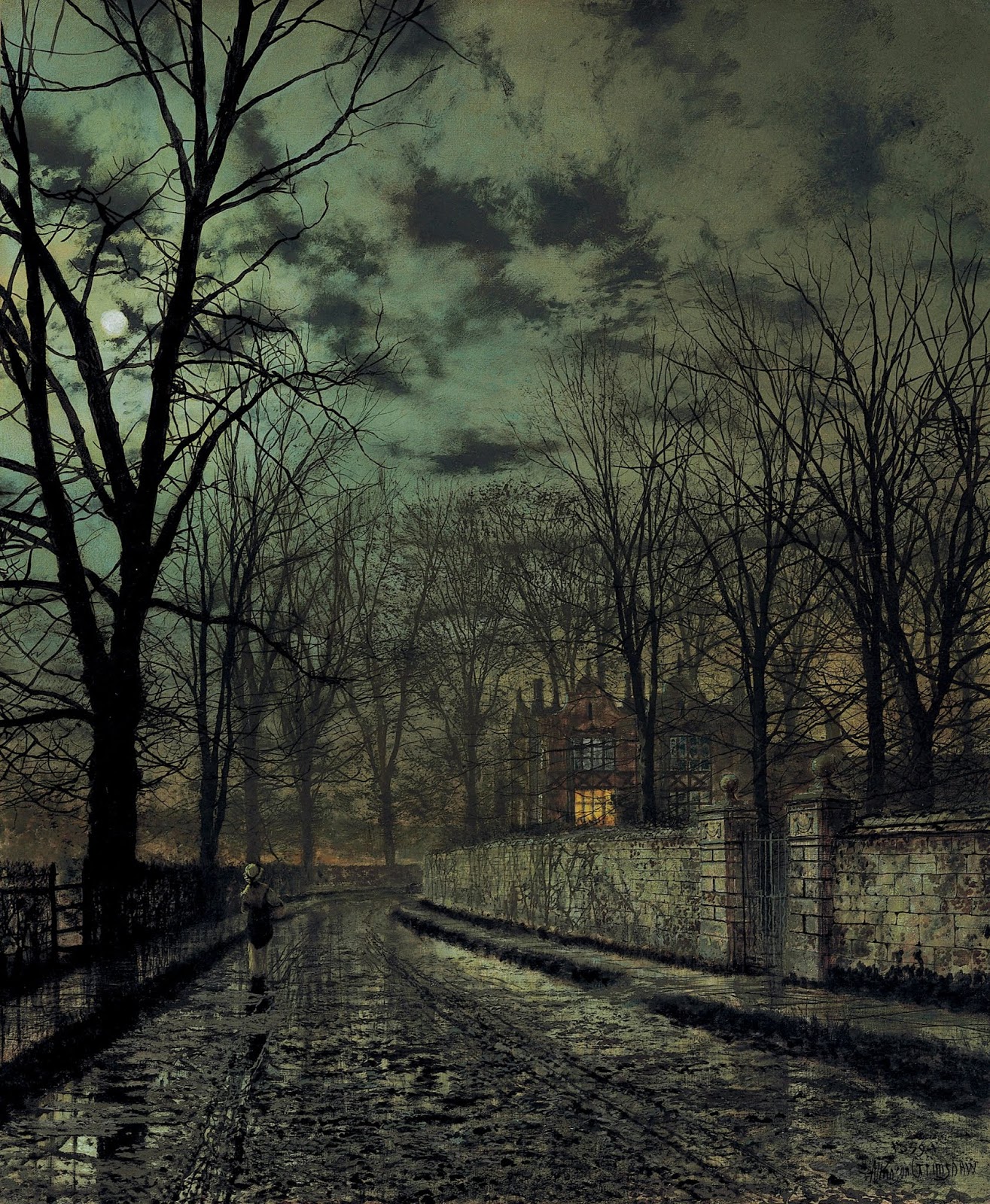


John Atkinson Grimshaw, November, 1879, oil on canvas, private collection

The range and nuance of the power of painting to depict things comes through in a technical virtuoso master of expression like Grimshaw. His incredible moonlit skies, varied light sources, and textured foregrounds are testimonials to the ability of oil paint to represent. 


One of the most diabolical aspects of modernism was the notion of autonomy [click for a post]. This is the false premise that art has no purpose other than to be art. That it exists in complete isolation from any function or expectation other than itself - paint on a surface, form in space, in a disconnected cultural space called art. Even after Postmodernism restored the idea that art represents things, it kept it locked in the stunted, self-referential discourse of "art" and focused on perverse "critiques" of the culture and history of the West.

On the surface, autonomy seems simply retarded, but we've come to realize a more diabolical purpose. Consider: the art of the West is purposeful, but the purpose is to express episteme - abstract truths that aren't obvious in the world around us.


Sanford Robinson Gifford, A Gorge in the Mountains (Kauterskill Clove), 1862, oil on canvas, Metropolitan Museum of Art 

This can be explicitly spiritual. But it can also be as basic as the truth of natural beauty shining from creation and the healthiness of man's place in it. Logos in a material sense.

Gifford, like Grimshaw above, made art that made us aware of the wonders of the world around us with ideal visions of what that could be. The beauty comes from the ordered perfection that is implicit in the natural world, but rarely seen directly. 


Carl Bloch, The Daughter of Jairius, 1863, oil on canvas, Statens Museum for Kunst, Copenhagen

A picture like this one wears its truths - faith, salvation, and the actual Logos - openly. Bloch depicts the moment before the miracle to capture the sorrow and loss. Jesus' arrival in the background is electrifying.


"Autonomy" eliminates all of this - even the logos-free allure of the Cabanal. It cuts art off from it's most essential cultural function - manifesting the True, the Beautiful. and the Good in visible, meaningful forms. Autonomy bars us from what has always been an essential vector for encoding wisdom, values, aesthetics, and discernment, and replaced it with hideous idiocy. Viewing art shifts from perceiving logos through phronesis to an act of humiliation - the self-abasement of capering around rooms filled with detritus while degenerate blurbs and audio guides tell you what to like. In other words, licking the globalist hand as it slaps away your fundamental identity.


Atrium of Daniel Libeskind's Museum of Contemporary Art in Milan.

Postmodern architectural darling designs a house of trash. 

Because Italy lacks decent art to look at...


Simply calling artistic autonomy retarded sells this way short. It is evil. Pure satanic inversion of the bedrock identity of the art of the West. Representation, communication - enculturation - are not aspects of art, they're fundamentals. The reason for its existence. Without this purpose, there is no art.


Julius Klever, Winter Evening in the Forest, 1897, private collection, oil on canvas

Like the connection between people and the land by a Russian artist. Globalist filth deny the reality culture in order to transform people into fungible units of debt and consumption. A painting that communicates the logos of a unique identity based on shared experience opposes that. 

That's why globalists are evil - they're satanic liars who invert what it true for personal gain.


Jean Auguste Dominique Ingres, Oedipus and the Sphinx, 1808, oil on canvas, Louvre Museum

Or the civilizing message of the triumph of reason over animal savagery that's the subject of this mythic scene by an academic painter. The Sphinx is a murderous beast with a perverse nature signified by her hybrid form. Contrasted with the well-formed Oedipus, she embodies the violation of distinctions and boarders that reduces life-preserving civilization to primordial chaos.

Globalists wish to invert the logos of civilization and reduce us to manipulable pink slime - it's clear in their endless attacks on clear definitions and differentiation. A painting that reiterates reasoned clarity and distinction over bestial emotion and whim opposes this.  


The art of the West is the opposite of autonomous - if it were autonomous, it would cease to be the art of the West. Which is what has happened in the sham "art world" of today. The irony is that modernists decry the so-called arbitrary standards of the past while dishonestly promoting the most arbitrary perspective of all - a meaningless bubble filled with talentless hacks, self-promoting sociopathic liars, and money-launderers trying to outdo each other in praise of garbage. It's hard to imagine something more purposelessly arbitrary than that.

Its no surprise that the wicked invert reality, then project that inversion on the targets of their wickedness...


William Blake, Eve Tempted by the Serpent, 1799-1800,  tempera and gold on copper, Victoria and Albert Museum

...they learned from their master. 


In reality, artistic forms are culturally arbitrary, but the purpose is not. Art communicates truth visually by showing us things that we can't see in everyday life. But because of the modernist assault on our heritage and identity, many don't know how to see the communications. They don't know how to read or hear what art has to say. And worse than that, they're so turned off of art in general by the modernist-globalist-luciferian garbage surrounding it that they'll never look closely enough to figure it out.

The pretension, moral ugliness, and dishonesty of the modern art "scene" and the self-abasement needed to subscribe to its nonsense make it a non-starter for most. Healthy people tend to avoid weird creeps and liars. Then the historical art that actually is appealing gets buried under the discursive blather from the same. And things like this go unnoticed:


Johan Christian Dahl, View of Dresden by Moonlight, 1839, oil on canvas, Staatliche Kunstsammlungen Dresden
Imagine if the art appreciation types really put the full scope of the beauty of the West against the Modernist hacks?


This site was the first hit on a duckduckgo "art appreciation" search. Notice how talentless modern garbage predominates on their landing page. They're typical for the way the conventional modern institutional definition of art is simply taken at face value and presented as fact. Great works and trash are put side by side as if they share anything beyond designation by anti-human globalist freaks. There's no mention of the True, the Beautiful, and the Good. There's no consideration of the relationship between art, culture, and values. Just the mindless parroting of the atavists, poseurs, and frauds that choke our institutions like the plaque in a diseased artery. We aren't singling them out for criticism - they're simply an example of what passes for "art appreciation" in the cultural cesspool that is Art! 

Here's a question:


The answer is obviously that you can't. Which is why you'll get nonsense descriptions of movements and the importance of technical terminology and nothing about communication. How artworks encode logos in appealing visual forms that can make the soul soar. Nothing about how those techniques arrange that wisdom for emphasis and reliability. Nothing about the interplay of the old Aristotelian terms of dialectic and rhetoric, or pathos, logos, and ethos in lines and colors. In short, nothing to let you connect with the real artistic heritage of the West and let it show you what we are, where we came from, and where we need to go.

The Band came together to fight back against the lies. Since then, it's become apparent that reconnecting people with their artistic and cultural heritage is a major component. This is a big project - what is peddled as "art" needs to be completely reconsidered in light of logos. Modern history needs to be scrapped altogether and a reality-facing alternative set up in its place. How to look at, understand, and yes, appreciate art needs to be built from the ground up.


Jonas Lie, The Old Ships Draw to Home Again, around 1920, oil on canvas, Brooklyn Museum

A history where 20th century art actually relates to the life, people, and culture of the time rather than theoretical nonsense and talentless hackery.


Aleksandr Averin, Walk #3, around 2017, oil on canvas

And contemporary art is distinguished by mastery of techne and the logos of beauty - of both nature and human nature. 


This isn't going to happen overnight, or through the work of one small site. But we can start.

With that in mind, this post will look closely at two pictures as a demonstration of what art says and how it says it. It won't be the systematic, ground-up, "how to read a picture" that needs to happen - that's a project that will unfold over time, and will involve other platforms as well. But it is a start. And once you start thinking about what art says, you become empowered to read other pictures, make your own judgments, reject the cultural emasculation of the liars and globalists, and begin to wake up to the incredible heritage that you're part of.

A new dawn. Sort of like this:


Frederic Edwin Church, Coast Scene, Mount Desert (Sunrise off the Maine Coast), 1863, oil on canvas, Wadsworth Atheneum Museum of Art, Hartford, CT


The two pictures that we're going to look at are an uncommon pair. One came from the daily paintings that the Band posts elsewhere and the other was contributed by an ally and associate. Both were popular, but come from different periods and address very different subjects. They share Slavic origins but it is unlikely that they have any direct connection beyond that. But this is the difference between reading paintings and building histories of style or defining movements - the direct connections matter much less than the logos that shines through them. Once you can see that, the entirety of Western art opens up to you.

What they do do is communicate opposite messages in similar ways.


Gavriil Pavlovich Kondratenko, Moonlit Winter Evening with Solitary Figure, 1903

Pre-Communist Russian painting is fascinating. It shows some influence of European movements like Romanticism and Impressionism, but had a unique quality that we can call fantastical realism. That is, realistic art with a fantastical quality. 

It is especially good at capturing the feel of the land and the relationship of the people with it. See the Klever painting up above for another example. Not surprising, considering the size of the rugged Russian landscape, but other places were quicker to toss their heritages for modernist lies. 

This painting is impressionistic in its grainy blurry quality but doesn't share the Impressionist interest in making images out of color dots. What it does is capture the feel and beauty of a bright moonlit snowy night where the noises are muffled and edges blurry. The light in the church is the point of warmth that draws the traveler forward. 


Our second picture is an untitled piece often called the Valley of Death or of the Dead by a Polish master of surrealistic hellscapes. The dimensions of the painting are such that we can't fit a large version with text beside it given Blogger's format constraints, so we'll introduce it, then blow it up into a larger view after.


Zdzislaw Beksinski, Unntitled, 1972

The Band generally dislikes Beksinski's work. He's a skilled technician, but wallows in horror and depravity in the nihilistic "moral vacuity of modern life" cliche that isn't so much wrong as a dead end. Endlessly pointing out how vile the contemporary world is quickly crosses over into debasement porn without starting to show a way forward. At the same time, he did live through the Communist system and was knifed to death by a teenage "friend" looking for money, so it is possible that his hellish visions were true to his inner life. But this isn't that. 

Untitled is an excellent depiction of hope and resolve in a dark world. The monstrous figures loom but don't threaten, leaving a clear path without a clear beginning or end. Crows circle, but the figure moved forward, guided by the brightest light in the scene. 


Here is the large-scale view for comparison with the Kondratenko. Note the lighting - it also only illuminates vague forms, but it is more monochrome and has no obvious source. Just a grim haze that recalls distant fires reflecting off an ashen sky. It's the light of pyres or hell - the opposite of the pure light of  the moon on fresh snow.

We should note that Beksinski denies giving meaning to his works: "Meaning is meaningless to me. I do not care for symbolism and I paint what I paint without medating on a story." But art expresses the world that it is drawn from. If the artist wishes to include explicit meanings, that's great. But it isn't necessary for insight to be communicated to us.


So why look at these together? What makes them jump out? First, look at the overall compositions. Both feature solitary walkers, single points of light, and diagonal pathways through uncertain terrain. Composition or arrangement is how the paintings are put together. Not the materials used, but how the elements in the picture are arranged or composed. It's like music or writing that way. There are many ways to organize a scene, and how the artist does so determines not only what it looks like aesthetically, but how you will understand it conceptually.


Rembrandt, Aristotle Contemplating a Bust of Homer, 1653, oil on canvas, Metropolitan Museum of Art

Here, Rembrandt obscures the background to push your attention onto the figure and the bust. The diagonal light connects them and especially illuminate's Aristotle's face to enhance the impression that the great mind is deep in thought. Dressing the philosopher in 17th-century clothing made him more accessible to Rembrandt's contemporary audience. 

Composition is a huge part of a meaning - a reflection on the legacy of the classical tradition that the West was built on.


Consider two versions of the same scene from eminent academic painters. They depict the moment when the great Roman poet Virgil was reading his masterpiece to the Emperor Augustus and his family and referenced the death of the emperor's nephew Marcellus. Augustus' sister Octavia, Marcellus' mother who was devastated by the death of her son, faints at his mention. The emperor's second wife Livia was married to him for over 50 years but they had no children. She was accused of having Marcellus killed so her children from her first marriage would become heirs to the throne, though the rumors were never proven.


Angelica Kauffman, Virgil reading the Aeneid to Augustus and Octavia, 1788, oil on canvas, Hermitage Museum 

Kauffman was a rare female history painter and a founding member of the British Royal Academy whose art is defined by Neolassical clarity. 

She depicts a moment of dramatic action, rushing to the aid of fainting Octavia, while Livia looks reproachfully at the somewhat worried poet. 

Jean-Auguste-Dominique Ingres, Virgil Reading from the Aeneid, 1864, oil on canvas, private collection

Ingres was president of the French Academy and combined Classical and Romantic themes on the way to becoming the preeminent artist of his day. 

He downplays the physical action to focus on the psychological intensity of the scene. Augustus locks eyes on Virgil and commands him to stop while to advisors communicate nervously behind him. The focus in on the poet and emperor while between them Livia sits unconcerned beneath the statue of Marcellus, emphasizing the crux of the drama. The lighting ratchets up the emotional tension, while Kauffman uses more natural illumination to create a more realistic scene. 


This is how composition determines the nature of the story you're seeing. The position and interaction of the figures, the expressions and gestures, the light and color, even their locations in space all shape the viewer's experience. Both pictures depict the same moment and are carefully structured with figures locking together into integrated groups. This allows both to show this as a Classical ideal rather than a random snapshot - you can see the conscious thought that went into the planning. But one opts for action, the other for psychological nuance, with the result that your impression of the scene is completely different.

When reading a painting, it is important to focus on the subject. But it's just as important to focus on the composition and be attentive to how the subject is put together.  The similarities - the solitary walkers, single points of light, and diagonal pathways through uncertain terrain - indicates that the paintings might be presenting information in comparable ways. So we look closer.

Start with the figures, because it is human nature to focus on the figures in paintings that include them. We don't necessarily see ourselves in them, but they do give us something we can relate to as an access point.


Two things jump out:

1. The are going in opposite directions. Kondratenko's is moving inwards - away from us - and Beksinski's is heading out.

2. The relationship to the warm light source is different. Beksinski's carries his like a torch while Kondratenko's is moves towards his. One lights his own way and the other is drawn to the light.


These differences are significant, especially when taken together. One follows the light inward, towards something known. The other has to light his own path and is moving out towards the unknown. Which poses the next questions - where are they coming from and where are they going?


Kondratenko's destination is a church. Where he is coming from is unclear, but this is unimportant, given where he is going.

He follows a light that he doesn't have yet, but will soon reach. His journey is from the exterior world to the Logos, to the Christian community and salvation that is the only antidote to the chaos and evil of a fallen world. We can see his destination because it is a destination - the endpoint of wandering in the wilderness. Just as it was for Dante in his dark wood.


Beksinski's comes from the mysterious depths of the scene and his destination is unknown. The lurid light darkens ahead of him, suggesting that he is finding his way out of the hellscape he knew, but the future is uncertain. There is no light to guide him other than his own - his wisdom, discernment, resolve.

If there is a refuge of faith and Logos, he can't see it yet. It's a secular, material world, where fallen man is on his own.


Bringing us to the next question - where are they?


Kondratenko's world is cold and obscured, but natural. There is a bright moon and harsh beauty.

The perspective funnels our - and the wanderer's - attention to the warm light from the church, and the alignment with the moon tells us that this light is natural in its own way - the natural culmination of a journey through the metaphorical wilderness of the spirit.

The wander will soon be home.


There is nothing natural about Beksinski's. This is an artificial hell, a man-made one. The path isn't through nature, but between monstrous, anthropomorphic forms. The lighting is not a natural source like the moon, but a dirty glow. The way forward vanishes into darkness, rather than culminating in a house of Logos. And the only direction is the figure's own tiny light.


Taken together, the opposites are complementary inverses. The inversion point being the presence of Logos in the represented world. Beksinski's is the monstrous secular hell of materialist tyranny. Where there is no clear path of righteousness, just lurid depths where you're on your own. Survival demands some kind of escape but the light of your own powers promises nothing. Kondratenko reminds us that Logos restores the natural human condition, and that with it, we are never alone. We don't have to bear the overwhelmingly daunting task of navigating the valley of death that is the fallen world because the pathway through is assured.

Look at them together.


One is the promise of globalism - the tyrannical collective lie that crushes the spirit and stacks the bodies. There is no logos here - just a road into darkness that goes as far as your own spirit can take you and where you can't even see the sky. The other is the natural order of man in creation. A world where beauty prefigures spiritual wholeness. It's possible to imagine them as the same path - a journey out of the evils of vanity and inversion and into the light.

When we read these paintings, we see why the art of the West is purposeful. Although some 70 years apart, they describe mirror-image conditions that in the modern world must consider. And they don't just explain them like our narration - the show you them in a real visceral way. You can feel the oppressive gloom and the menace of one and the warm hope and promise of the other. You can see the difference between trying to light your own path through darkness and death and seeking your place in the Light. Between standing alone against the hopelessness of a fallen world and taking your rightful place as part of something bigger, no matter how what the world around you is like.


Caspar David Friedrich, Winter Landscape with Church, 1811, oil on canvas, Museum für Kunst und Kulturgeschichte, Dortmund


This is the cultural heritage that the satanic globalists would steal from you.

We think otherwise.


Sunday, 8 September 2019

The Terms of Creation


If you are new to the Band, this post is an introduction and overview of the point of this blog. Older posts are in the archive on the right. Shorter occult posts have their own menu page above.
Comments are welcome, but moderated for obvious reasons. If you don't see it right away, don't worry. We check a couple times a day and it will be up there.


Well, it's been a while. But frustrations are fleeting and truth abides. The best way to jump back in is to jump back in and try to pull together some threads and observations from our recent look into the birth of the West. This one took a lot of researching - we hope you like pictures...


Julius Klever, Returning Home at Sunset, 1902, oil on canvas on board, private collection


The last several posts have been looking into the beginnings of Western art and culture from the ancient world. This started as a way to understand how Modernism replaced art traditions with total opposites - noise rather than melody, slashes and scribbles instead of pictures, gibberish in place of stories, meaninglessness for form. How beauty as the enemy rather than a goal. And this is important because the Postmodern globalism that is the target of this blog sprang directly out of this. It really is all connected.


It’s not a coincidence that Modernism in art hit at the same time that we see new levels of globalist control over the American state. The Armory Show that is usually taken as the official arrival of Modern art in America took place in 1913 - the same year as the imposition of federal Income Tax with the 16th Amendment and the creation of the Federal Reserve. 


William Barnes Wollen, The 1st Buckinghamshire Battalion at Pozieres, 1916, World War 1 postcard

World War I followed a year later. 


Marsden Hartley, Abstraction, around 1914, oil on paperboard, Museum of Fine Arts, Houston

And American art turned into this. 


Looking at what went wrong is just part of the battle. There is a positive reason for going back to the roots as well. Creation is an act of ordering, of bringing materials of some sort into a new configuration to obtain a certain effect. The immense creative legacy of the West is the result of countless artists expressing themselves and their cultures with techniques developed over time. Modernism is the inverse - Art! - imposed by the purported guardians of cultural tradition, and the artists expected to follow the narrative. 


Jennifer Jacqueline Miller, Creative Freedom, photo

So when we peel away the putrescent crust, we can see what Western culture actually is, and recover the perspective that makes real creation possible. 


It’s common for people to see the artistic brilliance of the past and feel depressed about the present. But as we are seeing, the great artists of the past didn’t follow a narrative of willful cultural destruction or a globalist kiss on the forehead. They applied skills to create beauty. 


Albert Bierstadt, Mount Corcoran, 1876-1877, oil on canvas, National Gallery of Art, Washington


Looking at the historical roots shows that cultural creation in the West is not a set of “rules”. It’s attitudes and processes for expressing abstractions - logical, emotional, spiritual - in material terms. That is, in the terms of the present day. The same is true today. 

Inversion isn’t creation. Evil can’t create. Postmodernism is just the endless remixing of existing ideas - bits of pop culture, references to old art, etc. This has now trickled into pop culture - Hollywood is creatively bankrupt to the point where remakes and franchises carry the freight. But a glimpse at history show the West has always been a creative powerhouse. That is still there. We just have to remember what we can know and how we can know it.


Bringing the early epistemology posts together with our glimpse at the late Roman world let us see how the big historical developments in the formation of the West fit the pattern of what we can know ontologically. The key was St. John’s description of Jesus as the Logos - a word from Greek metaphysics that ties together the Neoplatonic hierarchy of reality.


Classical metaphysics extended empirical knowledge into abstraction through logic. We can reason and conceptualize things that can’t be directly observed. Ultimate reality is beyond conception - beyond the limits of any discernment. It’s necessity can be inferred, but not seen. Like footprints of something unseeable. Jesus as logos fulfills - literally fills out or completes -  the abstract pathway traced by Classical philosophy. This is similar to the way the Incarnation fulfills Old Testament prophecy, only it’s a logical structure that’s being lit up and not revelation.


The result is a vertical arrangement where the ways we can know - observation, abstract reasoning, and faith correspond to the interlocking historical pillars of the West.

Morality and Truth at the level of ultimate reality. Classical virtues and reasoning as the abstract bridge. And history at the material level - the rise and fall of nations in reaction to empirical events


This is a simple three part structure to avoid endless distinctions, but it aligns with the world as we experience it. It’s not a “philosophical case”. It’s a simple observation of how we are capable of acquiring knowledge, and what the obvious limits of those methods are. We gain knowledge of the material world empirically, starting as limited, subjective creatures trying to make sense of the vast unknowns around us. Over time we learn to recognize patterns needed for abstract thinking. This lets us work with others to achieve more than we alone and understand things beyond the information we get from our senses. But we can never gain perfect clarity or insight because we are trapped within the spatio-temporal constraints of the universe, and that immediate context is always changing. 


John Faed, Expulsion of Adam and Eve, 1880s, oil on fabric, Cleveland Museum of Art

And we’re fallen...


One of the great insights of Christianity is the notion that the world - including us - has been distorted from its intended nature through terminal vanity, greed, and the related idolatry of self-worship. In earlier posts, we looked at the Biblical account of the Fall as expressing an abstract truth about human existence with an allegorical written story. It was notable that this Fallen state of seeing a valley of shadow through a glass darkly - to mangle Bible quotations - is describing the same uncertainties of comprehension and discernment that we are observed at the limits of scientific observation (click for post).


Ivan Aivazovsky, Chaos: The Creation of the World, 1864, oil on canvas, Vatican Museum

Realizing that the Fallen world Biblically and the finite-entropic world physically were the same thing is very uplifting. Eden is timeless, so Falling from that means falling into a world of decay and change. What physics would call entropy. God's order is what the Fall opposes - the Creation is the ultimate un-entropic act conceivable. 


Vickie Wade, Night Ride, print

This is confirmed by simple observation. The only thing that works against entropic forces - temporarily increasing complexity before succumbing - is life. And only life keeps renewing itself. When death inevitably takes one, others are growing. 

Humans take it further by creating on their own. Only we are able to build beyond rudimentary structures and organizations and push back against the entropic nature of our fallen world. 


Everything we build, everything we create, every willful act of logos and beauty we put into our families, our cultures, our nations is a tiny personal echo of that original act of un-entropy. Building puts in tune with Creation. But there is something to the Fall that entropy and limits of discernment don't capture. They are signs of the Fallen state but not complete ones. Consider:


Still from horror film The Evil Within, 2015

The Biblical account addresses something that uncertainty, entropy, temporality and other physical indicators of our fallen state don’t - the reality of evil


H James Hoff, Chandelier, print

Uncertainty in measurement and decay over time are observations of material conditions. They don’t include intention like human actions do. It's obvious when you think about it. The shape of a miniscus, wear and tear on a car, failure of biological systems, or the inability to make a cut narrower than the cutting tool are simply facts of nature - they complicate our existence, but not deliberately. Natural forces are impersonal.


Lee Anne Stieglitz, Temptations, painting

Evil is something different because it is willful. You can make an evolutionary argument for the motivation to gain something at someone else’s expense because greed appears to enhance the odds of genetic survival, at least superficially. But that doesn't explain appetites that are hostile to the social survival mechanisms we’ve developed over time. And what about sadism and the will to power? The drive to hurt and dominate for pleasure rather than practical advantage? The entire litany of cruelty and malignant short-sighted stupidity has marred our species from the beginning? 


The Fall is an ontologically coherent account for what looks like an inherent human immoral streak. We've considered this in previous posts - the best way to sum it all up is to think of it as different ways of describing the same existential condition. The valley of shadow and darkling glass of Biblical language and the limited discernment and entropy that we see empirically can also be expressed in psycho-socially. Here, it shows up as the vain self-deception that we can wish away our place an integrated vertical ontology for the fantasy that we can be masters of reality.


Mark Scheider, Avaritia (Greed), photograph, 2013

Greed and vanity over empirical, logical, and metaphysical truth is the darkling glass and limits of discernment in the world of human behavior. It seems so obvious written out, but it’s catnip for the darker human appetites.


The morality is clear when we realize how the levels of the ontological hierarchy are bound together by logos. At the level of ultimate reality - God in Christian terms - the Good, Beautiful, and True are the same. God is Good, and the Good is True and Beautiful. By putting subjective desire over reality, the Fall denies what is true True. It is therefore a rejection of the Good.

This makes it evil.


Cut off from the True and the Good, fallen humanity wanders in the shadowlands of entropic material reality, feeding appetites and lashing out in animal fury, as an endless line of idols congas by. Liar after liar lines their pockets with the “true meaning of reality” before rotting in forgotten graves. And smug retards dance about in their fancies on the ends of the globalist puppet strings, unaware that they’re basically already dead.


Mattia Bonavida, The Solitary Dancer, poster


And you have to choose...


J. Kirk Richards, The Temptation, 1999, oil on canvas


Remember, the Fall was preceded by an earlier slide into ruinous vanity - Satan and the Fall of the Rebel Angels. This elevation of pride over truth is the prototype descent into evil through ontological inversion that mars human nature. One does not have to be Christian to see that the notion of an immortal evil prince of this world - irresolvable rage and hatred into an endless spiral of self-destruction depravity - better accounts for the empirical reality of human existence than any “naturalistic” theory out there.


John Martin, Pandemonium, 1841, oil on canvas, Louvre Museum
Better to reign in Hell, than serve in Heaven is the famous quote on Satanic pride from Paradise Lost. It's a losing bargain from any angle, but at least he gets to rule something. Consider the prospects for the rest of the Hell-bound. However you define it.


The Band is based on the pursuit of empirical truth while accepting the limits of our own discernment and of a blog as an idea transfer mechanism. It is a material world entity - if it didn't proceed with what can be known empirically, it would be contradicting everything it stands for. History has objectively shown - empirical knowledge - that utopias always fail, usually in awful ways. Go deep enough and the underlying pattern is consistent - the human belief that circumstantial opinions are universal truths inevitably collides with the human propensity for evil. Secular transcendence and the Fall. 


Edvard Munch, Friedrich Nietzsche, 1906, oil on canvas,  Thielska Galleriet, Stockholm, Sweden

Nietzsche even wrote a book called Beyond Good and Evil, where he opposes his fundamentally luciferian will to power - also a Nietzsche title - to the Christian morality of restraint. 

The notion that naked vanity and greed should be checked by a higher moral imperative is one of the Christian contributions to the culture of the West. And better titles than books is one of Nietzsche's. 


What jumped out from breaking this down was how well the big historical factors in the development of the West line up with the epistemology graphics from the early posts. That's the reason the Band takes the time on graphics - to make it easy to recognize and track general patterns that get lost in the details. 


Christianity provides moral direction grounded in ultimate reality, making Truth and Beauty qualities of Good. 

The Classical heritage laid the foundation of abstract thought needed to apply this morality to the ups and downs of material existence. The basics of logic, jurisprudence, empiricism, and the arts can be found here - like tunnels channeling the light into the world.


This means aesthetics connects to morality


This is the vertical logos, and what it does is place abstracts and universals outside of the empirical world where they belong. Human reality doesn’t have to be more than what it is - a series of organic reactions to historical circumstances over time. Christian morality and Classical reasoning provided the abstract framework within which the Western nations formed.


Adam Cvijanovic, Fun, 2006, oil on panel

The opposite is secular transcendence - a conceptual flatland where universals are jammed into the material world and imagineers conjure “principles” out of desire. Combine the entropic nature of reality and the Fallen nature of humanity, and it’s easy to see how claims of higher knowledge inevitably lead to corruption and tyranny.


Modernism was doomed because it replaced art as an organic material practice guided by higher principles with man-made rules that claimed authority over both. But creation is fundamentally opposite  to to entropic Fallen material existence - it pushes against decay and dissolution by deliberately bringing things together for a higher purpose. There is a reason why artists were traditionally used as metaphors for God. Their creations aren't the wonder of life, but they do bring beauty into the world by aligning matter with logos. 

Connecting aesthetics and morality is unthinkable in secular transcendent Flatland because the operating system in that fantasy world pretends everything - abstracts included - is fully subordinate knowable to human desire "reason". It's literally unthinkable - post-Enlightenment epistemology does not allow the possibility of even considering it. On the other hand, it's obvious when we are honest about what we can know empirically and ontologically. 


Carl Bloch, The Shepherds and the Angel, 1879, oil on copper

To repeat, Beauty, Truth, and Good are the same at the level of ultimate reality. There's no dilemma here - there is only what is. On the material level, we have to apply moral certainty to complex and ambiguous cases. And we can choose immorality. 

Down on the bottom of the vertical logos, truth is a choice rather than a condition - the condition here is Fallen ignorance that makes truth hard to spot. We have to judge what is true by the logic and morality behind our empirical observations. 


Art also involves choices - expressing self and world in a way that aligns with reality or wallowing in inversion and dark desires. It doesn't have to be explicitly Christian to be beautiful, but the intention does have to be to align with reality on some level. Without the True and the Good - even if only imperfectly understood - there can be no beauty. At best a superficial allure in our fallen minds, and usually not even that. 


Claude Monet, Water Lilies, 1916-19, oil on canvas 

Impressionist paintings are perennially popular because lots of people find them beautiful. They didn't paint in the Academy style, but they were truthful. Their technique tried to simulate how we see color in real life. Directing their art towards empirical truth let them find unnoticed beauty in simple experiences. Impressions are subjective so they get thrown in with Modernism, but there is an objective sincerity that is opposite Modern solipsism.


Modernism replaces organic practice - whether a Greek sculptor or Impressionist painter - with fake discourse. At first, the discourse is based on cultural norms, but this is superficial. Even the command to copy the great masters is a false authority that disconnects artistic development from metaphysical truth and subjective experience of the empirical world. So there’s nothing except the de-moralized ghost of "tradition" to stop the discourse from being subverted to self-interest, perversion, and even cultural destruction. 


We see how effective that is in the face of human appetite. 


This is why we had to spend so much time on the metaphysics of vertical logos. We had to sketch out how culture and morality fit together in order to understand how art relates to cultural and morality. What we found is that our Greek-derived art concepts fit perfectly into our vertical ontology.


First the Greek concepts, then why their notion of art is consistent with the history and culture of the West and with what we can know.


Techne is skilled craft. It’s material, and follows culturally-specific customs. 

Episteme refers to higher principles in the abstract - the metaphysical ideals that don’t exist materially. 

Phronesis is the coming together of the two - techne guided by episteme.

Art” can be distinguished from "craft" or "skilled labor" as phronesis. It is techne whose main purpose is to communicate something about episteme in material terms, whereas craft would be aesthetic decoration on something functional. The art of the West is purposeful, not autonomous, but the purpose is to express abstractions. 


The mistake to define art as either the making or the ideals - it is the coming together of the two.


Now put this up against the vertical hierarchy of Western ontology:


See how clearly it all fits?


Fresco from Rila Monastery, completed 1846, Rila, Bulgaria

God is ultimate reality - the objective ontological and moral foundation of all existence and therefore synonymous with the Good. At this level, the Good simply is what is metaphysically, and is therefore True. This is the episteme that radiates down through creation as logos and empirical truth. 


Marble relief sign of coppersmith's shop, from Pompei, 1st century AD

Techne is the sort of organic, cultural practice that we find in the material world. It has its own internal logic - it has to because it is purpose-driven creation and therefore not entropic - but it has no inherent moral direction and comes in countless forms. 


Lawrence Alma-Tadema, A Sculpture Gallery in Rome at the Time of Agrippa, 1867, Montreal Museum of Fine Arts 

Phronesis is the application of episteme to techne, of higher principles to material practice. This is the same as moral reasoning and belongs in the realm of abstraction between empirical and ultimate reality. 

Which is where it ought to be. It's pretty obvious that it is an abstract concept. What this does is explain how that abstract fits within a coherent ontological picture. Of course, it also means that not every attempt at creation is art, because not every attempt at creation aspired to episteme in phronesis.


It's not completely cut and dried. Episteme doesn't have to be Christian - the original term wasn't. The issue appears to be whether the techne is being used to express some higher truth or principle. Monet exploring how we see color qualitatively, for example. But art does need to at least accept truth within the limits of our discernment, and the Christian episteme of the West does that.

You can have techne without episteme:


Adolf Hirémy-Hirschl, Souls on the Banks of the Acheron, 1898, oil on canvas, Belvedere Palace and Museum, Vienna
This painting belongs to the Symbolist movement - a Modernist inversion that kept the Academic techniques and used them for decadent, immoral, or other degenerate topics. Hermes is shown bringing souls to Hades with a high level of technical ability, but there is no episteme here. Just a clinic of nudity and fear beneath the disinterested eye of a "god". 


You can have higher values without skilled craft:


The metaphysical elements of Proclus, a late Neoplatonist philosopher

Not much artistic techne in this picture, but a lot of metaphysics packed in.


The problem with Modernism is a Flatland one. It comes from pretending art is a real material thing rather than an abstract conceptual category of phronesis. There is no one definition of art in the West because it’s not a “thing” to define. It belongs to the world of abstraction, between the world of actions and things and higher principles. It’s an attitude towards making - a subset of making that seeks to represent truth and beauty through material. The "purpose" is above the natural.
Modernism is the inverse - the arbitrary descriptive category “art” is presented as some sort of real intangible category that precedes or preexists the actual things created by artists. The formula is money + discourse control.


This is the exact opposite of what "abstraction" really means for finite beings in a fallen universe. Reliable abstract knowledge starts with empirical observation. It comes from finding consistent patterns behind the variance and messiness of everyday life. Mathematics begins with abstract quantification - number removed from circumstance to make universally applicable calculations. But the idea comes from noticing that quantity is something various types of material objects have in common.


View through the Egyptian Room, in the Townley Gallery at the British Museum, 1820, watercolor, British Museum, London

A man-made category like art is the same sort of abstraction, only the trait being abstracted is qualitative. It is descriptive not numerical, so it can never have the precision of a mathematical proof. But it is still built off a quality extracted from empirical observation. 

It's where period styles like "Egyptian"...


William Chambers, The Sculpture Collection of Charles Townley in the dining room of his house in Park Street, Westminster, 1794, watercolor, British Museum

... or "Greek" and "Roman" and all their sub-categories come from. Observation and abstraction.


If we look at the history of the West empirically, art is skilled craft work guided by higher principles. It therefore takes different forms in different contexts. Modernist Art! is a secular transcendence, in that it pretends that man-made empirical categories have abstract properties. As we saw in the last post, this is Flatland, where the abstract and material are jammed into the same place.


Here, artists serve Art! instead of art emerging from the work of artists. There is no episteme to channel, because there is no episteme in Flatland. 


Think of it this way: the art of the West has a fully empirical material component and a fully abstract metaphysical one. They come together in an aestheticized material. In Flatland, everything pretends to be material, so the category of Art! becomes the abstract and the material component.

No need for episteme means no need for techne either. Abstract and material are subsumed in secular transcendence, and art is whatever the narrative engineers desire it to be. 


Recognizing the inversion shows why Modernism triggers such visceral dislike in so many people, and why Modernists despised the art of the West so intensely. The common word “art” hides the reality that Modern and Western art are not different takes on the same thing - they are expressions of diametric metaphysical opposites. One is based on seeking higher principles in subjective ways, the other’s existence requires destroying the very possibility of higher principles. Empirical, subjective skills go too because they are also outside the secular transcendent fantasy of metaphysical authority in a man-made category.


Sydney Contemporary art fair, 2015

Some modern work can be eye-catching, but that's all it needs to do - catch the eye of a narrative controller in the art world. There's no techne, no logos-based episteme. Just empty suits madly dancing for a spot in the show. 


Consider that the West and its art was woven from Christianity and Classical thought - where the different dimensions coexist in their proper ontological spaces, anchored by a moral service of truth. Then remember the Old Testament hostility to images and lack of art traditions among the first Christians. The Romans were the opposite - extremely visually oriented, with images used in every aspect of life. Distinctly Christian imagery only appears when Christianity spread into Roman society. So the artistic tradition of the West is truly a marriage of Classical and Christian roots. Calling it a new phronesis is not just logically correct - it's historically accurate too.


Jeasus Healing the Bleeding Woman, 300-350, Catacombs of Marcellinus and Peter.

When Roman Christians looked to express their beliefs, they turned to the familiar link between higher principles and material action in the Classical tradition. That is, art. 

More specifically patrician Roman figures painted in the Greek style. This tells us a couple of things: 

1. Western art - visual phronesis with a Christian episteme - is another aspect of the abstract Classical legacy to the West.

2. Modernism isn’t amoral amoral from a Western perspective. It’s immoral, in that it reprises the Fall by placing human greed and desire over what is true, beautiful, and ultimately good. It's literally Satanic.


We mentioned Pope St. Gregory the Great’s comments on religious art in our last post. He appears to set the tone for what became the official take on images in the West - they are like visual texts and not inherently idolatrous. Worshiping images is human error and not something to be blamed on the picture. What matters is what is said - the message - just like with books. It is hard to express how important this is historically for Western culture. Consider:


Saint Peter, 6th-century, encaustic icon on panel, Saint Catherine's Monastery, Mount Sinai, Egypt

The Byzantines developed a more overtly Neoplatonic doctrine around a special class of pictures called icons. These were more than just pictures - ritualized copying of purportedly miraculous prototypes creates metaphysical connections to the subjects. Click for a good summery of icons. This limited art to formalized models and created greater fears of idolatry since the pictures actually had a spiritual dimension. 


Iconoclast theologian John the Grammarian destroying an image of Christ, 9th century, Khludov Psalter, State Historical Museum, Moscow

This isn't just conjecture - the Byzantine Empire had a long period of official iconoclasm, where religious images were violently suppressed. 


Title page from an Egyptian Koran, late 14th century, ink, watercolor, and gold on paper, Smithsonian Institution, Washington

The Muslims - Abrahamic monotheists who reject the divinity of Christ - made a lot of religious art, but avoided figures altogether. Their art can be very complex but is all abstract. The styles are different, but the attitude is similar to the Byzantine iconoclasts. 


So the "Eastern" monotheisms give us two extreme takes on religious art - icons that open portals to higher reality and idols that are to be avoided entirely. 


Pope Gregorius I Dictating the Gregorian Chants, around 1000, from the Antiphonary of Hartker of the Monastery of Saint Gall, Cod. Sang. 390

Gregory sails right up the middle, denying art any actual metaphysical status but allowing it for purely communicative purposes. Idolatry became a matter of correct vs. incorrect practice and not something inherent in the pictures themselves. Artists were freed from the strict rules of the icon to develop rhetorical and technical innovations. And the door was opened for the proliferation of national and regional styles and art forms that define the arts of the West.


... or this masterpiece of Meuse Valley metalwork...


Tabernacle, around 1180 from Cologne, gilded bronze and copper on a wooden core, with champleve enamel and walrus ivory, Victoria and Albert Museum, London

...or the mosaic splendor of the high medieval papacy...


The Coronation of the Virgin, 1130–1143, mosaic, Santa Maria in Trastevere, Rome


...or the delicate beauty of the manuscript painter.


The Limbourg Brothers, The Annunciation, 1405-1409, tempera, gold, and ink on vellum, from The Belles Heures of Jean de France, duc de Berry, folio 30r, The Metropolitan Museum of Art, New York


You get the point.

There are some stylistic similarities - there always are when we are talking about cultural production at a particular time. Experts can always get at least a rough sense of when a musical composition, a painting, or a piece of literature were made from these period tells. And the West has a complex identity. The national cultures can be very different, but the common Christian and Classical heritage made it easier to share artistic ideas. The Church, and then the web of noble connections that evolved into the aristocracy [click for a post], connected the European nations in a lot of ways. Art has always been an elite activity - you need the money for something not necessary for survival - so those period connections are especially visible. But within that general framework there is lot of difference.


That is, common episteme, variety of techne. Different ways of expressing common understanding of the truth.

What matters is the connection between techne and episteme. Skilled craft expressing higher truth. The “rules” are metaphysical. The techniques are local and organic. 


The fusion is art. 


Master of the Amiens Triptych, The Gustav Rau Triptych with scenes from The Death of the Virgin, around 1310-1320, ivory


We are keeping things general for the sake of clarity, but even this simplified formula raises problems that we have to consider. Art as phronesis - skilled making applied to truth - invites pointless quibbling over whether something is really art. If Truth and Beauty are the same, can techne express episteme truthfully and be ugly?


Bohemian Master, Man of Sorrows between Two Angels, around 1470, tempera on canvas on wood, National Gallery, Prague

The Western position that images were more like texts than idols or icons led to all kinds of advances in visual rhetoric. In the Middle Ages, that included sorrow and pity over Jesus' suffering and sacrifice. This is an example of a picture designed to trigger those feelings. It represents Truth from the perspective of a Christian episteme, but most people wouldn't call it materially beautiful. 


Once again, vertical distinctions matter.  


Gustave Dore, The Vision Of The Empyrean, recolored

Truth and Beauty are the same because they are what is on a basal ontological level. Precede "is", actually, because is implies the existence of "is not", while ultimate reality doesn't. 

This version of the Dore print captures this ultimate transcendence by making the center black. Beyond the limits of discernment. 


George Inness, The Valley of the Shadow of Death, 1867, oil on canvas, private collection

Material reality is an entropic, fallen shadowland, where appearances can deceive, fair can seem foul, injustice abounds, and everyone dies in the end. We can choose to ignore the essential nature of ultimate reality. We can even thrive materially while doing so. 


But ontology is vertical. And setting a course that bores into the fleeting worldly "glories" sends you in the opposite direction of what is ontologically most real. It is spiritually reductive.


Sandro Botticelli, Map of Hell, between 1480 and 1490, Vatican Library


It's Hell as ontological self-erasure.


This is why the Band distinguishes between beauty and allure when referring to visually appealing things. Beauty has a metaphysical component that comes from alignment ontological Truth. But art isn't episteme - it's episteme expressed in techne, and the techne brings its own considerations. Allure refers to pure sensory appeal. All the qualities that make something attractive to look at. Pathos and not logos as we saw in an earlier post.


William-Adolphe Bouguereau, Innocence, 1893, oil on canvas, 

Franz Stuck, The Sin, 1893, oil on canvas, Neue Pinakothek

You can make the argument that both paintings are alluring. Only one is beautiful in the ontological sense. 


Let's pull back for a moment because this can get lost in the weeds. By this account, the Bohemian Master gives us beauty - episteme of Christian Truth - but not allure. Stuck gives us a dark allure, but not beauty - no Logos here. Bouguereau gives us beauty and allure. So which is "art"? The Bouguereau fits. The Bohemian Master as well, because there is techne serving episteme. This is a reminder that art doesn't have to be alluring, but it does require truth and skill. The Stuck has techne, but the "episteme" is a negative inversion of the principles of the West. It's not episteme. It's the ontological self-erasure of Flatland glory, where material urges and principles are all the same. The Stuck may be a picture, a decoration, a prized possession, whatever. But if we are rigorous in the definition of Western art as rooted historically in the history and ontology of the West, the Stuck doesn't belong.


Techne is a necessary precondition of art, but highly skilled craftwork can be made for practical purposes and not as an intentional expression of episteme. As we’re all too aware, you can also express “ideals” without any artisinal skill. Postmodernists love to attack man-made categories by pointing out ambiguities around the edges. How to distinguish between art and craft is one of these things.


William Lightfoot Price, Library Table, 1904, stained oak from the Rose Valley Shops, Delwarare County, PA, Metropolitan Museum of Art, New York

The Arts and Crafts Movement tried to blend art and craft. It reacted to Industrial Revolution mass production by bringing artisanal aesthetics to functional objects. It was also popular with progressives because it attacked the class distinctions of academic art culture. 


The reason why it can seem so complicated is that the difference between art and craft isn't something to be found, like a new species of plant or a geometric proof. The definition is attitudinal. Is the representation of episteme the primary goal of the skilled techne, or is it secondary to a more practical purpose? That’s it. It’s a category for that group of things that are made to be representational and not functional. But in secular transcendence Flatland, there is no “episteme” - everything is material. So either this distinction disappears - with no episteme to represent there can’t be “art” - or we pretend globalist preference and cultural animus is metaphysics.


The problem with Flatland is that everything has to be able to coexist on the same plane and be defined by the same standards. It can't imagine metaphysical ideas channeled through material objects. The secular transcendence has to be conceivable alongside the material and contingent - "art" as clearly definable as "pear". 


Lawrence Alma-Tadema, The Picture Gallery, 1874, oil on canvas, Towneley Hall Art Gallery & Museum

But this doesn't fit the empirical reality of something abstract that evolved organically to materialize higher principles in pathos-inducing ways.


So we wind up with the institutions defining art instead of collecting, displaying, or studying it. Consider these stills from the SPRING/BREAK Art Show, held at 866 UN Plaza from March 5th-11th, 2019.


What do these have in common beyond all being in the same show? There's no techne - any crap will fly if the exhibitors accept it. And the lack of any higher principles or episteme is obvious. With no episteme, there is no defining characteristic outside of institutional placement. Centralized culture organs and their gatekeepers become the episteme. Because it's all secular Flatland. There is nothing allowed to distinguish art from other forms of techne other than globalist chimera masquerading as truth. Here, power and money call the tune.

Question: does any episteme count? The Band's perspective is Western, but there are lots of other art traditions in the world that use skilled craft to materialize or visualize metaphysical beliefs.


Roundel with Karma Lineage from 16th century Tibet, ivory, Metropolitan Museum of Art, New York

Historically, the Western episteme is Christianity channeled through Classical reasoning, so the art of the West is at least implicitly Christian in value. But our Greek terms can fit any context where skilled artisans express higher truth.

According to the museum website, this sculpture of monks dressed in the Karma tradition of Tibetan Buddhism - most likely 8th head of that lineage Mikyo Dorje (1500–1599) in the center and 7 earlier incarnations around him. Divine beings Vajradhara and Mahakala, protector of the order are above and below.


Alfred Sisley, View of the Canal Saint-Martin, 1870, oil on canvas, Orsay Museum, Paris

The Impressionists were secular materialists is attitude. But as pointed out earlier, they were capable of allure and even beauty when they sincerely tried to understand realities of light and perception.  Like the Tibetan sculptor, they serve truth as they see it. They may not be ontologically coherent, but they are creating, not inverting. And the techne is excellent.


What is the art of the West? It's not a thing or a place - it's an attitude. It's the intentional application of creative skill to express something truthful about reality. The expression is the point. Western art is phronesis, and the purpose of phronesis is to express episteme. There's the distinction from craft. And the creation can't be an inversion of reality. Creation is an ontological act. It is a material-level facsimile of existence - the projection of logos/Logos into matter. 

It has to be true. 


Back to the history. The potential for subversion is implicit from the beginning because of the connection between between art and resources. The early Christian art we looked at in the last post was made by people outside the social elites so they are unusually grassroots in formation. Once ruling classes adopt Christianity, the most sought-after artists and spectacular works serve their interests.


Aphrodite, Pan, and Eros, after 100 AD, Parian marble, National Archaeological Museum, Athens

The impact of Christianity on Roman art is hard to pin down for a lot of reasons. Not much survives after almost 2000 years, and Roman culture wasn’t monolithic. We've used our Greek terms to trace out an abstract concept of art that is ontologically coherent, but it doesn't dictate appearance. Even the Classical ideal was reduced to a “look” disconnected from higher principles - a preferred style. The sort of preconscious assumptions that any culture has about its own cultural forms. Allure or beauty. 

And we haven’t even looked at Greek painting - a more common art form dedicated to stories and illusions and not abstractly perfect figures. These painted scenes could depict everyday life or fantastical stories and teach moral lessons like drama. Unfortunately almost none survives.


Roman high culture developed off Greek foundations, but there were other things going on as well. Even before the emergence of Christianity, there is evidence of changing styles in the empire. Consider these two statues. Both are made of porphyry, a hard purple stone reserved for carving connected with the imperial family. The first is an unknown empress, the other the four co-emperors of the ill-fated Tetrarchy from about a century later. 


Crowned Empress, around 2nd century AD, porphyry and white marble, Louvre, Paris

We can see the familiar Classical style - realistic and stylized at the same time. The marble head and hands makes the imperial porphyry look like a real dress on a the standard "ideal" body. The usual higher order expressed in a material human form.


The Four Tetrarchs (Diocletian, Maximianus, Galerius & Constantius), around 305 AD, porphyry, St. Mark's, Venice

Historians have observed a new style in the later empire that seems to reject Classical aesthetics. It isn't clear from the easily-available information what caused this - there are different theories, but if one is considered conclusive, it didn't turn up at the scanning depth for prepping a blog post. It seems to be something observed by later historians and not anything that people at the time were writing about, making it hard to interpret. 

It's usually described by its appearance - stiff, hieratic, abstract, and formal. It's  sometimes traced to the eastern portions of the empire, but this is speculative. Here's a good post on the late style


They're both imperial Roman sculptures that use porphyry as a symbol of status. But they look totally different. 

The Empress is a realistic person perfected to show some kind of higher order - Classical phronesis. The newer style shows seems to reject both - it is less realistic and doesn't have that ideal Classical look. We don’t even see the sensuous allure of Hellenistic art. It is stylistically completely different.


The similarities - costumed figures, symbolic stone - tell us that they are both intended to convey a message about the status of the subjects. The Empress is shown as quasi-divine in the familiar Classical way, with marble face and hands to make the porphyry look like a purple dress on a real person. The Tetrarchs are something else.


The figures are more abstract - almost crude in comparison to the Classical empress. The new style has been blamed to cultural decline caused by the otherworldly focus of Christianity. This is obviously ridiculous given the date, but historians have been throwing shade at Christianity since the Renaissance.


Entry portal of the Cathedral of Saint-Trophime d'Arles, sculpture from around 1180-1190, Arles, France

There are several interpretations - the influence of  Eastern styles, changing demographics, and social decline. All or none may be true, because the Romans themselves don't seem to have commented on the change. There is a resemblance between these figures and some of the stylized and symbolic statues of the early middle ages. 


What the style of the Tetrarchs meant at the time is a mystery. All we can do is consider what they looked like in relation to what we know about the ideology of the time. The effect seems more symbolic than Classical works - abstract icons of imperial power and not realistic people. This does fit the notion of co-emperorship by downplaying individual qualities for shared official status. What they are, not who they are. But this is speculation. All we can see for sure is visual communication without Classical ideals.

So now we have three ancient modes. We'll call them the Classical, the Hellenistic, and the Abstract/Symbolic. Now to see how they mesh with our notion of art as phronesis. For starters, all are non-functional visual works that convey something intangible, but not necessarily "higher" values.


No pattern jumps out. Style can carry meaning - Classical phronesis. But it doesn’t have to - Hellenistic emotionalism. Or it might - symbolic abstraction. And we don't even know what they thought at the time, so the interpretations are all imposed after the fact. From a Christian perspective, we can rule out the Hellenistic as techne without episteme, unless sensory stimulation is your highest principle. It is very much an art of inversion, only not obvious like Modernism because it maintains the highest degree of techne and an overall Classical look to the figures. The subversion is on the abstract level - the intention to express higher virtue inverted into wallowing in material pleasure. It's "art" from a luciferian perspective, but not of the West.

If this distinction seems crude, keep in mind that this is not an argument against the enjoyment of Hellenistic - or any other - art. It is an attempt to distinguish art from allure and entertainment in an ontologically coherent way.


The Classical is where the notion of art as phronesis came from, but it suffers from some false assumptions. It is based on the notion that the perfect can be made visible in an objective way - that the perfect human form aligns with cosmic harmonies. 

Logos can be represented, but not in a materially perfect way. The body is fallen - perfection isn't possible here. So instead of something objective, it becomes another arbitrary symbol based on allure. And physical allure leads in the opposite direction to Truth.


If art is at best symbolic and allure is a problem, what about the symbolic style? It isn't as focused on techne as the Classical, but there is obviously techne there. The problem is the episteme - the higher principles are imperial right to rule. Tyranny and worldly power are also heading away from Truth. 


The biggest factor with the emergence of Christian art is that the episteme changed so the phronesis was different. And the Classical ideal body didn't fit the new paradigm. 


During a recent occult post, we came across an early Christian imperial building - a small church possibly built as a mausoleum for Constantina, the daughter of the first Christian emperor Constantine.


Santa Costanza, mid-4th century, Rome

This puts it at the beginning of the imperial Christian era - it's admittedly  from a quick search, but it seems to be the only surviving example of imperial-level work from this time. This lets us see how the grassroots attempts to fit the new religion to the Roman's visually-oriented culture in the catacombs happened uptown.


On the inside, the decorations are best preserved on the ceiling of the outer ring. The original mosaics can be seen in the lower left. The painting in the dome is from the Renaissance.


They mosaics make up a slightly arched ring. The columns seem to be original as well.


The motifs keep switching, but they are typical of later Roman pagan designs. Here's a nicely restored example of still life objects. It isn't clear what they symbolized, if anything, but depictions of luxurious things was common among the Roman elites as a sign of social standing.

Mosaic was much more expensive that the painting in the catacombs. Just the difference in art form is a blaring class marker. 


Some of the figures come from pagan myth but appear to have Christian connotations. The dancing genii look like ancestors of the little cherubs that are common in later Western art. Click for some common early Christian symbols.


This is the portion that turns up most often in searches, probably because it has a few actual pictures.


Here's a fairly Classical bust of the deceased - Constantia or Helena - surrounded by striking grape vines and proto-cherub harvesters. It's pure Roman in design - busts were commonly used on  sarcophagi and twisting vines had been an imperial  motif since the time of Augustus. But the grape imagery is new. It's usually interpreted as a reference to the Eucharistic wine, and therefore Christian rebirth through Jesus' sacrificial blood. If the Eucharistic interpretation is correct - and it seems plausible - this is a Good Shepherd type innovation. Roman image tradition adapted to a new Christian hope for salvation.


And a cart of grapes coming to the crushers, so it is definitely wine-making.


On their own the grape crushers don't seem all that different from older pagan scenes of agrarian labor...


Treading grapes, 2nd century AD, mosaic, from the amphitheater, Merida, Badajoz, Spain
Here's a pagan example from around two centuries prior.  


They're a bit different in style but really similar otherwise. Same picture, completely different religious setting. Grapes will go on to become a common symbol of the Eucharistic sacrifice, but it is fascinating to see it coming into existence. In art, if not elsewhere, transitional species abound.

There are also two mosaics in the semi-domical apses that are worth a look. There is conflict as to when they were made - either the fifth or seventh century - but in either case after the grape scenes. They pick up on another thing we found in the catacombs that is fundamental to Western art: how to imagine Jesus - that is, vertical Logos in material form or the entire ontological axis from empiricism to faith that we've been mapping out for ages - in the visual thinking that is part of our Classical heritage.


This is how they are positioned in the outer ring. Both show Christ the Pantocrator - All-mighty or Ruler of All. This was a way to represent his divine nature it really took off in the more Neoplatonic Eastern Church but never catches on in the West. These mosaics are old enough that the two hadn't evolved separate cultures yet. 


What makes these worth looking at is that they show the same developments that we saw in the catacombs become imperial. The most obvious similarity is that they show more than one version of Jesus. It's hard to say too much about this since we don't know when they were made, but they do appear to be the same age. The thing to note is that his image was still evolving, whenever that was. What was happening underground has made it to high society.


The first is a subject called the Traditio Legis - a young beardless Christ handing Christian authority to Peter and Paul. The image is very ideological. Peter and Paul were the apostles that went to Rome, and the Bishop of Rome - the Pope - was claiming authority after the capital moved to Constantinople as Peter's successor.

We're seeing an early argument for the Roman Church.


The view is distorted by the semi-domical shape of the apse. It's a rough quarter-sphere, so pictures make it seem much flatter than it really is. The figures in the real mosaic aren't so squat and seem to bend together like a real group. It's like you're part of this holy group - Jesus even looks right at you. The sheep are a shout-out to the Good Shepherd.


The depiction of Jesus is closer the beardless sun god type with a cosmic halo. It is obvious that a lot more care was taken making this figure that the cartoonish apostles on the sides. You can appreciate the tile-work in this picture.

Note the costume - the patrician togas in the catacombs have been replaced by golden imperial robes. The Pantocrator is the divine ruler of all. Here, this is expressed as imperial political power. 


When  the empire became Christian, imperial art repackaged the old cult of the divine emperor in a Christian skinsuit. By showing Jesus as the "Roman Emperor" of the universe, the actual emperor becomes his material image. This is a spin on Platonic logos, with the Pantocrator as a sort of Form of emperor shown through visual resemblances. You see Jesus as an emperor, so the emperor becomes associated with Jesus.


The Sarcophagus of Junius Bassus, 359, Museum of Saint Peter's, Vatican

The oldest known Traditio Legis is on the sarcophagus of Junius Bassus, a senator and prefect of Rome and a Christian convert. This is a high-quality work appropriate to his standing and includes a number of early Christian symbolic images.


The Traditio Legis here - top center - suggests that the idea originated with the young looking Christ as teacher type in the catacombs, then modified to suit an imperial context. The giving of laws is much more overtly political than general teaching - an interpretation better suited to expressing the idea of a divinely-legitimated emperor. 


Traditio Legis, late 4th century, Cappella di sant'Aquilino, San Lorenzo Maggiore, Milan

Here is an early mosaic version from a Roman imperial mausoleum where the effect of the curved surface is clear in the picture. Jesus doesn't have the same golden robe as Santa Costanza, but he looks way more like an god-emperor than a teacher. 


Christ Enthroned with Emperor Constantine XI Monomachos and Empress Augusta Zoe, 1034-42, mosaic, gold and glass, Hagia Sophia, Constantinople

The notion of emperor as earthly image of Jesus is the basis of the Byzantine emperor's authority as the head of the Orthodox Church. The emergence of the pope as spiritual authority in the West after the fall of the Western empire eventually leads to the split between the two churches. Here's a lengthy piece on the mosaic that a bit twee but informative.


The render unto Caesar split between sacred and secular authority that shaped Western politics didn't play out in Byzantium. The imperial court moving to Constantinople had a profound impact on the smooth integration of Christianity with the societies of the European nations.


Pope Leo III crowning Charlemagne Emperor on Christmas Day, 800, from the Chroniques de France or of Saint-Denis, vol. 1, second quarter of the 14th century


The imperial connection is more obvious in the second apse. An older Pantocrator is seated on the circle of the world to symbolize his universal authority. The robes are in the imperial purple like the porphyry statues up above.

He is passing authority to Saint Peter in a clear statement of papal authority. The lines of future conflict are clear between the emperor and the image of Christ and the bishop of Rome as his vicar. 


This is a good place to wrap. The marriage of imperial propaganda and the new Christian art is the point where the cultures of Western and Eastern Christian can be seen to diverge. Next time we can leave the ancient world for a while. Until then, here's the Byzantine direction, coming right out of imperial Christianity.

Consider the basilica of San Vitale in Ravenna, decorated after Emperor Justinian reconquered much of Italy from the Ostrogoths. The apse area is of particular interest for a mosaic seen in an earlier post.


It's the young beardless Pantocrator of the Traditio Legis, with imperial purple robes, but without the apostles. The political implications are obvious from the scenes below, on either side of the windows. If you look at the lower left corner of the bottom right-hand picture, you can see part of one of them.


Emperor Justinian with Archbishop Maximian, Officials and Praetorian Guards; Empress Theodora and Her Court, around 547, Basilica of San Vitale, Ravenna

It's the Emperor Justinian and the Empress Theodora with their imperial courts and dressed in the imperial purple. They are positioned on a lower level because they have a lower place along the ontological hierarchy - rulers of the material world under and in the image of the Pantocrator.

It's a cross between Classical and abstract figure types - the robes and basic facial types have Classical origins, but the overall impression is more abstract than realistic. 


Christian episteme is different from the pagan and there was no path to transcendence in perfect human bodies. God is transcendence and Jesus is the link, so artistic representations are symbolic. The costumes, poses, staring eyes, and extreme luxury of the materials show us that imperial power and sacred authority are extensions of the same divine logos. This is the ancient god-king in a Christian mask - the opposite of render unto Caesar.


Severino Baraldi, Theodoric Enters Rome In The Year AD 500, print

In the West, things were different. Moving the capital to Constantinople removed the imperial court from Rome, and within a century and a half, the Western empire was extinguished by migrating German tribes. 

Theodoric the Ostrogoth Theodoric the Great (454-526, king of the Ostrogoths 471–526)
established a Christian Gothic kingdom in northern Italy with a capital at Ravenna.


The culture of the Gothic tribes was completely different from anything in the ancient world. There were no grand buildings, refined notions of episteme and techne - not even a written language. They did have art of a sort - abstract metalwork patterns with distorted animal forms and bright colored materials, but no figures or scenes like the Romans were used to. Some Germanic kings like Theodoric and especially Charlemagne made a conscious effort to incorporate aspects of Roman culture into their own, but the difference between Classical and barbarian culture was vast (though there are artistic links).


Visigothic Eagle Fibula, 6th century, sheet gold over bronze with garnets, amythysts, and colored glass, Walters Art Museum

Barbarian art was often functional - these were used to pin cloaks. The eagle motif was one that the Gothic peoples adopted from Roman standards, but there is nothing Classical about the style.


Frankish Finger Ring with a Cross, 450–525, gold

What allowed the Classical and Germanic to come together to the extent that they did was their common Christian faith under a centrally-administered Church. At this point, the Classical becomes more intellectual heritage and Christianity the moral fiber of the developing nations of the West. 


This coming together of completely different cultures under the umbrella of Christianity gave the West its unique character. We've spent a lot of time working through the Classical intellectual and aesthetic legacy and how the fit together with Christianity. Time for a look at these guys:


Visigothic Pectoral Cross from the Treasure of Guarrazar, 7th century, National Archaeological Museum, Madrid


Most Popular Posts