Showing posts with label thinking. Show all posts

Sunday, 17 April 2022

Approaching the Colossus


We've mentioned looking into Christopher Langan’s CTMU reality theory on a few occasions. This post will introduce that project.

If you are new to the Band, this post is an introduction to the point of this blog that needs updating. Older posts are in the archive on the right. Shorter occult posts and other topics have menu pages above. 
Comments are welcome, but moderated for obvious reasons. If you don't see it right away, don't worry. We check regularly and it will be up there.

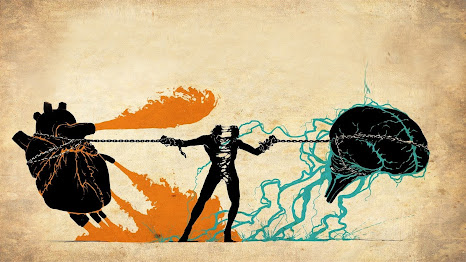
Image adapted from Colossus by Alex Olmedo.


There are a few things to consider before examining Christopher Langan and his CTMU (Cognitive-Theoretic Model of the Universe) reality theory. It represents a singular challenge for us and is not something done lightly or in a single post. This will lay out those considerations - the whats and whys as well as our own relevant strengths and limitations. The Band usually avoids being explicitly personal, but that same singular challenge forces us to be more self-conscious for reasons that will be clear. After this post, there is some scheduled business to attend to before returning to Langan and the CTMU. Another installment to the arts of the West and a wrap up the recent tour of the House of Lies with some implications. But by then we should have finished enough of our long-running preparation to come back around and get into the CTMU directly. 

Start with who Chris Langan is, what his reality theory is, and why the Band is interested in looking at it. The first two lead into the second – his intellectual profile as world's smartest man and the ambitious nature of his project make it a formidable challenge to the Band’s essentially Christian world view. Click for a link to the main CTMU paper that we are working from.


That relatively few people can even understand the CTMU makes this more important to address. The opacity lends a mystique to the theory that isn’t Langan’s apparent goal – in our experience he is as direct as his material allows – but exists all the same. Not being able to read it means not being able to assess it. This is apparent in the whiffing of his critics, whose dismissals reveal their own comprehension limits and will be addressed in a moment. But it also means that those not given to triggered gamma self-immolation can't determine how it relates to their own beliefs either. Awareness that someone of Langan's ability has declared a conclusive answer to the nature of reality becomes more rhetorically potent if that answer is unreadable. We propose to read it.

That gets to the challenges his thought presents for us, and how we can work around them. The CTMU is Langan's signature achievement, and that same intellectual profile that gives him his credibility eclipses our not insignificant cognitive abilities. This means our reading cannot claim to be definitive, nor can we comfortably second guess Langan's intentions. Unavoidable artifacts of being eclipsed...


But challenges also bring benefits. Engaging the CTMU forces us to push our limits and stretch our thoughts in unfamiliar ways. A recent post on parameterizing the concept of church over time would not have occurred to us without reading Langan. Likewise the addition of deontology to our Ontological Hierarchy. Before we start, we expect to further refine our ontological hierarchy as a way of visualizing basic relationships of reality as broadly conceived. Even our definition of reality emerges as something in need of clarity.

Plus it’s really interesting. The inherent challenges of the CTMU means it gets way less attention than it deserves. If we can remedy that in our small way, then we should. 


Take the  "conspansion" diagrams from the linked CTMU paper. This refers to how objects and events "shrink" internally through the parametric production of future states within present ones over time. So that the universe appears to expand relationally. Con-spansion - simultaneous contraction and expansion.


The mechanism of conspansion is akin to how further defining a set simultaneously increases the number of elements while attributively contracting the range of possibilities. This is an important aspect of Langan's conception of the universe as reflexively self-fashioning, and it's derivation is typical of how he melds knowledge domains.

Langan is someone we’ve mentioned on a few occasions. He's sometimes billed as the smartest man in the world, and with an IQ that may top 200, there’s no point quibbling with the provability of that claim. It’s certainly close enough to give an accurate indication of the scope of his intellect. Just reading his CTMU and contemplating it in its totality is sufficient corroboration of his cognitive profile. 


The numbers may not be exact. But it puts things into perspective.

To be fair, that is a flacid definition of genius at the top. The Band defines genius as intelligence plus accomplishment. High ceiling and something memorable achieved with it. 


We are not interested in debating whether the CTMU is a work of genius-level accomplishment - it may well be. But his pure cognitive firepower is overwhelming. The conceptual shifts, complexity of integrated structure, intensity of information density... The sheer scale and integrated scope of his vision - if you can see it - is awesome.


The Band realizes that the masses tend to be most impressed with mental feats, and he has plenty of those in his bio.


But Rain Man-type savants also perform amazing mental feats and no one really cares about their opinions otherwise. Let alone looking to them for theories on the nature of reality. And that raises the central problem for Langan’s public profile and the related lack of attention on the CTMU. He's too intelligent for most of his critics to even grasp what he's saying.


This is where the comprehension gap comes in – the inability to meaningfully communicate or comprehend beyond a certain difference in intelligence. 


The comprehension gap problem is exacerbated for Langan by the Dunning-Kruger effect, the related currency of false authority that makes up "academic expertise", and Vox Day's socio-sexual hierarchy. The first refers to the tendency of the mildly clever to think of themselves as much smarter than they are. And since they can't meaningfully "see" past the comprehension gap, they can't perceive their own limitations. This is endemic in university where such midwits obtain mastery of some "discipline" - itself a flawed silo that at best partly represents aspects of reality - and confuse it for actual comprehensive understanding. Like physicists blathering about numerological solutions to questions of existential origins. Highly proficient within a certain disciplinary silo, but too limited to see either the intrinsic limits of themselves - or their silo - for the problem at hand. 


An IQ of 130 is pretty rare. Most physicians don't have one. Neither does the average professor. It's also inadequate for the sort of theorizing that the Band does. Let alone the likes of Langan.


Vox Day's socio-sexual hierarchy is an immensely useful concept that we've posted on before. The comprehension gap problem is compounded by the extraordinary number of gammas in that midwit zone and in the appeal to "scientific authority" camp. Not only can they not perceive the difference between modern institutional scientific presuppositions and the scientific method, their entire fake self-perception of "genius" is predicated on the misperception.

When confronted with things outside their little silos that contradict their assumptions, retarded ironic defensive rage ensues. And they mentally and psychologically can't see it.


Langan's combination of incomprehensible intelligence, embrace of physicality, and complete disdain for credentialed authority is a trifecta of gamma triggers elevated to Platonic Form tier.


Here's a perfect example of a not all that bright gamma taking issue with the idea of the communication gap. Click for a link. This gamma's certainly not a 130 - probably closer to slightly above average. A 110 perhaps. Note how the headline promises a "myth" before moving into a tepid appeal to methodology as the metric of reality. It ends in a quibble, conceding to common sense that intelligence gaps impede communication "but that this always does happen once a specific difference in IQ points is reached seems doubtful”. We can't guarantee a precise magic number... is a conclusion considerably different from the impression given by the headline. And almost certainly by design since a journal knows better than most that more people skim headlines than process articles. Being well more than 2 SD north of said gamma, we'd guess the motivation is a mix of misunderstanding and butt hurt. 

Imagine what Langan has to deal with...
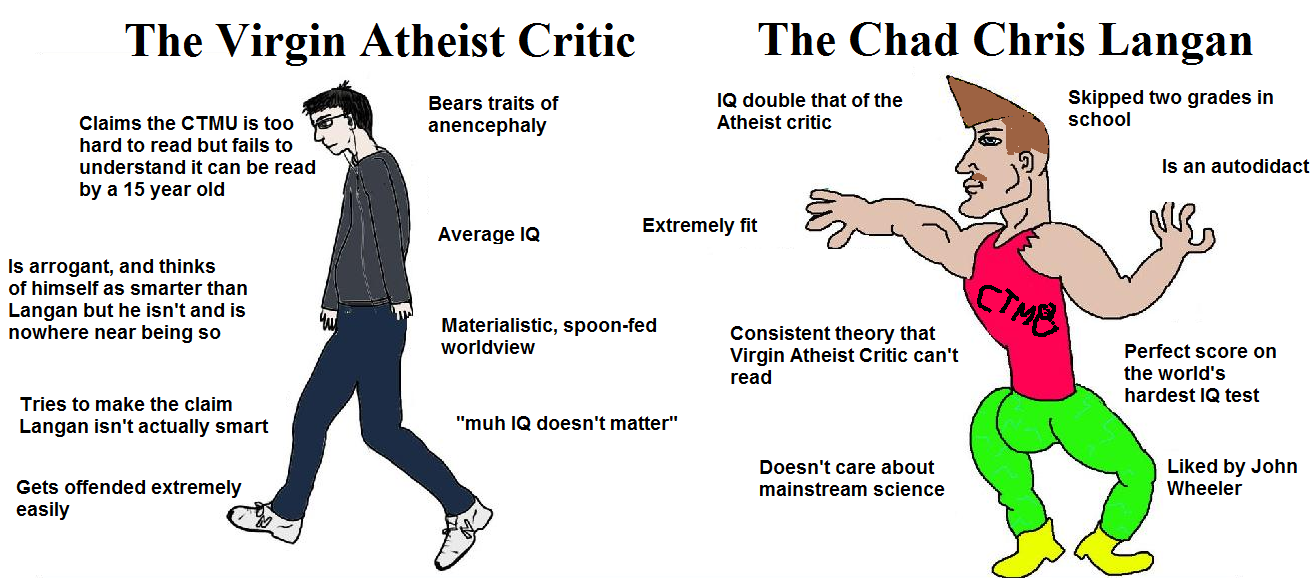


Perhaps we can rephrase.

It is impossible for much smarter people to discuss smart things with significantly less smart people. And painful to learn through experience that they can’t. 

This is neither arrogance nor insult, any more that noting a giraffe can see further than a porcupine. IQ has some inexactitude that comes with any assignment of a precise number for a multifaceted attribute. But differences in overall cognitive ability are painfully clear. If this is troubling or upsetting, that’s a measure of not being that smart. If they were smarter, it would be as obvious as sunrise. The alternative model is the midget opining emphatically on a shelf he can't see.


Drop below a certain point and metaphoric thinking isn't possible.

If that's not the case, it's easy to grasp with a visual metaphor - the big one doesn't fit in the little ones.


The two standard deviations difference in IQ, or about 30 is a rough measure, not "mythic". IQ is a general summation while individuals have aptitude peaks and valleys within that. In some areas they overperform and in others underperform. Nor does it mean that no communication is possible – the Band has shared basic information and instruction across about a 6 SD gap or ~90 points. What is means is that beyond a certain gap, unfiltered full capacity of thought isn’t meaningful communicable. The composite frame of reference, interlocking conclusions, shifting secondary implications, and conditional consequences can’t be cogently grasped. The person on the upper side of the gulf has to slow down and simplify, and this isn’t intuitive either. 

Some perspective.

We aren't just blathering. At peak, the leader of the Band has tested at slightly above 4 SD over the US average of ~98. 


The most generous evaluation of our absolute peak, graphically presented in maximal gamma triggering format.


Thought experiment. This is highly speculative for several reasons, but consider that an approximate range of 30-50 is applied to chimpanzees. Very approximate and not uncontroversially - species differences undermine the applicability of a human metric to a non-linguistic animal. Adding to the imprecision - the Band was a relatively late bloomer rather than a prodigy, meaning the relative gulf peaked in the later 20s. On the other hand, animals exhibit some pattern recognition, basic cause and effect logic, and reality-based learning  that human FTS-2 doesn't. That skews the comparison the other way. So very generally...


If we take that as a rough marker, the gulf between us and our average classmate was at least comparable to that gulf between our average classmate and a chimp. Basic communication could be bewildering, group interests inexplicable, and over time we learned through negative reaction what and how we could say things. We also became adept at detecting thought structures and capacity in others. Fortunately, once we realized what was happening we learned quickly. 

Think about that for a moment though. The need to "learn" people has nothing to do at all with psychopathic coldness. It's an illustration of how much of a factor the gap can be on interpersonal experience.


Now we instantly disengage the moment some contention or dispute reveals a limited comprehensive capacity, There's no point in continuing because it's not an issue that more information can fix. The gap also means is that someone in the middle of the bell curve becomes incapable of even recognizing extremely high intelligence. Because it falls outside their ability to process or comprehend. They can't think it, so they can't "see" it. The highly intelligent can be shocked at what registers as “smart” to the masses. That's because it has to fall within rough gap range from the average - otherwise it doesn’t register at all. 

This is where mental feats come in. They seem like little bursts of mental magic totally beyond the powers of even what passes for a smart person to the masses. Ways to make the otherwise invisible register. But from our perspective, the exceptional intelligence tells are functional. Information processing speed and capacity. Working memory. Ability to combine ideas across knowledge domains to generate insights. Pattern recognition of all kinds. Logic. Learning curve and adaptability. The list goes on, but it makes the point.

Now, Chris Langan has an IQ between 2.5-3.5 SD above ours


We had to extend the graph. And it shows. We are way outside of his gap. On the wrong side. Talking intensely with us would prove tiresome and limiting for him in significant ways. The chimp analogy starts to become uncomfortable. But the whole point of getting unusually personal and sharing out experience above was to point how widely we can see. Especially when it comes to the wide-scale associative conceptual abstraction and association we’re best at. There's tons of technical knowledge and ability that we are ignorant of, but we are not accustomed to struggling with well- presented complexity. And we can barely see what he's doing in a holistic way. Taking in his conceptual scope, intricacy and information density maxes us out in an unfamiliar ways. 


No one not to the far east of the bell curve could write the CTMU.

Let alone present it as cogently as he does. We certainly couldn't have produced it. It’s all we can do to keep it in sight at times. And yes, we are aware of the charges his wording is unclear or there are too many neologisms. How else does one use language and concepts derived from disciplines to address questions that the disciplines are incapable of addressing? That's precisely what we are talking about when we bring up comprehension gaps.

Speaking of triggering...


The scope, information density, and conceptual richness are simply too much even for most smart people to hold onto. So they quibble with isolated aspects that they can grasp, while missing how those are subordinated to the larger structural logics. But “disciplines” are self-evidently insufficient on their own - otherwise they'd have answered the big ontological questions they've instead whiffed on. Most of Langan's critics can't even see the onto-epistemological limits of the disciplines they base their critiques on. That they self-actualize through. Making them incapable of the critical stance they profess to take. 


Instead we hit limits of discernment and make-believe. And as any exceptionally intelligent person has experienced when "arguing" with someone who can't grasp the limitations of their frame of reference knows, the problem isn't lack of information. It's a lack of processing capacity. They can't simultaneously grasp their disciplinary silo and it's place in larger integrated infocognitive frameworks. Making a meaningful sharing of ideas impossible. If capacity limits could be surmounted, they wouldn't be... capacity limits. There's a parallel between the limits of disciplinary range and the limits of the discipline-huffers who can't see them.

But instead of recognizing limitations, beast-huffers prefer self-indicting rage over the reality that people more intellectually capable than them are aware of realities that surpass them.


A crude analogy is attempting to explain to a baby in a certain developmental stage that it doesn't become invisible when it covers its eyes. The conceptual capacity isn't there to process the necessary contextuals to grasp the why the frame of reference is inadequate. 


In various interviews and other comments, Langan has expressed annoyance at being ignored by the mainstream knowledge industry. What a sham academia must be if there is no place for someone of his obvious intellect. He is correct that it is a sham, but that’s not the only issue here. He’s too smart. Consider what the Band has written about university in the beast era. Where on earth would someone 5 SD north of the professoriate even be understood? Or as the smart Bandling - the one east of us on the bell curve - pointed out, what discipline would he teach in?


This isn't the operant principle in practice that official science - Science! - actually runs on. That dances to beast narrative. Honest description or identification of what is objectively real is not at all the point.  


If there is one thing Langan appears to miss about beast science, it's that the free-wheeling gonzo physics that captured his imagination in the 70s has nothing to do with academic science as an institution today. There are the odd intellectual outliers scattered hereabout. But they work in self-absorbed isolation. They certainly aren't charting the institutional course. The system itself exists to perpetuate beast narrative atop a self-evidently fake materialist onto-epistemology. It doesn't want to identify reality. So there's no place for someone who does. And the sort of self-indicting atheistic clown posturing on the internet is definitionally not one of those intellectual outliers. Meaning the [recognize the gap and disengage because it's pointless] axiom has to kick in.


The CTMU is described as a “reality theory” or theory of everything, although trying to classify it hides as much as it reveals. Most attempts at a grand theory of everything to explain the totality of reality and our existence in it start from purely materialist assumptions. This means they can never answer the question of origins in a satisfactory way and are necessarily DOA. Necessarily because the origin is the most important element. And if limited to material causality, the genesis of the material is outside the possibility of explanation. 


But one miracle means no longer operating in the strictly material. And that means that the system now has to account for the role of metaphysics. Failure to do so renders the game pointless. Lucrative, and lots of titles, accolades and nice buildings, but pointless.


The pretense that a purely materialist framework can address the origins of the material makes ultimate answers impossible. Which keeps the massive institutional grift paying out until the wheels finally fall of systemically. And that means a steady market for endless flings of made-up spaghetti at the discursive wall. None of which will ever stick - because they can't - or even be remembered in a few turns of the cycle - but are  good for the resume in the moment. Click for an example that is actually revealing, just of things other than claimed.

With sufficient cognitive horsepower, a pattern emerges in the materialism grift where the theorists’ primary purpose appears to be denial of human significance. 


It’s a fundamentally satanic perspective where rejecting the metaphysics of Creation or the inborn sanctity of man is the goal. This invariably consists of manipulating some equations, then declaring them keys to the fundamental nature of reality. While assiduously ignoring how this structure came to be.

And believers in this mythopoeia will attack the CTMU as not being empirically verifiable or predictive...


Langan sees through this ontologically-gelded myopia instantly and set out to build the CTMU to consider the physical and the metaphysical. Including the problem of origins. But that means rejecting the entire flawed onto-epistemologial and semiotic frames that modern institutional Science! takes as starting axioms. A non-starter. And an example of being too smart for the discursive silos that make up modern academe.

Then throw in the Dunning-Kruger gammas...


The CTMU is built completely differently. It accepts certain scientific premises, but is an attempt to theorize the totality of reality by working logically from what that must entail. Given that there is a reality that we can perceive and engage in some fashion, what is necessary for that to exist? This leads him through a dizzying array of ideas and conclusions that we’ll try and break down when we engage the it directly in the posts to come. 

And this gets to why we are motivated to address Langan and the CTMU. Readers of the Band know that our world view is fundamentally Christian. We do accept that there are aspects of scripture that are allegorical and limits to a fallen intellect looking at a valley of shadow through a glass darkly. But we also believe the account to be essentially True. Divinely inspired Truth, in fact. Creation, the Fall, and the necessity for redemptive sacrifice. Over the course of the Band we have reasoned to our satisfaction that what can be known logically and empirically of reality is consistent with those metaphysical aspects that are beyond our apprehension. Click for a post.


Different context but the point stands. We have no problems accepting limits of discernment and understanding. We're finite and fallen.


The CTMU acknowledges the metaphysical, but conceives of it's relationship to the material in a more continuous way that we would. It arrives at a concept of God, but with a recursive tautological account of universal self-creation that isn’t compatible with directed Christian Creation. This means that the smartest man in the world has devised a reality theory that differs from Christian dogma in significant ways but can’t be dismissed out of hand like the materialist numerology of beast Science!. A much more serious thing that it would be were it granted the academic attention Langan has mentioned. That's onto-epistemological erasure. This is much different.

Given that the Band’s motto is what can we know and how can we know it, we are almost compelled to visit such a creation. Not to try and “disprove” it – we aren’t capable of that without misrepresenting the complexity. But to ascertain how and why it differs from our Christian notion of Creation. And to see if there is anything that we can learn from the exercise. 


Readers are also familiar with our Ontological Hierarchy – the graphic representation that ontology and epistemology are layered and related from a human perspective. 

This is the most up-do-date version of it, with binding logos between ontological levels, the extension into self-erasure of evil, and the related epistemological and deontological tiers on the right. The need to add explicit objective morality came to us from an earlier reading of Langan. The Good, Beautiful, and True are old Platonic terms that just refer to abstract qualities of ultimate reality as it crosses into the capacity for temporally-sequenced human conceptualization.


The Ontological Hierarchy isn’t a reality theory per se because it acknowledges a noumenal or transcendent “level” that can’t be theorized beyond the necessity of its existence. Nor are the transitions between levels perfectly quantified, partly because theoretical quantification isn’t applicable to understanding all levels of reality. It’s a form of abstract epistemology that is of limited descriptive value for empirical reality and not of value at all for ultimate. This is one assumption where we diverge from Langan. Different but interrelated and tied together by Logos describes the aspects of our being-in-the-world without comprehensive theoretical unity. 

We also assert that there are intrinsic limiting filters to the human ability to grasp onto-epistemological clarity. 


Langan does address we're calling "the viewer’s share" – the reality that reality only exists to us in our perceptions of it. His concept of telesis implicates us in the formation of the universe as localized telic operators or telors. We would suggest that this improperly conflates representation and reality. Langan suggests the reality and representation are isomorphic to the point of conflation. More to come in later posts. 


Quantum uncertainty involves a viewer’s share as well. Though there, the incompatibility between the abstract formulas and human perceptual experience suggests opposite sides of an Ontological Hierarchy divine. Or limits of discernment, where abstract quantitative reasoning fails to correspond with fallen empirical perception. Langan doesn’t differentiate between onto-epistemological levels but prioritizes logic in a single unified conception of reality. This is also something we’ll take up in detail later.

The other is something Langan doesn’t take up and yet another thing we’ll look into further. That’s the semiotic filtering – the communicative reality that our discussion of any level of reality is dependent on material signs. 


Letters, numbers, and pictures. Reality may only exist to us in our perceptions, but our perceptions only exist to others in our signs. And representation is materially different from the thing represented. Even if the conceptualization that results - the mental picture - is the same.


Langan conceptualized reality in linguistic terms – not identical to human language, but an SCSPL or Self-Configuring Self-Processing Language. Where processing and configuration, syntax and content and mutually generate in total self-containment - to the point where SCSPL "linguistic" expression is perfectly homologous or identical with the reality it describes. Reality becomes infocognition - information "content" and cognitive processing "syntax" as one indivisible reciprocal reflexive self-fashioning. Where theory of reality and reality are isomorphic. What we call semiotic filtering would add that his act of theorization results in a material construct intended for readers. Is this significant?  

The Ontological Hierarchy is not a reality theory because it doesn’t offer an comprehensive explicatory theoretical account of reality. It is a descriptive visualization of how reality appears to us, meaning that the viewer’s share is built in. We aren’t dependent on any philosophical model because philosophical models are inherently limiting. But if we had to find the closest analogy it would probably be phenomenological because we assume an “objective” – meaning external – reality that temporally precedes our existence in it


Bernard Jean Corneille Pothast, A Happy Family, 20th century, oil on canvas, private

This is what we mean by “material reality”. A physical environment known empirically with apparently consistent properties that we are born into and come into consciousness in. Catch a ball, hear a noise, bump your head – all are purely material aspects of being in the material world. Infants and animals respond to physical stimuli. Before we can think, we are.


Robert Hannah, Master Isaac Newton in His Garden at Woolsthorpe, in the Autumn of 1665, 1850s, oil on canvas, The Royal Institution

Abstract thought – logic – extends thoughts beyond the purely sensorial material. This is where we hypothesize things that can’t be seen – everything from moral principles to… well… reality theory.


The Ontological Hierarchy is hierarchical because the things known abstractly that can’t be perceived directly are considered “more” true or real than the material things that can be. This is the epistemology part of onto-epistemology – the modes of knowing abstract realities are considered to be of greater truth value that the subjective and unreliable senses. Abstract reality itself is timeless and unchanging - unlike entropic, shifting material reality. This is how we get to ultimate reality as the most True and faith the most certain.

Langan recognizes that a noumenal ultimate reality in a Kantian sense is external to his logical-empirical account of reality and excluded as a result. Faith doesn’t really enter into his work.


His ultimate reality/God is the level of reality that has no ontologically or temporally prior explanation or situatedness. But he does assume that it can be adequately framed through conceptual structures of abstract human logic. And like the parameters of a set, distributes across all reality "below". Another point for closer scrutiny.


The Band perceives the levels of ontology and modes of epistemology as appropriate to their own domains. If you need to eat, material activity is more pertinent that mathematical formulas. But obviously there is overlap – mathematical formulas can lead to higher material crop yield. This means that there are continuities as well as differences along the OH. Humans themselves have aspects of all three – body, mind, spirit – despite inhabiting material space and communicating with material signs. We realize that we can be accused of a dodge - claiming not to be a reality theory lets us off the hook by leaving the connections somewhat vague. But that's also the recognition of our intrinsic limitations. We are not being clever when we sidestep ontological continuities. We aren't clever enough to fully grasp them.

Another motivation behind looking at the CTMU is to see how someone much smarter addresses some of these questions. The hope is that it may clarify and refine our own descriptive efforts.

Then there is the issue of temporality.  


Empirically, time seems basically linear – we are born, days pass, we age, days pass, we die. Consciousness begins and ends. Whatever happens after is after. Temporally sequenced. 

The problem emerges when we attempt do translate the experience of time into the semiotics of abstract quantification. The language of math.  


Physicists can show that mathematically, time is neither constant nor theoretically linear. 

Higher dimensions likewise allow for the possibility that our perception of temporal linearity is a limit of our three-dimensional existence. And yet...


Sequencing still happens. The theory postdates the theorist. The world precedes the perception of it. We don’t exist materially prior to birth. After birth, we do. We are small before we are big. And any creation is preceded by its creator. These are material facts of existence. And any string of numbers or printouts that say otherwise are a) largely irrelevant to material existence and b) things that come into existence after the person who created them. 

Thought experiment.


Yahoo Serious, Young Einstein British Quad Movie poster, 1987; Salvador Dali, Profile of Time, conceived in 1977, first cast in 1984, bronze


Consider the paradoxical results of  material-abstract relations with theorizing the relativity of time as an example. The physicist has to appear before the theory. Therefore time either exists objectively and prior to the physicist with extant properties awaiting discovery or the relativity of time is created - spoken into existence - by the act of theorizing because reality is created by the observer. Since the stability of the perceptual universe is an anchor of Langan's theorizing, we suspect he would lean towards the former. But in either case, the sequential arrangement of material physicist then abstract theorizing supersedes any relativistic conclusions the theory draws. Relative rates don't effect priority order. And sequencing implies some sort of temporal dimension.


See the differences between linked onto-epistemological levels? Their importance becomes clearer when we realize that theory is a semiotic artifact that appears at a moment in time.


Langan theorizes reality as a self-generating linguistic process where the syntactic operations and content are mutually recursively self-creating. His formation is actually much more complex than that– we are not doing it justice at all and will be more through in posts to come. But even with temporal recursivity in what he calls telesis – the reality-forming work of telic operators general and localized – verbs are used. Descriptive action. And that implies some sort of sequencing. Bringing us to  temporality.


This is different from what the Band refers to as true a-temporality. The absence not only of time as a physical property, but of any sort of before-after sequencing at all. We associate this with ultimate reality. Before the Creation. It is something we cannot even conceive of because thought itself is sequenced. But the definition of a temporal sequence presumes the preceding a-temporal originary state from which it comes. That's what the Band calls God qua God. Not the identity of an extant reality, but the apophatic ground against which Langan's totalizing definition of reality is positively conceptualized. The latter is closer in relative ontological scale to a Neoplatonic world-mind or demiurge than true transcendence.

And if the smartest man in the world - who juggles knowledge domains like data points and acknowledges the necessity metaphysics as well as materiality reasons out an alternative to our Christian framework? That's something we have to address seriously. Because not many can

We're not 100% sure we can. And that brings us to why this has taken so long. 


We may not be smart enough. 

The Band does possess certain attributes that do equip us for this sort of task. Like Langan, we see the intrinsic limits of “disciplines” and recognize the need to treat knowledge and thought as unified wholes. We are also comfortable combining disparate types of concepts to build composite structures and insights. For example, we don't care whether he uses "set theory" in orthodox ways, only the meaning of the ideas his usage expresses. But the IQ gap means he is far more capacious in what he can bring together and cognitively powerful in generating structures and insights.


In our thinking about thinking post we described how greater intelligences can pull together more information and connections and by holding more together at once, see broader and more complex patterns. Langan can encompass so much at once and manipulate vast fields of data through overlapping lenses. We get the impression that the whole CTMU exists in his head as a fluid logical totality. And that he can work on it in that totality. We can't hold the whole thing. Where he is holistic, we have to become sequential and rely on extensive notes. This means we don't see it the same way, opening up all kinds of possibilities for misunderstanding.

It is true that IQ is a general measure and that individual aptitudes within it vary. 


These sorts of breakdowns always understate the interrelated aspects of intelligence. But it does a good job of pointing out how many components there are to it.


The Band is especially strong at broad abstract conceptual visualizations and pattern recognition across domains. The skills most needed to follow something like the CTMU. In these areas, we may even scrape the bottom of the gap between us and Langan. We are also inclined to think past and across disciplines and recognize the limits of materialism, making Langan's approach intuitively sensible to us. This mix of aptitude and attitude is not common - it's why we observed there are not many who can take this up. But it still may not be sufficient.

A general average means peaks come with valleys.


 As the interminable typos in our work show, we are less inclined to fine detail and precise accounting.  We can barely glimpse his big pictures but his information density just blows us away. At times, the CTMU seems fairly clear and at others it’s a fog of symbols.


The time has been necessary to even try and do it justice. We only have limited time for the blog. And there's never a point engaging a straw man of your own making. In addition to the CTMU paper we’ve watched an in-depth video - which is something we never do – in order to better understand. But ultimately we are on the unfamiliar ground of not being sure we haven’t misunderstood an important idea or missed a significant implication. As such we will be more cautious and less aggressive than usual. 

We can't critique his logic. The nature of the CTMU is that it subsumes anything sententially real. And anything that isn't sententially real is excluded from the reality that the CTMU theorizes. Tautology - true statements in any circumstances, or statements that can't not be true - is a basis of Langan's theory. 


But we can discuss some assumptions and framing. So that's where we'll be focused.

We respect Langan’s work and his self-evidently vast intellect. We even hope to learn and evolve from him. The encounter is humbling. But it’s also necessary. And we don't need to discuss ourselves any more, but please feel free to share any comments.

We hope our readers will enjoy it.


Montague Dawson, Galleon in Moonlight, 20th century, lithograph


Saturday, 23 October 2021

Seeking Truth in a House of Lies - Logic, Feelings & the Strange Curse of Binary Thinking


More & more it seems that everything around us is lies. Call it the beast system, de-moralization, looming systemic collapse, globalist tyranny, the climax of secular transcendence, whatever. Why does the truth seem so elusive? 
 
If you are new to the Band, this post is an introduction to the point of this blog that needs updating. Older posts are in the archive on the right. Shorter occult posts and other topics have menu pages above. 
Comments are welcome, but moderated for obvious reasons. If you don't see it right away, don't worry. We check regularly and it will be up there.  


Take a different tack on the inevitable collapse of the post-Enlightenment legacy of secular transcendence [click for an explanitory post] and the false idols of modernity that it spawned. One of the most visible signs of this is the epidemic of dishonesty. How seemingly every institution has betrayed it's stated purpose, no government works for the nation it claims to represent, and everything is corrupted to the service of unaccountable globalist entities. When nothing is what it is meant or claims to be, we are in a house of lies. And that raises the question of what is the truth? More immediately, why does it seem so elusive - on pretty much every level - in this late stage of beast system collapse?

Check the lexicons before speculating. 


The OED is the granddaddy and comes with a huge amount of material. Here are some expurgated salient definitions.

Basically conformity with what is factually real. And here's the first insight into the house of lies - ignoring the existence of objective reality removes the basic standard for truthful judgments.


Here’s what Webster’s has to say – they’re the American standard. The wealth of historical etymology and usage isn’t there, but the main definitions are pretty similar.

Face and reality presume objective external existence. 


Always fun to check 1828 Websters to identify the degradation of the language. Not that different this time.


This actually doesn't help that much. We all live as if reality is objective - not walking into doors, expecting the light switch to work, and so forth. If the truth is this straightforward and consistent, why is it so elusive? 

Quick aside – the Band grew up hearing things like “politicians all lie” as a breezy commonplace. A truism not worth a second thought. This troubled our young minds, since the same “wise” adults told us that electing politicians was how we were governed. How it  ensured that the "will of the people" was respected, unlike the bad countries. But if we choose leaders on the basis of promises and they all lie, the truth is that the will of the people expressly isn’t respected. It is willfully ignored. 


To the surprise of no readers, no one cared. Just another childhood milestone in the lifetime of alienation that led us here.


But it’s worth a moment’s consideration. Why do we cheerfully accede to the predations of liars? And why pretend that a system predicated on lies expresses some “democratic values” that it self-evidently doesn’t? And it’s getting worse, not better. Prosperity, security, culture, are systematically destroyed in the name of facts that aren’t factual, values we don’t hold, and reasoning that doesn’t follow. The logical outcome of generations of cheerfully acceding to the predations of liars. But why?

Part of it is mass stupidity. 


MPAI – most people are idiots – isn’t only a statement of cognitive potential. Although it’s true that the complexity of the societal garden we're boxed into far exceeds the comprehension powers of most of its aphids. 

It’s that most exhibit gross cognitive deficiencies regardless of innate intelligence. MPAI joins the natural idiots with the functional ones – those who act the part despite having the ability to be believe and do not moronic things.


Thinking itself comes with inherent limits. An earlier post on thinking about thinking mapped out different levels of complexity. And it's an unfortunate reality that the ability to process complex mental structures goes up, the number capable of doing it goes down. Likewise the number of people that more complex thought structures can even be communicated to. 

But the limits of thought are deeper. Thinking itself – no matter how complex – is woefully inadequate to capture the fullness of reality and it’s countless interactions. It is inherently representational and limited to human scope.


Representational on several levels. Our thoughts are not the same as their subjects. They’re mental representations of external reality and limited by the scope of our minds. 

Even when these representations are truthful, they make up a tiny fraction of what is. They’re abstracted and isolated patterns from reality that are then subject to mental operations.


This means that assessing truth is a judgement of fit between a thought or expression and the subject of it which is different. Any discussion of truthfulness has to address how mental processes and operations correspond to external reality.


Point 1 – Simply recognizing that thought and expression are representations starts building the framework to distinguish truth and falsehood.


Representational patterns make hierarchical dependence or priority order obvious. If you think about something, the something precedes the thought. Even a novel creation is made of pre-existing ingredients like "concepts" and "words".


David Day, illustration from his The Illustrated World of Tolkien

Even an creator as original as Tolkien finds inspiration from previous things. It's inevitable because everything - language, belief structures, cultural resonances, etc. - come from experience. 

Something with no connection to anything meaningful would mean nothing to the audience. Even the closest thing to meaningless trash like modern art or "literature" has to be part of an existing discourse - the art world or "literature" - to be recognized.


You may be picking up and building on other thoughts or concepts rather than concrete objects – that’s the "discourse" retarded postmodernists like to pretend precedes reality. There might be something there if you’re incapable of conceptualizing anything beyond yourself – there is a reason PM is psychopathic. But even a chimp can grasp rudimentary time sequencing, and any sequence of ideas started with someone. Someone reflecting on something prior.


Getting on a train midway along the line means your station isn't the beginning. You're getting into something ongoing. 

It doesn’t mean that the train didn’t start somewhere.


It doesn't even matter what you believe about origins - every belief system has an origin of communication or language. The Bible begins with Adam conversing with God. Purely secular history identifies the development of written language in ancient Sumer. Spoken language develops somewhere in the peleolithic era. In either case, everyone subsequent is forming representations and expressions out of something that came before the representation.

Priority order. Regardless of beliefs.

But it’s even more personal as well. 


Warren F. Neary, Story Time, oil on canvas

Any language or sign system that you use had to be learned at some point. 

Meaning you predate your usage. 

Read that again. It's not just a matter of the means of representation - language, picture-making techniques - preceding you. You also precede your understanding of the means of representation that you use

Priority order.


This isn’t debatable. It’s necessary sequencing because time exists as an experiential human condition. It’s so brutally obvious that it should instantly dispel any of the postmodern, word-magic, be your own god idiocy that reverses representation and reality. Instantly and without need for even a second’s reflection. It’s that simple.

So why doesn’t it? Why is simple truth so elusive?

Try something more timrly. 


Recently we are told by “authorities” that brand new genetic therapies are “safe” long-term... 

...despite their newness rendering conclusions about long-term safety literally impossible


That's another one to read again. We aren't even saying they might not be safe, though it seems increasingly unlikely. That's the point - they're new. The claim can’t be made. We can model likely outcomes, but we can't know the long-term outcomes. The basis of the claim can’t exist. Any more than we can claim to know the exact temperature of a given day a decade from now. Or what you’ll have for lunch next year. It can’t be known because the knowledge doesn’t exist yet. It's so obvious that we feel stupid spelling it out so emphatically. Yet masses of ninnies nod along. Why is the truth so elusive?

Impossible truth claims are slightly different that the claiming an effect comes before a cause or the promise-breaking and other lies of the political class. It’s a bit more abstract. 


The others are objectively and evidently wrong – like calling a red apple blue. It doesn't require any conscious thought beyond basic linguistic processing. 


The impossible safety claim is unverifiable. That's why it's impossible. It's not known true or false when made. It's not knowable period. This complicates the acceptance of the lie because the statement itself may or may not be untrue. It's a second-order lie. One that needs a modicum of interpretation beyond the thing being discussed in the present. What is necessarily objectively false is in the claim to know something that isn't knowable.


We can’t know the effects of the chemical long-term until sufficient time has passed. So the lie is the claim that we do. This makes it easier to obscure and misdirect by dithering over the accuracy of predictive methods. 


But a lie all the same. And still not hard to pick up. So why does it seem so hard to pick up?

Acceptance of lies or insistence on truth points to how people are motivated. Motivated because we’ve noted that something can be known, even believed, without impacting how someone reacts. Like recognizing politicians are liars and nothing changes for the better and still willingly participating in the process regardless. Or grasping that future outcomes are not knowable, but acting as if a brand new experimental substance can be declared safe long-term regardless. This is the functional idiocy – mentally capable of understanding the difference between true and false, yet acting as if too stupid to do so. 

Like the a-holes and morons that blather about "trusting Science" as if it were a thing and not a methodology with verifiable performance and accuracy metrics. 


This bit of functional retardation comes from several places. 

Poor educations. How many can even define what "science" is? Dunning-Kruger effects. Consider the average university scientist has a piffling IQ in the ~130 range and the average trust science moron is at least an SD below that. They aren't smart enough to even perceive systematic limitations in world view, let alone correct them. Atheistic external morality. Endemic lack of personal integrity beyond getting promotions in an epistemologically-gelded system is an incentive to dishonesty.

The motivation to believe in a totem that doesn't exist as a monolithic thing and doesn't offer that level of assurance by it's own definition is a mix of laziness, arrogance, and existential fear. It's more desirable to make up a fake priesthood to outsource truth to than to have to face the uncertain realities and limits of being in reality.


And motivation brings us to the old Aristotelian distinction between rhetoric and dialectic. The universal scope of this can be easy to miss because of the somewhat technical-sounding names They are easier to assess in relation to broad-based motivation patterns if we think of them as feelings and logic or reason

Aristotle offered them as modes of argument or persuasion – appeal to the emotions and appeal to logic or intellect. We aren’t substantively changing this – just rephrasing them more broadly. 


Motivated by logical processes?


Or by feelings? 


The catch is that only one of these is related to the truth. That's logic. Emotional motivations have nothing to do with whether or not something is factual. Only how we feel about it. Feelings may align with what is true, but they don’t have to. They’re independent variables. This is why so many people are driven to actions that are self-destructive - positive feelings about something that is actually negative motivates in the wrong direction. Just as importantly - only one of these is related to desire. That's feeling. Just like emotion and truthfulness, logic and personal preference are independent. Something truthful may be distasteful, while lies can be pleasing.

Logic is based on internally-consistent truth claims. Consider the most elementary forms – a basic syllogism or simple math sentence. These are verifiable as true or false independent of the sign system used...

2 + 2 = 4 
as
II + II = IV 
as
two and two are four

If you speak the language or recognize the signs, you can ascertain whether the claim is true. It is even applicational. If there are two cars in the lot and two more pull in, there will be four cars there. Internally, verifiably true.


We qualify with “internally” because the conditions can be false, yielding a false conclusion.

Maybe there weren’t two cars arriving, in which case, there won’t be four in the end. The number sentence doesn't apply.


But if the reported conditions are accurate, the relationship is truthful, every time. Internally, verifiably true.

Now, see the problem?


Point 2 –  Even simple logical facts are dependent on external conditions in practical situations. 


Nothing around us exists in a vacuum. Material reality is an endless network of temporally sequenced butterfly effects of unknowable interactive processes. This obviously presents a problem for the depressing prevalence of linear and binary thinking. Even when people know this there is a tendency for oversimplifications. More on that later.


So if there conditions are factual – two cars and two cars – the conclusion is truthful – four cars.


Bringing us to evidentiary standards. If logical conclusions depend on factual conditions, how do we know that the conditions are factual? That part's easy. Empirical observation. Count the cars, observe the actions, identify the colors, etc. 


In terms of the ontological hierarchy – objective observation  is material level epistemology. Brute empiricism. The evidence of the senses. The most simple being in the world.

From there mental processing kicks in. Logical operations move into the abstract level of reality by recognizing patterns and relations that are not directly and immediately visible. The two flow together seamlessly for the non-dishonest and non-idiotic, but they are separate epistemological processes involving different levels of reality. 

This sort of mental housekeeping is one of the real practical values of the ontological hierarchy.


There’s a reason why the Band keeps returning to the ontological hierarchy. It doesn’t just map out what we can know and how we can know it and avoid category errors. It clarifies the nature of truth and lies in a more comprehensive way than adjudicating simple statements of false facts.

The ontological hierarchy points to surrounding realities beyond brute material existence. It’s essential given the representation/reality issues we’ve examined in recent posts. Because the reality is that reality isn’t homogeneous. Nor are modes of knowledge. We can see that when we compare a mathematical theorem to actual measurements. 


In the past we've used the Pythagorean Theorem as a simple example of abstract reality. Abstract concepts have internal, perfect truth value that cannot manifest in the material we inhabit. 

Every measurement has minute material differences and uncertainties. The abstract, immaterial mathematical relations have absolute perfection with no variance or uncertainty at all.


Nor can we know them the same way. No material construct that you can see corresponds to the 0.0000 repeating perfection of a logical mathematical construction. 

But you can’t see the Pythagorian Theorem in itself as a mterial physical entity. One is perceived empirically, one perceived logically. 


So two different kinds of reality known in different ways. Not different “truths”. Different things that are true and true in different ways. But the true is… well… true. Just different things that are truthful in their limited frames of reference. 

This helps account for some of the insane prevalence of lies in today's society by separating truth claims into two different  levels.

Level 1 - Basic observations
These are first order lies and in theory the easiest to see through. Like the apple is blue. It obviously isn’t, and no logical reflection beyond the necessary linguistic processing is needed. That doesn't stop people from falling for them - the foundations of "leftist' retardary is denying plain empirical observation for convoluted blather and a bizarre obsession with impossible wishes. Much of this would vanish if the idiot masses weren't hypnotized by television and had memories surpassing those of fruit flies


Like listening to the same liars dithering over variants in arctic sea ice when they terrorized the same  idiot masses with risibly false predictions.


Level 2 - Logical conclusion
Second order lies – like asserting this brand new thing is safe long-term – doesn’t confront you with an obvious empirical falsehood. To see through them, rudimentary assessments of the logic is needed. Ruling out a big swath of the idiot masses from the jump. Even before getting into questions of motivation.

Putting the lie at one remove – from empirical observation to logical conclusion – makes it easier for those who want to believe the falsehood not to “notice”. Not being so blatant makes room for feelings to induce willful blindness. This covers false starting conditions - GIGO like building a "green energy" strategy by starting with basic lies about the viability of pathetically inadequate "renewables". Or creating false syllogisms like "climate change" projections.

Empirical or logical deceptions - two levels of lies aligning with two levels of reality. 


The thing is, both require some effort to check, but if the information is available, they are verifiable. Either observing the facts for yourself or breaking down the reasoning. Time consuming, but doable. The problem comes in when the information isn’t available. Like long-term data from a new invention. We face worlds of things where information is incomplete. 

Consider historical studies, where we have to theorize about past circumstances where next to nothing is known. Like building Stonehenge. We can reverse engineer the structure using the technology of the time. But this method being historically likely isn't absolute mathematical certainty.


In these cases, even the soundest logic gives provisional conclusions. These also can be evaluated for false claims – conclusions that the available conditions can’t support, like powered cranes at Stonehenge. But we often find people prefer to believe impossibilities just because they are pleasing to them. 

Bringing us to rhetoric.


The appeal of emotion or feeling is a much more profound problem vis a vis mass acceptance of lies because whether or not the motivation is verifiable is irrelevant


Feeling is independent of logic. Not parallel or “opposite” – completely detached and unrelated. The two are often presented as a pair of opposing motivating patterns, but they are not a closed binary relationship. They are completely different motivators that coexist to varying degrees in almost everyone. 

It's not entirely the fault of the idiot masses because simplistic logic vs. emotion binaries are repeated like mantras. As if abstract concept distinctions define lived experience. 


It's a sharp graphic for those times feelings pull in a direction that is illogical. 

What about when they don't?


Logic and feeling are in harmony open the pathway to great art and profound achievements. Like the refined techniques and careful structure in the stunning sublimity of a Hudson River School painting. Or a Beethoven symphony. Or a Gothic cathedral... 


Albert Bierstadt, Mount Corcoran 1876-1877, oil on canvas, National Gallery, Washington


This shouldn’t be hard to grasp, but forced binary thinking is the idiot default and a major reason for the plague of lies that is modern life. Besides, if you didn't force inane "left and right brain" binaries as oppositions, you couldn't praise illogical morons as "creative". Remember, in the de-moralized fake  beast system, there is no place for the painting up above. And "science" is oracular truth pronounced by lab-coated narrative-huffers.


Something like this - where thought patterns are reimagined as opposing personality types so low-wattage cattle can feel better about vacuity.

Can't see it? Picture your favorite discoveries, artworks, insights, etc. Then try and imagine how their make-ups correspond to a division of characteristics like this. 


Logic and emotion are tendencies that may or may not clash. Feelings can be perfectly logical reactions to truthful perceptions of reality. Like the feeling of well-being from healthy living or exercise. Love for a mate or a child. Awe in the face of the Lord. Fear that steers you away from peril. Pleasure when surrounded by natural beauty. All powerful feelings that are perfectly logical responses as well.

Feelings can also be illogical impulses leading to self-destruction or worse. The rush of addiction to porn or meth. Unfounded greed, jealousy, and hatred. Stalking someone who is disinterested. Hedonism without regard for costs. 


It's not that they're intrinsically opposed. 

It's if they are opposed or in alignment.


Where logic and feelings do oppose each other is in their relationship to the truth. There is no intrinsic truth-value in feelings beyond the fact that you truly feel them. No intrinsic value of any kind beyond your subjective assessment - and that by definition is of your inner psychic reality, not objective external reality. 

How feelings relate to reality – the degree to which they align with the truth – can only be determined logically or empirically. Neither their existence nor their intensity has any necessary connection to external reality. 


Is what is felt to be also objectively factual? 

And if not directly observable, does it follow logically from things that are? Like the ironically appropriate author's name, for example...


Here’s why this matters. Objectively, thinking is representational and representation implies hierarchy order. [Truthful] reality precedes your thoughts about reality. Your sign-systems precede you. But feelings are not bound by truth and don’t have to accept the necessary priorities of reality.

The empirical reality is that most people are motivated by feelings first. To the extent that they will accept any number of lies and inversions to maintain or protect how they feel. Consider the difficulty so many seem to have seeing through the massive lies that surround us. Take "freedom" – to choose a big one. In what way are we “free”? Think about it. Can you say whatever you want? Go wherever you want? Choose to keep all your pay or not? Raise livestock? Opt out of government programs? Operate a business without a license? Etc? In what way are you “free”? Put another way, what definition of “free” actually corresponds with contemporary life?


Now explain to a boomercon that “freedom” as a value is inimical to “society”. Atomization vs. collectivation. 

The irony... it burns!


And that any value that inverts what it is used to "support" when followed through isn’t really a foundational value for that expression. It may be conditional, but it's not fundamental.

A functioning polity requires submitting to certain realities. Either basic facts about human nature, cooperative effort and being in the world. Or the current tyranny of lies. Blathering self-evident falsehoods like freedom as a foundational value is simply choosing the latter.


E. W. Potter, Frontiersman, 1955

These guys lived free. Not cushy mouse utopia, but free.

It’s painfully obvious when we think about it, yet it doesn't prevent recurring asinine rhetoric that better suits the reality of a 19th-century frontier woodsman. They’re lying. Perhaps not intentionally, but consider the "political" filth that promotes this sort of deceit as an ideology. Anyone doubt it's to create a false impression, curry support, or train compliance? Something other than the best interests of actual people in actual conditions.


So why does “land of the free” nonsense persevere in some circles? Because it’s too vague a lie to trigger the narrow simplistic frame of reference that most de-moralized, de-cultured, mindless media-huffing consumers exist in. If you’re in a tiny box and someone says a red ball is blue, you detect it. If the shoebox itself is a lie, it’s hard to see from the inside.

And most people - even those who consider themselves moral or right - would rather cling to a self-evident falsehood than jeopardize treasured feelings. Consider another abject idiocy - that the Christian God would “bless” a secularist, materialist, fame-whoring, aborting, imperialist monstrosity like the modern US. Either the Bible is lying or America is closer to the whore of Babylon from Revelation. Yet self-described moral people still mouth it like a fact and not a request.


William Tylee Ranney, Boone's First View of Kentucky, oil on canvas, 1847, Gilcrease Museum, Tulsa

Consider the difference in freedom between yourself and a frontier woodsman. Why do the liars who claim to stand for “your freedoms” never address their complete evisceration? Why do they never restore swaths of personal responsibility? Or even shift the debate in that direction? Ever?


By the fruits. They don’t want to. And by accepting their terms, you contribute to your own slow, progressive enslavement. Even destruction. 

A world view where “Republican” battle “Democrats” over “freedom” a false perception of reality. A vision of life as a shoebox made of lies. It is a bunch of representations – a representational complex as we call it – but one that doesn’t correspond to material or even abstract reality on any level. 


Not how decisions are made or the country run. Not how power is wielded. Not even what the puppets you see on t.v. really think and act. But if you believe it – if you act as if it is a truthful reflection of how things are – you become complicit in the destruction of culture, society, history that it is designed to obscure. 


Most don't even realize how power structures even work. And many become angered if you try and explain.


Why is it so difficult for so many to penetrate these lies? Why is it that even when you walk them through the above step by step - so they agree with each one – they reset back to idiot acceptance at the end? We’ve called it a glamour. But why can some see through it while others can’t?


What makes it so destructive is something we’ve raised in posts on mass glamours and word magic. Acting as if reality was different from what it is. Meaning they will do things to preserve the feelings that are actually harmful in actuality. Like sending money to a party that is actually tearing apart their way of life. Or attacking someone trying to defend their own nation with made-up words from liars that hate them. Or accepting mass therapies on terms that can’t be true.

Why is truth so elusive? Because in the inverted, narrative-huffing, grasping materialist, de-moralized hellscape of the late stage beast system, lies usually feel better.

Read that again. 


Maybe de-moralized materialism isn't the human telos...

Consider -  a huge IQ is hardly needed to see through the objectively pathetic deceptions that ensorcel the idiot masses. Why are they so  impenetrable? 

Why do they reset to idiot mode even when the can see the errors in the lies? 


Because they want to believe. Because they are motivated by desire, and only feelings – not logic – are intrinsically connected to that. 

Part of it is masturbatory. The dopamine that soulless husks feel from some more material crap, a titillating program, or the devolutionary animal gluttony of a mouse in a maze hammering the food button.


Lile this braindead nonsense. It's preferable to lie and face inevitable mobility, cardio-respiratory, and countless other avoidable health crises before an early death than face bio-medical reality. And basic physics.

On a personal level it's basic Darwinian self-selection. Broadcast through beast media is another plank in the house of lies.


Even more of it is fear. 

Fear is a motivator of primal power because it connects to self-preservation. Reflexively leaping out of the way of an accident. Not entering the ominous location. Rushing outside at the smell of smoke. It goes on and on. Powerful, even preconscious, motivating feelings that spare us injury or death. But in these cases, the danger is real and the self-preserving feelings – the rhetorical motivator – does align with truth. 

But remember – the truth-value of feelings is not intrinsic to them. It is circumstantial and can be misdirected or mistaken. What if we are made to fear something harmless or even beneficial? The same overwhelmingly powerful motivating mechanism will kick in but now it’s detrimental. Not leaping away from danger but into it. 


A vast portion of modern falsehood is based on media-generated fake fears that don’t align with reality. It's rooted in factual or logical errors and lies through vehicles that the idiot masses put unearned faith in. 


This is a product of the glamour that we’ve discussed in other posts. The centralized fake reality / de-moralization / mouse utopia that the beast system offers in place of authentic experience, organic community, and logos. Only the fear side rather than greed-driven dopamine hits.

“Brainwashing” is too simplistic. Programming fits, but we need to be specific. What is programmed are feelings, independent of external logical observational reality. Primal emotional drivers. And once established, bloody hard to break or even modify. 


And the beast doesn't try to alleviate the fears. It creates and stokes them. Because the fake fear allows for endless creeping power grabs. Think of all the government intrusions into private life in the name of "safety" from fake threats. Things that aren't really dangerous or problems. The retarded legal system is part of this as well. 


Fake fear makes people complicit in their own enslavement. 

Everybody dies. But beast media creates the illusion that death is unnatural and immanent unless we give it powers to keep us "safe". It can't. All it does is create false feelings that it then exploits with false solutions.


But it's all lies. Top to bottom False claims about observable reality. False claims about the involved parties. And false logical conclusions about the solutions. 

Beast media - t.v., big tech, globalist print - is a synergistic false reality. The house of lies that traps modern society. And it is so powerful for two reasons - it is totally immersive and based entire on manipulation of feelings. Fears, lusts, excitements, flattering reassurances and corrosive undermining of confidence. A constellation of fake emotions that insidiously take the place of reality in de-moralized mouse utopia. 


The house of lies is so pernicious because although a fake experience - virtual is merely a nice way of saying fake - it still registers as experience. It is representation instead of reality, but it is processed through the same representational processes of thought in the same way. It's audio-visual experience like any other. What it lacks in other sensory inputs is made up in tailored psychological appeal. Like any powerful vision, once the things it shows are seen, they can’t be unseen. Even with conscious awareness of the unreality they mark the subconscious. And when most don't maintain that constant conscious awareness, the fake reality becomes confused with - or replaces - awareness of the real.


Why centralized media with audio-visual immediacy and beast control is so pernicious. It conditions fake understandings - conscious or subconscious - and implants thoughts and concepts that would never be found naturally. The psycho-sexual degeneracy of porn is a great example and is demonstrably toxic on every level from the personal to the civilizational. But for all that, it's one tiny piece. There are false impressions about human nature and interpersonal relationships. Dissatisfaction and scorn for normal organic behavior. Grasping envy. Fake normatives. Even the endless myth that life should be "heroic" in some extraordinary way – that "out there" is better. Vicarious entrancing lies. All of them.


This is the argument against tolerating evil in public discourse. “Free speech” is another feel-good but embarrassingly idiotic objective lie that collapses and inverts the moral society it is claimed to be a foundation for. 


Consider for a moment how retarded you have to be to breezily assert that "free speech" is a "right" and some speech is not allowed at the same time. It's mind-boggling to a non-moron. A right is or isn't, and if you can't say anything, there objectively isn't a right to free speech. At which point, the only debate is what the rules are. Christians - not satanic inverted churchians - would have been wise to assert the same rejection of blasphemy that the beast imposes on whatever fake transgression best suits it's sorathic, dyscivilizational goals at the moment.

So how does one break through the house of lies if truth is irrelevant to rhetorical emotional motivators? 


Find stronger feelings that supersede beast dancing lights that aren't empirically and logically false. Looking back at the ontologically hierarchy, that means going to higher truth of more real reality through faith. We are not given a spirit of fear. And the other fake implanted feelings can be countered as well. 

Either that or hope logic will somehow start to override primal animal limbic reactions. Good luck with the last one. 


One of the biggest lies in the house of them is that "secular" morality is viable and that Christianity can be evolved past. And once that bit of empirical observation and logical conclusion - multi-spectrum truth - penetrates the web of deceit, the only possible alternative  becomes objectively and dialectically obvious. Whether one can accept that becomes the index of their entrapment in the feel-good world of rhetorical lies.


Logical, truth-based arguments fail because people who can see the logic won’t apply them. What chance do the idiot masses have?


Truth-value isn’t part of the calculus of feelings-based motivation at any point. It is utterly independent of whether or not it corresponds to reality. It is built out of ignoring objective observation and dialectical conclusions. In fact, those measures of truth don’t even signify to it’s operant processes. 

So what possible value can there be in reiterating things that were never part of the equation? That don’t even show up on the radar? Unless presented in some novel way that creates a countervailing feeling, it’s just repeating what already failed. And persuasion directed to creating counter feelings is… rhetoric. 


Ironically, trying to counter emotional motivation with observation and logic is observationally and logically retarded. 

Might as well be the Charlie Brown teacher.


Now consider this before we even raise the inherent limitations of thinking as a representational process. Brute observation and rudimentary reasoning as fact-based motivators is already beyond most

Now consider those for whom it shouldn't be. As we already explained, logic and emotion aren’t a binary opposition. They coexist to varying degrees in everyone. It's the interplay between [has the ability for logical thought] and [reacts on emotion anyway] that undergirds the idea of functional idiocy. If thought is an abstracted and simplified representational activity, what determines the nature of the representation?


In the thinking about thinking post we considered the cognitive thresholds for different types of thinking. Rudimentary binary thought, the need to be this tall for multi-variable thought. All the way to full non-linear thought, where the cognition mirrors the fluid and protean nature of reality itself.

It goes a long way to explaining things like the 2 standard deviations of IQ communication gap.


But this is hardware. Inherent capacity based on general intelligence. The faulty reasoning of functional idiocy – the semblance of logic but with self-serving errors and oversights – is usually emotion-driven. Asinine assumptions and blatant oversights to create the illusion – the lie – that what feels good is logical. Is factually correct even though is clearly isn’t. 

This is rationalizing, not reasoning. 


So if all thinking is an inherently distorting representational process and linear thought patterns especially so why does binary thinking stand out as a curse? Outside of naked emotion, oversimplifying causal relations and possible outcomes might be the biggest structural reason for the plague of lies. Because it is a type of theoretically logical thought that is woefully insufficient. And the more oversimplified, the less likely to capture the truth in most cases. The appeal is obvious. What is simpler than this or that? Anyone can grasp either/or.


And it’s natural. We appear have bilateral symmetry [the fact that we really don't on close examination indicates the problem being referred to here]. We see from two eyes. Computers run on binary code. Life is filled with up-down, in-out relations. We reproduce through binary pairs. 


But in many cases, what we think of are binary opposites are actually extracted from more complex relationships. Or artifacts of linguistic abstraction. For example, there is no inherent “night” and “day” as consistent phenomena, let alone absolute existential opposites. They’re qualitative terms applied to relative levels of lighting or points on a clock. 


Even Genesis links them to qualitative distinctions and immediately complicated their binary opposition with other periods like evening and morning.

They’re "binary opposites" because we’ve labeled them that way for practical purposes. This isn’t wrong, but they don’t determine or construct the nature of reality. They don’t even capture the gradients of diurnal light cycles. 


William Bradford, Ice Floes under the Midnight Sun, 1869, oil on canvas, private collection

To say nothing of the midnight sun...


Presenting complex things as simple binaries and pretending that they are determinative is a major way liars manipulate the thoughtless. Wrap by returning to a consideration of left and right – the political terms, not the opposed sides of the body which actually are a binary opposition. A main manifestation of fake "freedom" discussed earlier.

Left and right are presented as diametric ideological poles embodied by "parties". But observation and logic indicate that we are ruled by a uniparty elite that only moves in one globalist sorathic, civilization-destroying direction. People act as if this false choice was meaningful and throw their support behind one or the other tentacle of the same beast. 


Note how nothing ever happens to meaningfully roll back the scope of government power or legislate in a way that prioritizes the interests of the American people. It would be easy to pass laws deporting criminal aliens, punishing offshoring, imposing rigorous standards, reforming the justice system, etc. Yet it's never even debated. And virtually no one voted for the system we live under.

And yet...


It's not just support for the fake tentacles of the beast. Often times people emotionally invest in these bogus totems to a degree appropriate to an actual existential clash. Although this does mercifully seem to be abating as the sheer corrupt dishonesty of the oligarchic freaks gets harder to hide. Nevertheless, for a long time - and still to a degree - the idiot masses committed to "parties" despite the empirical and logical obviousness that they were not what they professed to be. Feelings over truth.
 

Creating fake binaries hides dyscivilizational evil behind pablum-level rhetorical "sides" to impel cooperation in self-destruction. 


In reality, there is only one real absolute binary – Good and Evil. What we’ve defined elsewhere as alignment with or rejection of the primordial forces of creation and the objective reality that it generates. 

For those too limited to perceive the ontological hierarchy, think of it as True and False. Functionally accepting and aligned with objective prior reality or not. The latter being the whole asinine do what thou wilt, be your own god, representation over reality, secularist cesspool. 


Carl Bloch, Jesus Tempted, 19th century, oil on canvas, Frederiksborg Palace, Copenhagen

Note how despite all the false binaries the beast creates, this fundamental one is the one that is unacceptable. Undermining objective morality has been its premiere goal from the jump. It’s how you know it’s narrative huffers are liars. 

All the rationalizations, word magic, and pretense that goes into avoiding it just places them in the latter box. False pointing to Evil. 


Bringing us to a concluding irony.


On a strictly material level, binary thinking is an obfuscatory plague intended to misrepresent complex reality for disastrous ends 

AND

Any truth-based system that recognizes complex materiality must be based on a founding ontological binary.


It’s complex...


Most Popular Posts