
William Blake, Ancient of Days, frontispiece of Europe: A Prophecy, 1794, metal relief etching, hand colored, approx. 24.1 x 17.2 cm. The Whitworth Art Gallery, The University of Manchester
For the mystic Blake, the world was itself a "representation," an imperfect expression of the perfection of the divine will. This is why his creator holds a set of compasses, which symbolizes this fundamental act of creative mediation. It is up to us to read this divine discourse to reach the truth lying beyond the image.
The political implications of the Postmodern assumption that representation is all there is are obvious; if reality is discursive, and discursive constructions are essentially the same in their lack of external meaning, whoever controls the discourse is all-powerful.
The Postmodern aversion to categorical differences between things in favor of undifferentiated chaos or entropy, allows for important differences between knowledge domains, each with their refined hermeneutic methods, to be swept aside.

Lee Lawrie, Wisdom, with Light and Sound (not shown), 1933, above the entrance of 30 Rockefeller Center, New York
Note how Lawrie's image of a higher power reflects Rockefeller's faith that human ingenuity and technological progress can usher in a Utopian future. We see the same creator, rendered in the Art Deco style of the time, only this being is charged with what looks like electric energy and the universe he creates with his compass resembles a mechanical abstraction.
Without external reference, signs become whatever you want them to be, only it is more insidious than that. The Trace of the old meaning remains, to lend false credibility to the new usage. In Lowrie's vision, science is accorded a metaphysical status appropriate to an object of religious faith. This will prove devastating as science the empirical method becomes "Science" the discourse.
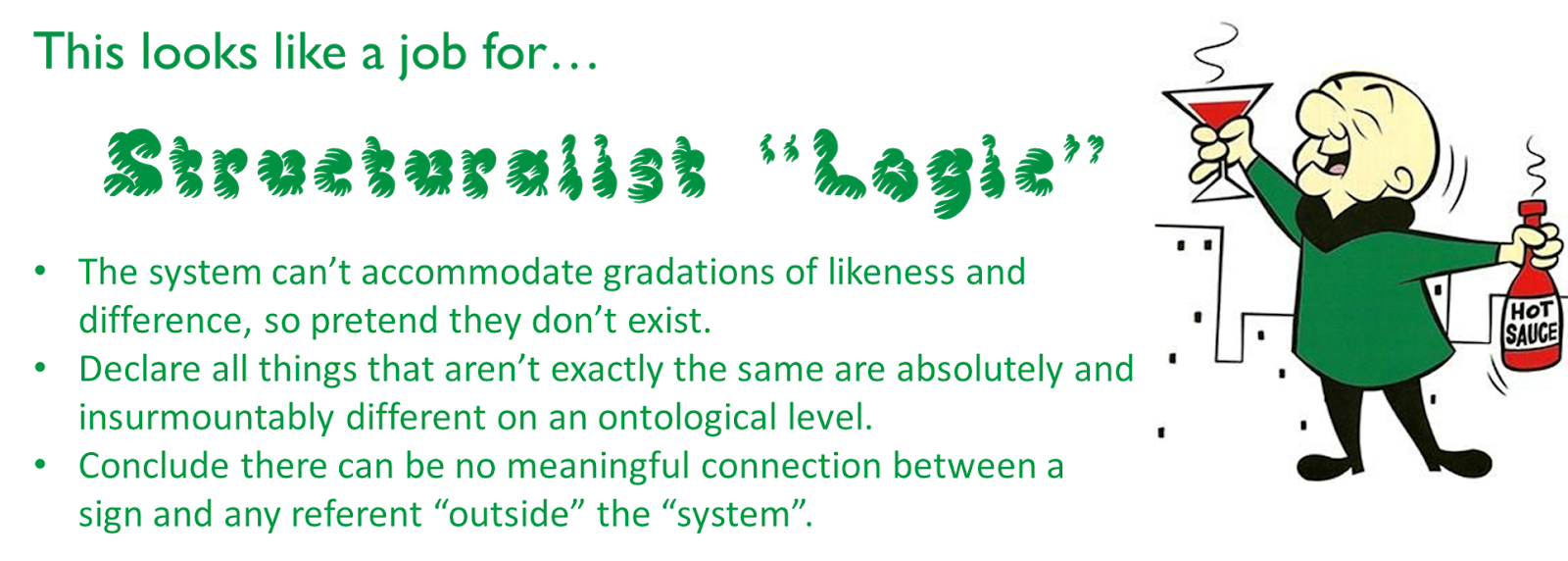
Philosophically, the Postmodern drive for empowering meaninglessness gave us "theory," where the full range of actual discursive tools developed to extend human understanding can be reduced to empty pages of unreadable text. Politically, the wonder of human biodiversity was jettisoned for a soulless consumerist monoculture where you can “express yourself” by the color of your iPhone case. Look how Postmodernists responded to linguistic inteterminacy – not by calling for better hermeneutics, but by denying the possibility of meaning at all. How is this a normal, healthy reaction to the abstractions inherent in communications? Short answer: it isn't, but leveling categories and blocking external verification is what empowers their Orwellian inversions of language:
 |
There are at least two levels of displacement hiding beneath the notion of the discursive construction of reality that make the act of writing Postmodern theory especially nonsensical, but also makes the nonsense harder to pin down.
The first of these is the translation of reality into structures of discourse, which are the large categories or domains of all kinds that define human existence, such as “science,” languages, religions, social customs, disciplines like philosophy, and so on. This allows the “theorist” to claim mastery over the subject in question without actually knowing anything about it, and is the source the ludicrously ignorant critiques of things like logic being racist or sexist. One need not understand, or even be capable of understanding, the internal consistencies of symbolic logic to dismiss it “discursively.” Identity grievance narratives are excellent popular examples of how Postmodernism appeals to the simpleminded while empowering grifters and storytellers.

Ladies and gentlemen: Discourse. What could be more Postmodern than a quantitatively illiterate journalist quoting a quantitatively illiterate "professor' applying a non-existent conspiracy theory to math? At least only one of them is on the taxpayer's dime.
|
The second displacement comes from the claim to meaningfully comment on the discursive construction of reality in a book, which, as written text, is itself a subset of discourse. As a signifier, text has been dismissed as arbitrary, imprecise, and bereft of external meaning since the structuralist movement of the early twentieth century. Yet how would people know that they are merely ampules in a vast system of endless representation if other ampules didn’t write daring and challenging tomes to tell them? This recent (Oct., 2017) offering "revives" poststructuralist theory "show how useful it is in the current century in opening the minds of students to the dangers of claiming to have a fixed identity."

To summarize, subjectivity trumps biological reality because Derrida and friends claimed discourse is meaningless, but selective interpretations of an idiosyncratic reading list reveals a fundamental flaw in the human condition, while a clever take on Maya Angelou blazes a trail of personal restoration.
The false assumptions are so layered so thick there is nothing to engage. They are literally making this stuff up.
Let's consider the two levels individually and identify the moments of deception.
Texts and Semiotics
Postmodern theory dismiss binary distinctions as artificial, but from the moment of entry into the world human existence is defined by a fundamental rupture between internal thoughts and sensations and an opaque external ebvironment:

Salvadore Dali, Geopoliticus
Child Watching the Birth of the New Man, 1943, oil on canvas, 44.5 x 52 cm,
The Dali Museum, St. Petersburg, Florida
We build sign systems as a way of trying to bridge a gap that cannot be bridged because we can never bring the fullness of the outside world and the people in it into our consciousnesses. Yet at the same time, we must accommodate the reality that our environment shapes our development while our actions influence our surroundings in turn. We all know that these systems don't pretend to be what they represent; they are just abstract constructs to organize and make sense of the incomprehensible array of things that are not us.

Distinctions in the natural world are often indeterminate but meaningful. As this spectrum shows, the world doesn't fall into tidy categories. We can identify specific color bands, but the boundaries between them are vague and indeterminate. does this mean that "Blue" could be anything?
Why should human categories like self and other be expected to conform to a higher standard when they are realized materially in the natural world?
Postmodern attacks on independent (Cartesian) human consciousness are of a kind with their opposition to binary divisions and categorical systems in general. Individual writers vary widely, but the gist is that categorical distinctions are never absolute, so the categories are not meaningful, and they all share the same goal of destroying autonomous human agency:

 Deleuze, Foucault, Derrida. Funny how image-conscious these deniers of agency were. Almost as if their didn't entirely believe their own tripe...
Deleuze is a difficult figure because his work is so non-linear and fragmented; insanity as a metaphor for the Postmodern condition, and the self/world distinction merely endless, recursive inflections of the same essence. There may have to be a post on him.
The discourse/reality clash at the heart of Postmodern denials of subject-object relations is built on a fundamental misconception of the semiotic systems (sign systems, or things that mean things to people) that we use to mediate the gulf between our self-awareness and an "external" world that we do not have the same degree of mental access to. External is not in quotation marks as a Postmodern evasion, but to point out that even if one accepts self and reality to be inflections of the same discursive matrix, the inflection senses and feels what it understands as "self" differently from all else. This misunderstanding originates in a self-crippling logical inversion within the structualist origins of the Postmodern understanding of sign systems. In fact, one might call it another Trace that hollows out the foundation of the whole enterprise.
Structuralist linguist Ferdinand de Saussure
characterized the sign as a mediating element between viewer and world that is completely autonomous, meaning it has no essential connection to the thing that it represents. As the diagram shows, it is an arbitrary symbol or grapheme that triggers a thought in the mind of the reader or viewer.

While Saussure claimed to be writing a general semiotic theory, his concept was fundamentally linguistic in origin, and marked by his structuralist's adherence to rigid conceptual maps over lived experience. From this perspective, the difference between the sign and the thing it represents, or referent (not the signified, which is in the mind of the viewer) is "problematic," to use a Hall of Fame Postmodern adjective. In fact:
Let's look more closely at Saussure's sign.

The diagram is helpful because it shows how the structuralist sign as an entity contains an arbitrary component (the word Tree) and a subjective component (the impression in the reader's mind), but no objective component, or reference (real trees). If sign systems develop to bridge the gap between ourselves and the world, there is no recognition of that within the concept of the sign vehicle itself. The mediator is absolutely detached from the mediated.
Also, where is the viewer? We can see their subjectivity in terms of a concept evoked, but the sign includes no more connection between the thought-picture and the thinker than between the word and real trees in the world. From this perspective, it is easy to characterize the signified as another element in a linguistic-type structure: the set of mental pictures and associations that you select to pair up with the signifier, or tree. Thought pictures and concepts are not as rigid as linguistic entities, but they still operate under the same structuralist logic of a closed system, cut off from any significant relation to an external referent, and distinguished only by their differences from each other. Rather than "mediating," Saussure's semiotics are purely arbitrary and subjective, hermetic sets of self-referential signs that have no way to offer any real connection with between individuals and the exterior world. This is the forerunner of the Postmodern obsession with subjective, meaningless discourse.

Yet from the moment of self-awareness, we have to make our way in and around things that are not ourselves.
Michelangelo, The Creation of Adam, 1509-12, fresco, Sistine Chapel, Vatican
Nineteenth-century American Pragmatist Charles Sanders Peirce proposed a more organic, empirical system that incorporates the process of mediation within the concept of the sign itself, and considers many more forms of signification. For Peirce, both the referent and the bebolder, or interpretant, who makes sense of the sign are included.

Rather than beginning with a top down structure like Saussure, Peirce built up by observing how people interact and interpret signs in reality, and while his
system is an abstraction of his observations, it is secondary to the human experience it draws from. This allows him to look beyond linguistic models and consider semiotic relationships much more broadly. He actually identifies three types of sign:
 |
The structuralist concept of sign is limited to the symbolic category, or what Peirce calls arbitrary signifiers. Saussure completely misses Peirce's motivated signifiers, the icon, which represents by shared character or likeness, and the index, which, like a clue, is evidence of something that doesn't resemble the referent, but isn't arbitrary either. Icon and index can function without interactions
with others, or the construction of abstract representational systems. Not touching a hot stove more than once is a fine example.
Comparing the models directly fully reveals the dehumanizing nature of Saussure’s
formation:

The structuralist removes mediation from any meaningful relationship from the things mediated; it is an autonomous system that abides by its own internal rules. But it is also the only way we have to understand the world and communicate with others.This means that everything we think, say, do, believe, understand, etc. is subordinate to the operations of an alien, mechanistic structure without meaning beyond itself. The system comes before the human. With Peirce, the world (referent) and beholder (interpretant) are instantiated within the sign-vehicle itself, and the "system" is relegated to its proper place as a human creation, not as the creator of the human. Saussure, in his desire for mastery, puts the cart before the horse. Pierce
diagrams a process of making your way in the world, which is not a fixed structure, but an cumulative journey that is NECESSARILY
incomplete and abstracted. Which more closely approximates human development, both on the individual and societal levels?


Thomas Cole, The Voyage of Life: Childhood, 1842, oil on canvas, 134.3 × 195.3 cm, National Gallery of Art, Washington
Unfortunately for the descendants of structuralism, we do have a broad understanding of the development of language, and all signs point to human experience coming first. There are two basic explanatory frameworks that I will call supernatural and evolutionary for simplicity. From a supernatural perspective, language was given by entity beyond our realm of experience. Religious accounts tend to land here, as do more outre fables of extraterrestrial or extra-dimensional intervention:

Adam Names the Animals, 12th century mosaic from the south cupola, west arm of atrium, Basilica di San Marco, Venice

Abstract language systems developed from mimetic, associative representations. The Sumerians were the first, but Egyptian hieroglyphics and Chinese pictographs followed a similar evolutionary patters not that long after.
The history is not a secret, but is it easier to pontificate in ignorance from a theoretical safe space than to do the hard, and often unrewarding philological, archaeological, and historical research, where the reality of the limits of knowledge is humbling.

The Rosetta Stone, granodiorite, 112.3 × 75.7 × 28.4 cm, with Egyptian hieroglyphs, Demotic script, and Greek script, 196 BC, discovered 1799, British Museum
If language systems lacked common referents, how is translation possible?
There is one final problem with the semiotic assumptions of Postmodernism: the false axiom that all signs are necessarily imprecise, and that internal concepts cannot be accurately transmitted between individuals. Remember Saussure's sign vehicle contained only the uncertain interaction of subjective thought pictures and arbitrary signs. When poststructuralists addressed the fact that structuralism is a static system and can't account for evolution in time, they kept the misconception that sign systems precede their creators and that difference, rather than analogy, is the basis of communication. Deconstruction was based on the idea that words are not transparent, and that even if you speak a common language, there is no way to be sure that you and your interlocutor are using a word or phrase in the exact same way.

No, it's not Foucault, it's Professor X, the popular telepath from Marvel's X-Men comics and movies. If Postmodern logic is correct, "true" communication, meaning a perfect transmission of something "external" between discursively constituted subjectivities, would require supernatural means. Because the communications and the subjectivities are built out of semiotic systems that ultimately signify only difference.
It is interesting that Postmodernists have little to say about mathematical notation, which is an abstract semiotic system with its own characters, grammar, syntax, and linear notation that is much closer to textual language than it is to the likes of Peirce's icon or index. However, numbers also have a very different sign-object relationship than linguistic signification.

History’s greatest painter meets history’s greatest philosopher:
Raphael,
Aristotle, detail from The School of Athens, 1509-11, fresco, Stanza della
Signatura, Vatican Palace.
Perhaps the most important thinker in history, Aristotle’s achievements and influence are too vast to summarize. He recognized the difference between mathematical entities and other categories over 2200 years before the first structuralist misunderstood his first semiotic relationship.
One of Aristotle's insights was to divide the world of human experience into broad “categories” to better analyze and understand the seeming chaos of existence. He placed numbers under the category Quantity (in the subset Discrete Quantities), which he noticed were unique for being absolutely distinct (non-overlapping) elements that are complete and unchanging in themselves. Add any value, no matter how tiny, to a number, and the number becomes something different. Because of this, only quantities can predicate equality and inequality; only quantities can be determined to be precisely and absolutely equal or unequal to another quantity. Comparisons within other categories will always include the tiny variations that structuralist semiotics redefine as absolute difference. For example, two marriages (Category: Relation) or two stones (category: Substance) may be extremely similar, even practically the same, but not absolutely identical. Quantities are different; 10 is precisely 10 every single time, or it has no claim to being called 10 at all.
These are substantive observations about quantitative entities that Postmodernists ignore, but constitute the foundation of all subsequent developments of symbolic logic, including the mathematical sciences behind the appearance of this post on a computer screen. There are two main reasons for this disregard: quantity relationships represent a fundamental challenge to their Postmodern assumptions about the nature of sign systems, and math is hard.

Like any arbitrary sign, the shape of a specific numeric character is unimportant; arbitrary signs are consensually determined. but once agreed upon, the relationships are absolute and unchanging. These signs all represent twenty-seven in (clockwise from top left) the Arabic, Babylonian, Roman, and Mayan systems. Two are base 10, the Mayan system is base 20 and the Babylonian base 60, but these four characters all represent exactly the same value, with no variation. They are perfectly translatable across vast historical and cultural divides.
Mathematical relations represent concepts that are abstract, but are perfectly knowable, replicable, and transmittable in themselves. The choice of signs is arbitrary, but they are transparent in ways that linguistic signs are not. Specifically, the polysemy, or multiple shades of meaning, that make words indeterminate or ambiguous does not appear to apply to numbers, nor do the shifts over time that cause languages to evolve.

Oxyrhynchus papyrus (P.Oxy. I 29) fragment from Book II, Proposition 5 of Euclid's Elements, ca. 100 AD
Euclid determined his postulates, or axioms, in the 4th century BC. The first four hold today as written.
Euclid calls attention to the mathematical learning process, which is discursive, in that it relies on an arbitrary semiotic system, but seems to progress in mysterious, almost mystical, leaps as explanation suddenly becomes insight. Mathematical referents, or Quantities, in Aristotle's terms, are abstract, or conceptual, in that they do not exist as tangible objects in the material world, but they are clearly "real' in that they can consistently predict material outcomes. The moment when a math student "gets it" is unpredictible, and will occur at a different instant for each member of a class.

Raphael, The School of Athens; detail, Euclid and his Students, 1509-11, fresco, Stanza della Signatura, Vatican Palace.
In this passage from perhaps his most famous work, Raphael demonstrates the mathematical learning process with his characteristic compositional brilliance. Here Euclid, modeled after Raphael's friend, the great architect Bramante (the collection of artistic talent in Renaissance Rome is literally mind-boggling) demonstrates a proof to a group of students. We trace the arc of dawning realization in a sweeping, fluid curve from the engrossed boy in pale blue first struggling to understand, to the boy in green who looks up as he begins to "see" (note the almost mystical expression), through the self-assured boy leaning in who now understands, and into the celestial globe that signifies the abstract universal knowledge conferred by Euclid's teachings. Meanwhile, the confident student in the green tunic who leans in has clearly already mastered the lesson, and follows along, ready to offer a helping hand to his junior fellows like a classical TA. The fluid grace of the composition masks the strict geometric structure, making what is essentially a conceptual diagram seem as natural as a conversation.
A leap to abstract knowledge that can be perfectly replicated and endlessly retransmitted essentially disproves the semiotic foundations of the Postmodern concept of discourse, if that mattered in a world where logic, like math, can be written off as sexist or racist, discursively. Perhaps mathematical notation can further "problematize" the notion that difference precludes a meaningful relationship:

An average is a repeatable process within an arbitrary semiotic system that simplifies a group of numbers into a single term that may be different from all of them, but is intrinsically connected to them as a group in a meaningful way. No matter how large the group becomes, the average retains this connection. It is abstract and incomplete (all semiotic mediation is) but it is neither random nor autonomous.
It is obvious that the very building blocks of Postmodern discourse are rotten to the foundation.
Semiotics and Discourse
At this point I want to look more closely at the second displacement noted at the beginning of this post: the replacement of reality with discourse, but the semiotic/language issue proved lengthy enough, so I will deal with discourse more thoroughly in the next post. It is worth taking the time to address these foundational issues closely before moving on.
In the meantime, some deep questions from Judith Butler, both as a reminder of where the slippery slope of discourse leads, and as an insight into the torments I've endured acquiring the background to write these posts. Because when Luce Irigaray poses the question...


