Showing posts with label Prometheus. Show all posts

Sunday, 8 March 2020

Prometheus and the Occult: Modernism, Postmodernism, Prometheanism


Constantin Popovici, Prometheus, 1965,  Vidraru Dam, Romania

If you are new to the Band, this post is an introduction and overview of the point of this blog that needs updating. Occult posts like this one - posts on the history and meaning of occult images - have their own menu page above. All  posts are in the archive on the right. 
Comments are welcome, but moderated for obvious reasons. If you don't see it right away, don't worry.


The last few occult posts have been looking at Prometheus. It's been a long historical journey because he's an old figure with a lot of associations.

Now it's time for modern Prometheus. Not just to recap the symbolism, but to consider a fundamental inversion at the base of modern thought.


No one really believes in Prometheus anymore, and the elites don't care about Classical culture and history. But Prometheus has become a modern symbol that ties into the de-moralized luciferian occult that plagues contemporary culture. We can even call it Prometheanism. Start with the lessons we have learned about the historical Prometheus and see what made him such a compelling symbol.

The myths have no fixed form - just general associations. From ancient times the Prometheus story had different parts that could imply different things. These include the creation of man, the education and enlightenment of man, rebellion against the gods' authority, and punishment for pride and hubris. When we take these together, we get more of a set of possibilities than a single character. So later people can use him for different purposes, even contradictory ones.


Alexander Kapralov, Monument to Prometheus, 1998, Orlinye Skaly (Eagle Rocks), Sochi

If the story focus on creation and education, he is a symbol of knowledge and progress. If it ends with his torture, he is a cautionary tale about overreaching. If it ends with his deliverance, it becomes the triumph of human initiative and will. And so on. 

Like this Russian version where the titanic figure breaks his chains with no eagle or Hercules in sight. Modern Prometheus often stands for the idea of human overreach as a good thing - that we can somehow overcome our physical and socio-psychological natures by tech and will. And if this sounds like luciferian magical thinking, well the good thing about art is that you can make it represent whatever you want. Reality doesn't matter.


Renaissance Prometheus ties into human vanity. Prometheus was transformed from a mythical character to an allegorical symbol to be applied to humanity in general. He was already just a set of associations - this just detaches these from any ancient context and makes him applicable to any time and place. This symbolically subverts the traditional Western Christian understanding that objective, transcendent truths are known by faith and pretends that they can be acquired by our own power.


Hendrik Goltzius (after), Prometheus Forms Man and Animates Him with Fire from Heaven, 1589, Metamorphoses by Ovid, plate 2, engraving, Los Angeles County Museum of Art

You can see the conflation with Prometheus starring in a creation scene where the arrangement is very close to Christian versions. The visual connects the two in ways that the stories do not. 


There were two parts to this Renaissance subversion. The first is seemingly innocent - that ancient culture was better, so it offered lessons that Renaissance Italians could use to improve their lives. But these lessons included a boatload of metaphysical nonsense that vain court sycophants humanists claimed on their own authority could modify and improve things that are by definition beyond our natural limits. And with this move, raw human desire starts to masquerade as objective truth - an intellectually monstrous inversion that will have terrible consequences. With Prometheus as a symbol.


Jacques Réattu, Prometheus Raised to Heaven by the Genius of Liberty and Protected by Minerva, 1792, oil on canvas, Musée Réattu, Arles

"Freedom" is an empty word that Enlightenment demagogues loved to throw around without ever really defining what it means in physical reality. Making Prometheus the centerpiece means that the "liberty" here is freedom from natural constraints through self-generated knowledge, or "wisdom", as represented by Minerva. As if things within the box can tell you what's outside the box.

Overreach - impossibly "escaping" an inescapable material existence inanely redefined as an "earthly prison" - becomes inverted. An impossibility - a lie - is transformed into not just a virtue, but a goal. The failure of the Enlightenment and the cultural wasteland that we inhabit in its wake was literally inevitable. You can't build on falsehoods and empty vanity.


In the modern era, soundly reasoned faith gets pushed aside and infantile magical thinking based on desire and vanity takes over. The Band has addressed this de-moralization in other contexts - click for the post where we explain the concept, and, if interested, for the post where we introduce it [the early posts didn't use the hyphen. This was added to differentiate the removal of morality from the lowering of morale]. The basic pattern is that advances in technology and knowledge are fraudulently presented as "proof" that humans can overcome their subjective, finite natures and reach transcendent Truths. This is the myth of Progress! - that we can endlessly improve in wealth, knowledge and capability in an observably finite system. It's so retarded it's irritating. But people are so drunk on their own vanity that they will propose patent absurdities like terraforming Mars rather than confront our objective limitations. Like this garbage:


Artist's concept of a terraformed Mars (left) and an O'Neill Cylinder; Artist’s concept of a possible Mars terraforming plant, from the article linked below.

Like this absurdity entitled "The future of space colonization – terraforming or space habitats?" from something with a name that suggests empirical rationality: physics.org. A good rule of thumb when assessing nonsense claims is whether or not the Science! is dependent on fantasy art to make its case rhetorically. It's amazing how much jibber jabber goes poof! when this test is applied. 

And as for terraforming Mars, consider that we can't terraform Antarctica. And space habitats? Watching them explode on the launch pad may provide some dark humor. But the real benefit of imaginary science is that you can imagine as diverse a team of imaginary scientists as you want...


We can see how we've stalled out now - burgeoning third world population, skyrocketing housing costs, education, media, and government replaced by webs of lies, perversion as mainstream culture. The list goes on The falseness of Progress! in human nature as a promise is obvious now.


Looking at current trends, a self-selected elite living apart and off of teeming struggling masses looks more realistic. Though even this fails to account for the massive population reduction that would follow the collapse of widespread advanced infrastructure and logistics.


But it wasn't obvious to the turds in the Enlightenment who thought that their little theories could usher in Utopia. And when it quickly became obvious that they couldn't, it wasn't obvious to the fresh turds who declared everything subjective and ushered in Romanticism. And now the collective delusional vanity is such that modern turds actually will argue that that the limits imposed by human subjectivity means reality is unreal rather than admit that there are things out there that are beyond us. At which point irritating becomes pathetic and then self-destructive.

And so we get to modern Prometheus.


Ossip Zadkine, Prometheus, 1956, bronze, Paris

Like this ugly, late Cubist mess. Modern art is an expression of the modern Promethean perspective on culture - rejection of wisdom or legacy from the past for the deranged fantasy that we simply make up our future whole cloth. 

Humans are shaped by environment and genetic limits, just as art is a product of skill and beauty. The Promethean fiction is that we are "liberated" from external constraints - and empowered to do what we wilt. The result isn't pretty. Turns out just making up whatever we want doesn't yield much of value. 


We'll set the stage with Modernism's extension and antithesis, and a central theme in this blog. That is Postmodernism, and what it has to say about the nonsense claims that the Prometheans live on.


In the perfect Postmodern irony, the all the links on the site where this bit of Postmodern graphic design came from are broken.


An occult post isn't the place to get into the philosophical underpinnings of Postmodernism - regular Band posts are where we deal with that web of gibberish. It's enough for this post to point out the familiar characteristics - that there's no objective truth or meaning, everything is subjective, etc. What's important for us here is to distinguish the basic Postmodern conclusion that nothing is objective from the vile ideologies that make objective claims while professing to be Postmodern. Or post-Postmodern, if anyone gives a toss. Retarded fake belief systems like "social justice" are second-order effects - authoritarian scum taking advantage of the voids created when Postmodern cleaned out the old fake rules to introduce new fake rules of their own. Even the names - Post-postmodernism, meta-modernism, pragmatic idealism - are mentally-stunted faux intellectualism.


Simon Martin, Carlton, 2006, video, projection, colour and sound (stereo), Tate London

In practical terms, this distinction is irrelevant. No one cares if a cultural termite is a "true" Postmodernist or a "post" Postmodernist any more than whether a murderous thief is a true communist or democratic socialist. Or whether of not "the materiality of the object is subjugated to its historical context and cultural resonances" in a if a film of a bookcase taking up space in an art museum. They have to be opposed regardless. 


But the distinction is important if we want to understand what is going on, because any substantive cure needs a diagonsis.

If there is a Postmodern "logic"  it is oppositional. It both extends from and refutes the inane lies of Modernism that have progressively undermined Western culture for over a century. It is true that Postmodernity is anti-nationalist, anti-Christian, anti-human, and anti-truth, but in terms already laid out by Modernist anti-nationalism, anti-faith, anti-humanism, and anti-truth.

As an oppositional position, Postmodernism can't offer anything positive to replace the web of lies that it eviscerated. The nihilism of Postmodernism is specifically the destruction of Modernist faith, Modernist truth, Modernist objectivity, Modernist meaning, etc. It was the logical endpoint of nonsense Modernist claims - the demonstration that these claims were inherently fake and meaningless. If we call it a system of thought - which it really isn't - its conclusions are only relevant if we accept its Modernist starting point as a frame of reference.


Modernism sets the terms and Postmodernism deconstructs them. But deconstructing them is still taking them up - is still accepting the frame of reference that Modernism created. The answer to the Modern artists' claims of genius was "no you aren't". 


But in practical historical terms, the problem is that this is what happened. Our cultural institutions all did accept Modernist idiocy on faith, so when Postmodernism took a weed-wacker to it, there was nothing left to stand on. But the institutions continued as physical entities - buildings, staffs, budgets, etc. - so something had to fill the void. Modernism had already made our institutions anti-Western culture first and foremost - consider modern art, literature, social sciences, etc. The acceptance of Modernist ideology already meant that truth had been actively rejected. And an anti-Western, anti-truth orientation is independent of any one specific ideology, so Modernism could be expunged without changing this overall perspective.


Institutional carcasses aren't animated by arguments against Modernist idiocy. It's incoherent screeds in place of the now-debunked Modernism that share the same opposition to truth and Western culture. 


But the underlying vanity of Modernism isn't gone. If anything, it dominates our false beliefs that techno-utopias and state power can transform human nature. Put generally, Modernism is the objectively retarded claim that technical advancement gave humans access to pure objective Truth. That a never clearly defined "Reason" could define absolute laws of morality, control human nature, and unlock the secrets of the universe. The argument seems to boil down to this - logic is objectively true within it's own domain, and humans can perform logical operations like math, so "reason" gives us universal objectivity. It's literally that stupid, but incredibly seductive because it appeals to our vanity. And it's nothing new - Modernity just used new technology to supercharge it.


Gustave-Claude-Etienne Courtois, Adam and Eve, 19th century, oil on canvas, Musée des Beaux-Arts de Besançon

That somehow knowledge can make us gods is a delusion as old as the human species.


Compare this to the traditional West, where there are no human generated absolute "Truths". We acquire circumstantial knowledge through experience and draw conclusions inductively. Objective, transcendent, big picture truth are known by faith and applied to our circumstances deductively. These are the only paths to the respective domains. Empirical observation can't tell us anything about objective, universal, capital T Truths, and faith doesn't navigate the physical world for us.


Jadwiga Hawrylak-Grabowska, housing complex, Wroclaw, Poland. Built 1968-1973

From this perspective, Modernism inverted on both ends - it elevated our material impressions to the level of faith, then insisted that that fake faith determined the nature of the physical world despite empirical evidence to the contrary. Like this being an ideal way to live. Or pretty much any conclusion of the "academic" social sciences in general.


Postmodernism annihilated Modernist claims to absolute Truth with the sort of ease you'd expect, and revealed the fundamental inversion at the heart of it. Our language, perspective, formation, and context are all flawed, finite, and subjective. Our perception is conditional and our collective memory Swiss cheese. Modernism was the inversion of subject-object relations - contingent humans professing transcendent mastery. And none of this should cause a sensible person to even bat an eye.


Of course there is no transcendent truth available to our reason. Only a mentally-crippled Modernist ever believed that.

But where Postmodernism did become toxic is with how it replaced the Modernist nonsense in our dying institutions. Rather than returning to sound Western principles of empiricism and faith, it kept the Modernist lie that we master our own natures, even after destroying the arguments that that lie was built on. This opened the way to a fragmented and chaotic do what thou wilt - one where you could make up anything you want, and if you had institutional status, it was accepted as true. This was how chimera like oppression, hate, and diversity were simply declared articles of faith and replaced empirical observation and logic in in decision making. But there was no cogent reasoning - only whims enforced by state power. And the notion that power can force acquiescence to whims is neither modern nor postmodern.


Triad of Ramses II with the gods Amon and Mut, around 1270 BC, granite, Egyptian Museum, Cairo

It's as old as the first emperor claiming to be a god. 


And a quick note on deconstruction. The Postmodern argument against texts and images having objective meaning is often misunderstood and deliberately exploited. Obviously language is a form of reliable information transfer. We see that every day. 

What deconstruction shows that this information transfer is limited by the subjectivities of the language system and the people using it. It's not that there isn't meaningful communication. It's that the communication can't achieve pure, objective, transcendent Truth. We can't, so how could our tools?


Prometheus is the poster boy for the Modernist lie.

He was and remains, the pure symbol of human transcendence, in both Modern and Postmodern contexts. To the Modernists - the notion that human knowledge can overthrow the gods and usher in a state of rational perfection. To the Postmodernists - the notion that human striving and ingeneuity can impose our wills on an otherwise meaningless cosmos. But the irony is that in both cases, he is shaped by a fundamentally Christian thought pattern - just inverted in the typical Satanic way. This is the idea that humanity can fall or be saved, only fall and salvation are brought about by ourselves and not something external. And if that sounds familiar, it's because we're back in be your own god country.

To the Romantics, he symbolized the dangers of the human knowledge that the Enlightenment pretended would usher in a Utopia of pure reason. Our ability to bring about our own Fall, you might say.


Sir Luke Fildes, Houseless and Hungry, wood engraving from The Graphic, 4 December 1869

For example, those aspects of the Insustrial Revolution and Enlightenment that introduced the sprawling slum with new diseases and choking air.


Consider Rousseau - a pioneer of Romantic "thought" and a hollow gasbag with a knack for making up absurdities and selling them to other poseurs. His Discourse on the Sciences and the Arts (1750) [click for a translation], put him on the French intellectual map - the most intellectually overrated map in human history - for the "insight" that the advancement of human knowledge comes with a downside. He was typical of uni-dimensional Enlightenment darlings - a one trick pony whose one trick was empirically wrong. In this case, the idea that man in a "natural" state - without any trappings of civilization or technical knowledge - lived in a state of benevolent bliss. This is so stupid, so historically ignorant, that it is difficult to take seriously.

It is as if he saw a mythological Golden Age painting and mistook it for a true history.


Follower of Abraham Bloemaert, The Golden Age, early 17th century, oil on copper, private collection
The mythical "Golden Age" was a Greek fiction that was no more real than Avatar.


The inexplicable popularity of Rousseau has two factors: hollow nature of Enlightenment-era "intellectuals" and their place in the de-moralized naval-gazing academic world that followed. At a time when most people had to work hard just to make ends meet, this intellectual was were a small, incestuous group supported by parasitic aristocrats living off inherited wealth and others' production. Success had more to do with satisfying patrons and impressing gatekeepers than any real intelligence or meaningful contribution to human understanding. Which is why Rousseau's Discourse reads with such a blend of pomposity and banality - he was writing for a vain and vapid audience where pretense trumped insight.


Pierre Louis Dumesnil, La conversation de salon Couleur, 1739, oil in canvas.

It's hard to imagine a bigger crowd of self-promoters, poseurs, and gammas, than a French "salon". Modern academics love these collective ego rubs because they tended to be organized by rich, do-nothing women. Symbols of feminist enlightenment! All the sycophants like Rousseau would compete to be noticed by some self-proclaimed doyenne in a home she didn't buy. 


The level of thought that emerged from the salons is about what you'd expect, and intellectual minnows like Rousseau should have disappeared with the passing of time. But that's where Modernist institutional ideology comes in. Because the Enlightenment was declared fundamentally important to modern de-moralization, this self-appointed intelligensia became immortalized by later self-appointed intelligensia. It didn't matter if his idiocy was wrong, because it was held up as "important".

All you have to do is go to a search engine - Google Books, an academic database, a university library - and search for Rousseau. Here's Princeton's on-line catalog for example.


Look at the numbers. Literally thousands of books and articles wasted of a self-promoting fool who, if he hadn't existed, would have made no difference to human knowledge whatsoever. Though there is an outside chance that things would have been marginally better without the influence of his moronic blather. And consider this - the authors of all these books and articles aren't all idiots. Most were bright, hard-working, successful types with an aptitude for academics - the sort of people who could be useful to a society if productively engaged. Think of the aggregate brain power wasted on the endless recycling of Rousseau's asinine scrawl. One of many reasons why the modern university is actually harmful to society and needs to be replaced rather than reformed.

Prometheus appears on the frontispiece to the Discourse - Rousseau's first major work.


It's the fire bringer version of the character - he appears to be animating or enlightening a human figure - only there's a half-human satyr coming in from the right who isn't part of the story. And there is a caption underneath that says: "satyr, you don't know that". The text includes a description of the picture:
"It is easy to see the allegory in the fable of Prometheus: and it does not appear that the Greeks, who chained him to the Caucasus, had a better opinion of him than the Egyptians had of their god Theutus. The Satyr, says an ancient fable, the first time he saw a fire, was going to kiss and embrace it; but Prometheus cried out to him to forbear, or his beard would rue it. It burns, says he, everything that touches it."
First, he gets the legend wrong. It's true that the Prometheus story is has different forms, but in no version is it the Greeks who punish Prometheus for his gifts. It's humanity that benefits and the gods that punish. But Rousseau wants Prometheus to match his idea that the Egyptians disliked their god of knowledge Thoth, so he just makes something up. Same with the "ancient fable", which is neither. The message is pretty much his usual one - that Prometheus was the knowledge bringer, and knowledge takes us away from the blissful state of nature. He adds: "our minds have been corrupted in proportion as the arts and sciences have improved."

The first thing to note is the switch from the gods punishing Prometheus to the Greeks.


José Clemente Orozco, Prometheus, 1930, Fresco, 240 x 342 inches (610 x 869 cm), Pomona College, Claremont, CA

Mural that captures the idea of Prometheus, fire, and humanity as a closed circuit. No divinities required.


The whole inversion of modernism is based on pretending humanity makes its own fate, rather than existing in a reality that is outside and beyond our mastery. The luciferian inversion of what is rationally best described as "mortal" and "divine". That we can be our own gods.

Then there is the danger of knowledge idea. Apparently it isn't dangerous for everyone. Several years later, Rousseau explained the frontispiece in his “Lettre à Lecat” [taken from Thomas M. Kavanagh, Enlightened Pleasures: Eighteenth-Century France and the New Epicureanism (Yale University Press, 2010), page 120]:
“Prometheus's torch is that of the Sciences, created to inspire great geniuses; that the Satyr who, seeing fire for the first time, runs to it and wants to embrace it, represents common men seduced by the brilliance of letters, who surrender indiscreetly to study; that the Prometheus who cries out and warns them of the danger is the Citizen of Geneva.”
The "citizen of Geneva" is Rousseau himself - a "genius" who can see past the dangers of knowledge that seduces and burns the common man. He distinguishes between geniuses who are inspired by knowledge, likely to flatter his peers, while emphasizing the negative effects on humanity at large. Humanity makes its own Fall, but also possess the potential for it's own salvation. Just have to listen to genii like Rousseau.

It's the negative aspect of Promethean knowledge that will be the Romantic pattern. A modern mural visualizes this better than any Romantic era picture.


Harold Freedman (designer) and Tony Barese, Joe Attard and David Jack (mosaicists),  The Legend of Fire, 1980-1982, mosaic,  Eastern Hill Fire Station, Melbourne

The Melbourne Fire Brigade mosaic is an impressive bit of public art that includes the divine source of Prometheus' fire, but takes an otherwise pretty negative view of his gift


The lower panels tell the story - the left one shows both sides of the gift and the importance of firefighters in dealing with the negatives. What you'd expect from a firefighter mural.

But the right panel brings Pandora onto the scene and the fire is nothing but negativity and destruction.


A more straightforward Romantic era warning than Rousseau comes from Mary Shelly's Frankenstein (1818). It was even subtitled The Modern Prometheus. This refers to the famous scientist's creation of an artificial life that turns against him, killing those he loves before driving him to his own death.


Title page to the first edition of 1818

Victor Frankenstein becoming disgusted at his creation, frontispiece of the 1831 edition, engraving,  Colburn and Bentley, London 1831


Here, Prometheus is a reference to creation, and to knowledge in the Rousseau sense - as something that leads to a bad outcome. The idea is that human science will reach a point where it can replace what had been seen as divine - the creation of life - but the consequences will be deadly. It's a warning about overreach, about pushing past our "natural" place, and the consequences that will follow.

There's an almost endless number of stories on similar themes since - everything from new lifeforms to AIs - and the theme is always the danger of "playing God". Kind of ironic, since these stories always tend to be atheistic. It's almost as if the impossibility of creation ex nihilo is something even the most devout fingers in their ears and shouting retards can't help but sense subconsciously. Then again, the Modernism we're looking at is the inversion of divine creation.


An insidious contemporary version would be Ridley Scott's Pedowood trash Prometheus.


Prometheus, 2012, directed by Ridley Scott

This is a chapter in his Alien slaughter porn franchise - a long-running litmus test for moral emptiness. Here, the name refers to a spaceship piloted by a group of explorers seeking the "origins of humanity" only to be graphically butchered to titillate emotionally depraved modern culture victims the audience. Presumably the message is akin to Shelley's - don't overreach beyond your place or you'll suffer horribly like Prometheus - although there's really nothing linking the stories. At least as far as we can tell from summaries. The Band doesn't watch Pedowood slaughter porn.

This is the sort of fiction that is contrived to undermine the central place of humanity in creation - as made in God's image, and morally responsible for our own fate. By pretending we're second-rate offshoots of some other random species, it simultaneously denies that we're anything special while also lifting any spiritual responsibility. Created beings are what create life and the means of our own Fall. 


This is the Postmodern version of Prometheus. There is no dominant narrative of Progress! - just a random universe, but one where random sentient humanoids create life and we bring about our own damnation. The only thing that makes the "creators" important is that they created us - a purely subjective meaning to reality. But what none of these nonsense-peddlers ever address is the real physics problems that they space stories would need. This sort of creation story is utterly impossible just by the standards of the physical universe as we understand it. Simply the size of the power plant and the durability of atomic structures are sufficient to relegate this drivel to fantasy. But in the de-moralized world of idiot materialists, the materially impossible is preferable to the spiritually real.


There are "aliens"...


Gustave Doré, Lucifer, King of Hell, 1861–1868, engraving from Canto XXXIV of Dante's Divine Comedy, Inferno, by Dante Alighieri


They just don't come from space.


The more common modern Prometheus is superficially positive, but logically retarded and, not coincidentally, another bit of inversion. This is the symbol of man's limitless potential to challenge the divine and overcome limits with by the power of our intellect. This is the luciferian Prometheus - the firebringer that elevates us above our finite natures. And the punishment doesn't really factor in with this one. It's more fundamentally wrong than the physical impossibility of pushing a material lattice across interstellar space - the logical impossibility of infinite progress in a finite environment.


Maxfield Parrish, Prometheus, 1919, oil on panel, private collection

Parrish is a good artist. Here he captures the gist of this version of the Modern Prometheus. There is no punishment, and the figure of Minerva/Athena that represents divine wisdom in the myth has been added to the firebringer in the form of the symbolic helmet. 

Note how the torch of "divine" wisdom Prometheus touches names associated with technical and scientific Progress! He couldn't make the inversion of our place in the universe clearer if he slapped you across the face with it. 

We replace the gods through our own mastery of Promethean knowledge.


But this is the key to the modern symbol of Prometheus and the Promethian perspective. It is a rejection and attack on the basic Western understanding of human nature and salvation. It inverts the empirical and Christian notion that we are inherently flawed and require an external divine power to redeem us with an empirically false claim that we manufacture our own nature and destiny. The cautionary tales are that we bring ruin onto ourselves. So the implication of the positive version is that we'd be fine were we don't overreaching and do it right...

Consider: Kant called Benjamin Franklin the ‘modern Prometheus’ for his experiments with electricity and the use of scientific reason to control nature in the 18th century. Percy Shelley's Prometheus Unbound is dismissive of divine power and its hero the ideal man that leads humanity to a better state in the 19th century. Prometheus Books was founded by the same self-deifying buffoon that gave us the "Council for Secular Humanism" to publish self-deifying buffoonery in the 20th. A successfully cloned horse was called Prometea in the 21st.


LO Wenckebach, Prometheus, 1953, outside the Chemical Engineering and Chemistry building, Delft Technical University, the Netherlands.

Shimmying nude fire dancer lights the torch of knowledge above the entrance to institutional bloat. 


We will damn or save ourselves on our own power - not just in a technical way, but that our technological advancement will fundamentally change what we are. We are the gods that write our salvation or damnation. We hold the occult power over the universe. Or so the Prometheans tell us...


Prometheus relief on a house in Dresden-Neustadt, 1900

What was once a symbol of man's treatment by and rebellion against the divine has become man replacing the divine. 

Doesn't really answer how we got here though. But Promethean globalists pretend the past doesn't exist. Every day is day one, and every tomorrow is Progress! towards the the Utopia to come.


As if our technology isn't bringing us a surveillance state, cultural degredation, unhealthy diets, parasitic globalist grifters in government, lying media, social justice in education, and every other cancer that comes with centralization. We may eventually destroy ourselves, but you don't even have to look at the logic to see we're not saving ourselves. Just look at the pattern trajectory.

How's that IQ decline over time graph shaping up?


Design Toscano Prometheus lamp, replica of 1864 sculpture John Bell

Perhaps a Prometheus lamp could brighten up the objective degradation of the species.


Alternatively, ignore the logical and the empirical and just read Prometheus Rising (1983) by epic charlatan Robert Anton Wilson. Or don't. Infogalactic describes it as "an amalgam of Timothy Leary's 8-circuit model of consciousness, Gurdjieff's self-observation exercises, Alfred Korzybski's general semantics, Aleister Crowley's magical theorems, Sociobiology, Yoga, relativity, and quantum mechanics". In other words, the same old occult spray of symbols that we've been dealing with in these occult posts all along.

This would be the Postmodern version - no particular line of truth, just you making up whatever pastiche suits you out of whatever nonsense appeals to you. Instead of "human divine" wisdom making up collective salvation, subjective whims make up your own. Be your own god in a fragmented individual rather than collective way. So maybe don't read it. There's no truth to be found there. But then again, there is no truth to be found in globalist Prometheanism either.


Coming back to the Rockefeller Center where we started this journey, we can see the message in the golden statue more clearly now.


Paul Manship, Prometheus, 1934 gilded, cast bronze, Rockefeller Center


This Prometheus flies through the heavens carrying the gift of fire - no symbol of divinity or hint of punishment included. Placed in a prominent area in a complex built by and named for one of the architects of the modern beast system, it is the Modern Progress! version of the figure. This is made more obvious when we consider the figure visible on the building behind it - Lee Lawrie's Wisdom above the entrance.


Lee Lawrie, Wisdom, 1933, Rockefeller Center

Clearly a take on God the Father in the heavens, right down to the compasses that were an old symbol of divine creation [click for a post]. Only the creation is an abstract mechanical mess - the world of technological Progress! rather than any organic human existence. 

So the divine wisdom that Prometheus brings is the wisdom of the machine. Of human creation and ingeneuity. The collective message is that we are the creators of reality. And the globalist elites call the shots. 


Who are the Prometheans? The would-be masters of the world who seek to remake it in their own materialist, de-moralized image. To damn and save by their own means. To appropriate that which is logically divine to their own venal and contingent desires. In other words, the scum on the top of the globalist turd milkshake.

Maybe the best depiction of this collection of empty myths can be found in the Ukraine of all places - a statue where Prometheus teams up with another empty symbol of man claiming complete control over his nature and reality.


Prometheus and Statue of Liberty, Dneprodzerzhinsk, Ukraine

We haven't been able to track down the artist or date, but the symbolism is too perfect to pass up. Promethean wisdom is the path to "freedom". But freedom from what? Not globalist control. Not anti-human one-world fictions. Not fake morality, fake science, and fake institutions. Not censorship in the name of a Promethean agenda for everyone.


That's a good place to wrap, though we are going to have to look more closely at the symbol of the torch at some point. It's also worth considering if there is something in the Prometheus story that can be flipped around and turned against the occult masters of the world. But for now it's enough to see what Prometheus has come to represent.

We are finite, subjective, material beings. We are physically situated in a world of time and space that vastly outstrips us. It isn't a question of whether we "accept" that or not - it simply is. But we can pretend that it isn't, and in doing so tell lies that our surroundings aren't known empirically and our higher Truths taken on faith. It's wrong, it's inverted, but with enough wealth and power it can be forced by the elites through media and direct coercion. The lie is obvious when you need idols to fake gods to pitch it.


Wednesday, 19 February 2020

Prometheus and the Occult Pt. 4: Inverting Creation in the Renaissance.

If you are new to the Band, this post is an introduction and overview of the point of this blog that needs updating. Occult posts like this one - posts on the history and meaning of occult images - have their own menu page above. All  posts are in the archive on the right. 
Comments are welcome, but moderated for obvious reasons. If you don't see it right away, don't worry.


The last few occult posts have been tracing the figure of Prometheus from his ancient roots in order to understand his meaning in modern times. Modern Prometheus is a symbol of human vanity - specifically the fake notion of Progress! or the delusion that we can bank on endless growth and technical improvement in a finite environment. Or the idea that human intellect alone can make us masters over reality. A luciferian sort of figure, but without the identity confusion with Satan and more overt suffering at the hands of a divine tyrant.


P. J. Lynch, Lucifer the Light Carrier, 2011, watercolor

Lucifer is a Biblical one-off that seems to reference Satan and the Fall of the Rebel Angels. The idea of the bright morning star does align with the first among the heavenly host cast down for placing his own finite awareness above the cosmic order. Not much to build on, but a handful of wicked, decitful, and/or stupid have tried to take this passage and imagine him as something else. An empowering rebel who enlightens humanity. Prometheus the fire-bringer plugs into the same formula but without the need to explain away the satanic associations.

In this case, Lucifer/Satan is reimagined as a symbol of the objectively false myth that finite human minds can grasp transcendent truths about the nature of reality. Modernism was build on this gibberish. And look where it's brought us.

There is a reason why the Band is constantly looking not just at what we can know, but how. Liars will spout anything that tickles vanity. Assessing logic and argument is a way to smoke out  nonsense. Like morons who reject the Bible because they don't like it, but use it as a source for bits of information that they do.


Torches are an occult something that will get a closer look in the near future.

We also noted how the meaning of Prometheus changed over antiquity and the Middle Ages. There are basic parameters - the theft of fire, the creation of man, the bringer of knowledge, the torture by the eagle - but not all appear in any one account. Myths had no solid scriptural foundation so they shifted and changed even in ancient times. In later ones they were pretty much free-floating symbols to be used however the user wanted.


Giuseppe Collignon, Prometheus Steals Fire from Apollo's Sun Chariot, 1814, ceiling mural, Palazzo Pitti, Florence

Like this painting. It has a traditional Classical style, but changes the myth from Prometheus stealing from Zeus to stealing from Apollo. Probably because it makes for a more dramatic picture.


The last post looked mainly at medieval Prometheus, and how he became associated with pagan error. The euhemerist error - he was a real innovator who got mistaken for a god over time - and the theological one - divine creation was real but he didn't do it. These could be combined as well. But at the end of the Middle Ages, we saw the early humanist Boccaccio come up with a different take. Prometheus isn't the real creator, but he represents pre-Christian wisdom about the nature of creation.


Prometheus constructs the first man from a 16th century French translation of Ovid's Metamorphoses, Book I,  Oxford, Bodleian Library, MS Douce 117, fol. 9r.

Renaissance illumination where Prometheus creates man in a location that resembles the Creation in Genesis. A garden type setting, surrounded by beasts, sun and moon in the sky, the land and the waters, the firmament above... It's Ovid, but it would be easy to take as a traditional Creation of Adam painting without the labels.


The Christian attitude to the past was based on the notion that the Old Testament foreshadowed the New. That Jesus' new covenant was prefigured allegorically in the old Law. The thing about that though is that the Bible has a unique place in Christian thought. Once it was assembled into its final form, it's the closest thing to God's direct communique that we have. And the Old Testament is unique among pre-Christian sources for having this foreshadowing status.


Tree of Jesse Window with Reclining Jesse, King David, and Scenes from the Life of Jesus, from Swabia, Germany 1280–1300, pot-metal glass, vitreous paint, and lead, Metropolitan Museum of Art

The Tree of Jesse - a common medieval image - depicts Jesus' maternal lineage as a family tree. This one includes the Christian salvation foretold in the Old Testament ancestry. Note the prophets who did the foretelling with their prophecies between the larger scenes. 


It's a pretty interesting version. You can see how the artist integrated the tree trunk with the Cross to make the connection more obvious. 

The Ascension is also a nice touch, with just the feet showing as Jesus rises heavenward. 


The Old Testament is part of the Christian story. The Christians were the people of the Old Covenant who recognized Jesus as Messiah, while the pharisees and their followers were those who didn't. The notion of bringing the word to the Gentiles and opening up the faith came later - prior to the apostolic period, the gentiles are simply pagans. The last post looked at how the early Christian patristics dismissed their views as erroneous half-truths - at best poorly plagiarized from the Old Testament prophets and swept away by the Christian revelation that followed.

This changes in the Renaissance. Because some guys decided it should.

Seriously.


Michelangelo, Delphic Oracle, 1508-1512, fresco, Sistine Chapel ceiling.
Like the pagan Oracle of Delphi on the Sistine Chapel between ancestors of Jesus (left and below) and an Old Testament scene (right). Many of the early Christian writers promoted the idea that elements of Christian truth were uttered by the sibyls to prepare the gentile lands for salvation. But they are extra-Biblical and theologically not of the same status at the Hebrew prophets.


This post was going to overview post-Medieval Prometheus and see if we could get to modern times. But looking at the Renaissance made us aware of a certain pattern of inversion that is not obvious on the surface, but is fundamentally satanic. And since the point of the occult posts is to dig into how evil works, it seemed worthwhile to look more closely at this. We'll get as far as we can, but what matters is what Prometheus can show us about about deeper patterns of human error. And Renaissance Prometheus foreshadows a whopper in the inversion of the moral structure of the West.


Or we can sidestep the Lucifer identity crisis and jump right to satanic inversion. One that turns Prometheus into a secular replacement for sacred revelation, only rooted in human vanity and belief in self-deification. 

Literally putting man in the place of God. It's subtle - not as clear as it will become, but once you see it, the rest follows.


So how does this relate to the occult?

It is true that the occult simply refers to secrets, but simplistic definitions hide usage, and usage comes before dictionaries. When a modern person is referring to the occult, they aren't thinking about keeping the lid on a surprise party or hiding the Christmas presents. It's a kind of secret knowledge about the nature of reality behind the surface, and one generally connected to the supernatural in some way. Mainly using the supernatural to manipulate reality. It relates to esoteric, but more like a subset - the esoteric is broader and covers all sorts of bizarre "sciences". Magic, spiritualism, and demonology are typical forms of occultism. But they all share two key features:

1. some sort of inversion - moral, logical, and/or natural. The notion that the path to supernatural power or enlightenment is the inverse of what is empirically, rationally, or spiritually true. Satanist symbols are a particularly dull-witted illustration, where they just take things with Christian connotations and turn them upside-down or use things that Christians view as negative.

2. destruction of boundaries or distinctions. That things that are different "secretly" aren't. This is where it comes closest to modern secular materialism, despite it seeming like the two should be completely different. Both oppose distinctions and hierarchies for the myth of human empowerment to do what thou wilt. The differences are superficial - what boundaries to destroy, how to destroy them, and who gets the do as they wilt.

You can see both in this image:


Grand Rosicrucian Alchemical Formula from Museum Hermeticum Reformatum et Amplificatum, 1678, in Manly P. Hall. An Encyclopedic Outline of Masonic, Hermetic, Qabbalistic and Rosicrucian Symbolical Philosophy, San Francisco, 1928
The inversion is intrinsic in the concept that silly symbols allow humans direct access to the mind of God. It shouldn't take more than a few seconds to see how upside-down that is.
The denial of boundaries is connected - there's no meaningful division between the physical and metaphysical. But there's also the moronic "balance" - no ethical or rational ordering of different things. And somehow this leveling out of meaningful distinction is supposed to lead "upward"? The occult is as stupid as it is evil.


The Band stretches the boundaries a little because we look at the structures behind occult thinking, and this often brings us into more mainstream areas. Western morality is Christian, and from that perspective occultism is a subset of evil, which is founded on inversion. Not all inversion / evil is occultic - many secularists deny the existence of the supernatural, yet promote things that actively invert empirical observation and logic. The lines are blurry.

Purportedly materialist elites engage in occult-seeming practices like ritual and gematria. The abortion slaughter in the name of convenience is indistinguishable from a vast cult of Moloch from a distance. Popular culture uses occult images and structures with an unconvincing wink.


Like this gem from Taylor Swift. Idiots will defend this on grounds of creative expression. What they never answer is why, with all the creative options out there, does it always come back to inversion, perversion, and evil? To anyone seeking to wave this away, that isn't a rhetorical question.

Though the middle one does look more like bathroom distress...


This is why we focus on deeper structures rather than the impossible task of proving who "really means" what. Surface obfuscation is a big part of how liars lie. But by their fruits shall we know them. And the more fundamental the inversion, the more profoundly evil the occult secret.

So Renaissance Prometheus.

First of all, it is important to note that not all Renaissance myths had to have a moralizing dimension. According to this book by Dennis Geronimus, pleasure, in the imagery or storytelling were often the primary motivator of mythological pictures.


Titian, Danaë, 1545-1546, oil on canvas, National Museum of Capodimonte

The first of five versions the famous Renaissance painter made of Zeus coming to one of his many adulterous affairs in disguise. Other than the putative subject, everything about this is for visual pleasure. From the reclining nude to the rich colors and textures of the paint. "Humanism" as aristocratic softcore.


According to Geronimus the best examples combined both. The sensory appeal of an exotic, imaginary image and the intellectual stimulation of classical reference. He is writing specifically about 16th-century painter Piero di Cosimo, who we saw at the end of the last Prometheus post. Titian with his seductive nudes was a far more popular painter, but in the polite society of the earlier Renaissance, lip service still had to be paid to intellectual content.


Piero di Cosimo, Perseus Freeing Andromeda, 1510 -1515, oil on panel, Uffizi Gallery, Florence

Like this picture combining a good knowledge of the myth with fantastic elements and details.


You can already see the fruit of the pagan "rehabilitations" from the last post - the Ovide moralisé then Boccaccio's allegory - bearing their fruit. In the Renaissance, mythological idiocy from antiquity became a sign of culture and learning. According to Geronimus, the tales were a source of sensory and intellectual pleasure - entertainment, plus a way for windbags to impress a crowd of aristocratic parasites with their knowledge of irrelevant lies from the distant past. Though he puts it more gently. But really, what's the difference between that blend of spectacle and nonsense trivia and reactions to Hollywood today? Same mix of eye candy and ultimately worthless factoids - entertainment and fake erudition - to fritter away time.

And it's not the average person driving the occult...


An astrologer shows the future kings of France to Catherine de Medici, 18th century engraving from Eugène Defrance, Catherine de Médicis, ses astrologues et ses magiciens envoûteurs... Paris, 1911

Marie (1575-1642) came from the famous Florentine family and became Queen of France. Like most uber-elite of the day, she was a supporter of the occult. Her patronage of historic fraud Nostradamus included appointing him a Counselor.


Except there was one major difference between then and now: The Renaissance hadn't embraced inept stupidity as a pop culture value the way the modern version has. There was still a sense that being intelligent, learned, and capable were virtues. Just compare a talent like Leonardo da Vinci to the freakish products of Pedowood that are promoted as icons today to get a sense of the difference. So while our irrelevant diversions require no justification, the Renaissance's did. Which is why they had smart people writing justifications for their love of nonsense and we don't.


Not that we don't have people trying to justify it - commentary on entertainment is a vast industry. 

We're even told it has "career options".

It's just that they aren't smart.


Back to occult Prometheus in the Renaissance. Take a look at Marsilio Ficino - the preeminent Renaissance Neoplatonist and occultist who was prominent in the court of an earlier Medici. That is, Lorenzo the Magnificent (1449-1492), Catherine's great-grandfather who presided over 15th century Florence and had Ficino translating Hermes Trismagistus, Plato, Plotinus, and others, and setting up a "Platonic Academy".


Preface to Ficino's Latin translation of Plotinus’ Enneads, dedication copy for Lorenzo il Magnifico, illuminated by Attavante degli Attavanti, late 15th century, Florence, Biblioteca Medicea Laurenziana, Plut. 82.10, fol. 3r.

Ficino was at the center of the Neoplatonic revival in Renaissance Florence, translating many key texts into Latin for the first time. 

As a phiulosopher his goal was to integrate Christianity with this ancient "wisdom".


Ficino was a champion of something called prisca theologia, the projected fantasy that many ancient traditions prefigured Christianity. This echoes today amongst the unity of all religions morons who blather on about all traditions having "truth". Projected vanity may be a better description - since none of the traditions  claim to be complementary, one is literally stating that they know them better than they know themselves. That one can pick and choose what's "really true" from their dogmas despite likely never reading them. It requires a lot of making stuff up like the Renaissance humanists did.


Orpheus playing the lyre, surrounded by real and mythical animals, marble, Aegina, 4th century, Byzantine Museum in Athens

Like "Orphism" - a set of ancient beliefs based on the poetry of Orpheus, a mythical figure who descended to the underworld and returned. He was said to have invented the Dionysian mysteries despite not having existed. Then again, Dionysus didn't either. 

But this didn't stop Renaissance geniuses from lumping him with the other prisca theologia sages. 

And if this reminds you of modern pagan and unity of all religions occult LARPing - there is a pattern...


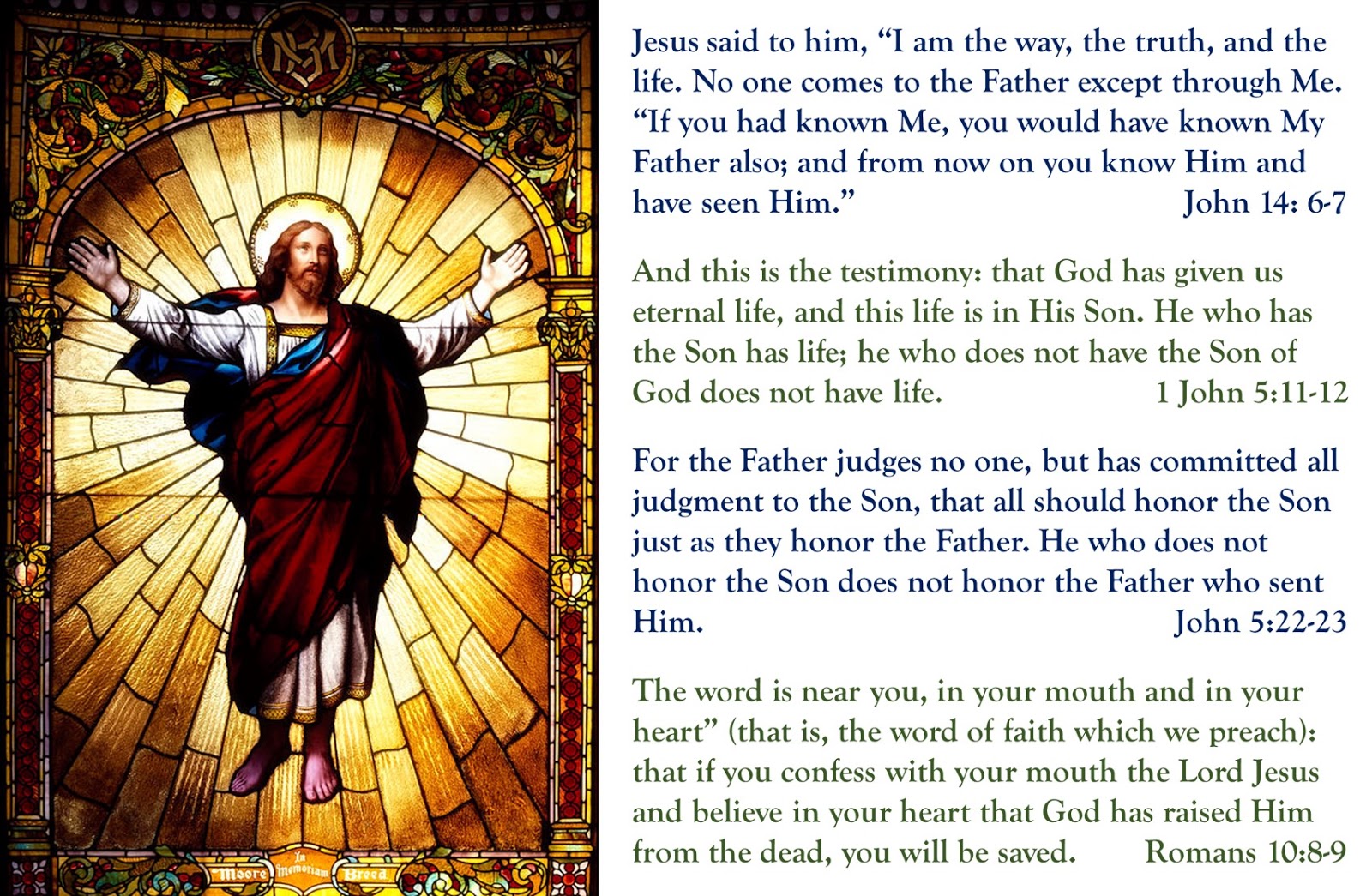
The Christian version of this arrogance is heretical in that it denies plainly stated Biblical claims about faith in Jesus Christ as the ONLY path to salvation from our fallen state. This is typical of the modern blasphemy of churchianity, where fake Christians elevate their whims and appetites over what is clearly expressed in the Bible. It's worth looking at a few quotes - not just for modern churchian solipsists who value desire over scripture, but for Ficino and the Renaissance prisca theologia fabulists as well.


Stained-glass window at the Neptune Society Columbarium, San Francisco
Readers are welcome to search for passages justifying Christian salvation by rejecting Jesus but being a good dude, or finding wisdom in the Buddha, or reading Plato. We won't wait, but feel free to post them in the comments when you find them.. 


Ficino wasn't blatant enough in his heresy to outright deny the necessity of Jesus in salvation while pretending to be Christian - but the roots of replacing scriptural truth with faddish whims were definitely there. Prisca theologia cracks open the door by replacing the unique historical relationship between the Old Testament and the Gospels and pretends that it is applicable to any scrap of pagan "wisdom" that seems to read like Christian revelation. Like the idea that ancient Greek oracles point to the coming of Jesus in the same way as the Old Testament prophets


Persian Sibyl, from Sibyllae et prophetae de Christo Salvatore vaticinantes, made in Tours around 1490, Munich, Bayerische Staatsbibliothek Cod.icon. 414

The sibyls are historically complex. Many patristic writers recognized them as having legitimately foretold the coming of Jesus. The problem is that their collected utterances - The Sibylline Oracles - only survive in a 6th-7th century edition, and are not the ancient Roman holy books that were burned in the 4th. Click for a link with excerpts. Infogalactic describes them as an "odd pastiche of Hellenistic and Roman mythology interspersed with Jewish, Gnostic and early Christian legend"

The early Fathers embraced them enthusiastically - likely because they were themselves former Roman pagans and pagan revelation appealed to them. They made a comeback with the Renaissance fetishizing of "antiquity". Like this lavish collection of 25 miniatures depicting them. While they have been called part of the Pseudepigrapha no canonical lists of any Church includes them.


Hermes Trismagistus was the poster boy for prisca theologia for at least two reasons, and his importance to Renaissance humanism and occultism was immense. Lorenzo de' Medici had Ficino delay his translation of Plato to get to Hermes. He is less well known now outside of idiot LARPer occult circles because his works were shown to be fradulent in the 17th century. Like the Sibyline Oracles they were actually based on the things they claimed to foreshadow. Idiot LARPers occultists claim that they're still really true, but that's why they're idiot LARPers.


Marsilio Ficino’s introduction (argumentum) to his Latin translation of the Corpus Hermeticum dedicated to Lorenzo il Magnifico, Florence, Biblioteca Medicea Laurenziana, Plut. 21.8, fol. 3r. 1491

Prestige texts in humanist circles like this would have a manuscript presentation copy for the patron long after the invention of printing. It was more of a work of art, while the printed books disseminated content. 

They're an attractive throwback to the old illuminated manuscript culture of the Middle Ages. 


Two reasons why Hermes was the poster boy for prisca theologia:

1. Renaissance humanists like Ficino thought he was incredibly ancient - the wellspring of Egyptian mystical knowledge and probably older than Moses. The whole prisca theologia tradition through Orpheus, Pythagoras, and down to Plato started with him. The appearance of Christian and Neoplatonic themes in something this "ancient" seemed to justify the whole Renaissance philosophy that the older the source the purer the knowledge. This let them build a tree going all the way back to the most distant antiquity - almost back to the Flood - off purely pagan sources.

2. He was fake. The Corpus Hermeticum was 2nd-3rd century AD forgery that resembled Neoplatonic and Christian ideas because it came after them. Even the "author" was a syncretic pastiche of Greek Hermes and the Egyptian Thoth - a figure that didn't exist historically before late antiquity. But to understand Ficino we have to pretend its real.


Hermes Trismegistus, 1480's, floor inlay in Siena Cathedral, Italy 

Popular enough to get floor space in a cathedral. It's the same attitude that put sibyls on the Sistine Chapel. It appears that the Renaissance could have used some fact checkers. 

It's a good piece of stonework, and Hermes looks appropriately exotic with his turban and odd robes.


The Platonic Theology - Ficino's magnum opus - was an effort to prove the immortality of the soul in Neoplatonic terms. It is historically interesting, but fundamentally un-Christian in that it relies on Platonic and Neoplatonic - Hermes and Plotinus mainly - arguments rather than the Logos of Jesus. Ficino's hierarchy from God through angelic mind through world soul into matter is more Gnostic than Christian. He himself shielded his arguments by downplaying the seriousness of them, but the effort that went into the Platonic Theology belies this.


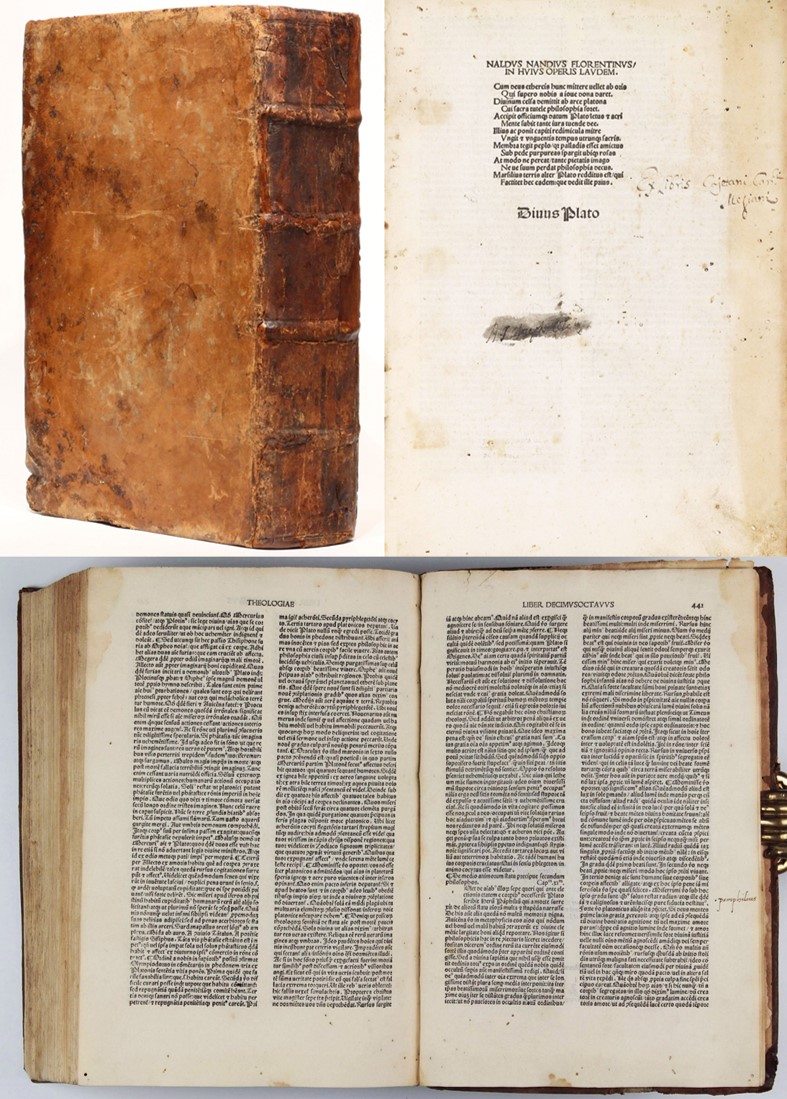
Second edition of Plato's Opera (Works) translated from Greek into Latin by Marsilio Ficino with Ficino's Platonica theologia de immortalitate animorum.(Platonic Theology of the Immortality of the Soul), Venice, 1491.

This shows the cover, the dedication to "Divine Plato" and two pages from the Platonic Theology,


So why is this relevant to Prometheus?

Because in Ficino's world of pagan "truth", mythic figures are allegories for real wisdom. And the "truth" represented by Prometheus reflects on Ficino's take on human nature.

For Ficino, the soul is the pivot between the material and the divine - it is drawn to the higher but embodied in the lower. In his thought everything has souls - not just humans - because souls are what animate and drive the material world. But he singles the human soul out as unique for its consciousness and ability to move up or down volitionally - by will.


Note the two things that we don't see in Ficino's Christian soul: Christ and faith.

It shouldn't need to be stated that the entire point of Christianity is that our souls can't fly to heaven on their own.


As he writes in his On Christian Religion - "the soul (as our Plato agrees) can fly back to the heavenly father and its native land with its two great wings (that is the intellect and the will)" and "the philosopher depends chiefly upon the intellect" while "the priest depends upon the will". He constructs a false dichotomy between "religion" and "wisdom" when what he is actually referring to is non-Christian dogma and Platonic philosophy.

Seeing this fraud base his fake Christianity on "disciples of wisdom and ... the caretakers of piety" brings us back to our opening remarks on the occult.  The inversion is replacing the need for faith - for God's grace - with purely human agency. As we've seen in earlier occult posts, will in particular is the luciferian path to spiritual ascent. Again, Ficino soft-peddles it, but we are looking at patterns - what opens the door to that dark fruit down the road. Even positing that will and intellect are the path to the soul's restitution with God is a fundamentally occult inversion.


Symbol and basic of law of Thelema

The primacy of will was central to Aleister Crowley's vision as well


Note that the Fall is also absent from this fraud's fake Christianity. From Crowley and the Luciferians too, but they don't pretend to be Christian. It has to be, because if he acknowledged our fallen nature, then will and intellect couldn't restore the soul to it's divine state. Instead he makes up his own fake reason - that it's the location of the soul between divinity and matter that causes its wretchedness. Embodied in a deceptive and dark material world, the soul "forgets" it's nature and sinks into depravity.

And we're back to the basic occult patterns that we started with:

1. Fundamental inversion. Christian metaphysics are based on the notion that we are inherently fallen. It isn't a choice - voluntary or involuntary - and can't be overcome by our means alone. This is why the Incarnation and Resurrection were necessary - to open the path that is otherwise closed.


Thomas Cole, The Expulsion from the Garden, 1828, oil on canvas, Museum of Fine Arts, Boston
Christianity 101: This isn't a suspension between heaven and earth, and there is no will or intellect that's going to reverse it. 


Ficino's fake metaphysics were reverse engineered to ensure humans were masters of their own fates - not just in this world but in the next. Which is fundamentally un-Christian and the satanic path of vanity and self-deification. To be fair, there is value in Neoplatonic metaphysics. They do a good job of mapping levels of reality. But their notion of the soul is opposite Christian salvation.

2. Elimination of distinctions and boundaries when "Christianity" is expanded at will. Not just the Sibyls, who at least had some standing in the early Church, but the whole gamut of ancient thinkers - including clear anti-Christians like Zoroaster and Mohammed and even fakes like Hermes and Orpheus. And once again, the driving reason is willful vanity and self-agrandizement. Ficino is a smart boy who read some books, antiquity is fashionable, and the money men like Humanism. So blow up the revealed Truth to be accepted on faith and replace it with dudes you think are cool.


Adolf Hirémy-Hirschl, Souls on the Banks of the Acheron, 1898, oil on canvas, Belvedere, Vienna


It's easy to see the coming of modern churchianity and unity of all religions idiocy.

But it's not Christian.


For Ficino and other Renaissance Humanists, Prometheus symbolizes the soul's quest for truth in the Intellectual realm. For this reason, he stands for the higher aspects of man, as opposed to his foolish brother Epimetheus, who represents the lower, animal aspect. The stolen fire keeps its connection to technical knowledge since Prometheus is a symbol of this more practical truth than a revelation of spiritual things. But it is still "stolen" because it is not innate to the material world, but the product of the higher functions of the soul.


Louis de Silvestre, The Formation of Man by Prometheus with the Aid of Athena, 1702, oil on canvas, Musée Fabre, Montpellier, France

The fire often gets paired with Athena animating the figure to represent two types of knowledge - the higher spiritual and more technical. But both are divine as opposed to brute matter. 


At this point, the Prometheus allegory has morphed completely into a positive symbol of human self-empowerment. It is set up for what will be the modern secular form of self-willed mastery over nature through technology when grasping materialism has replaced Christianity. Because once the metaphysical is removed from consideration, all that is left is technical knowledge in a material world. It's grotesquely inadequate to account for the human condition, but if that's all that's allowed to be discussed, that's all that's allowed. It's also why the modern world is circling the bowl culturally and ethically.


Paul Manship, Prometheus, 1934, gilded cast bronze, Rockefeller Center, New York

It remains a perfect metaphor on so many levels.


In Ficino's allegory, Prometheus' terrible punishment represents the consequence of the soul bringing divine knowledge into a less perfect material reality. Its immortal aspect can grasp it, but its material nature can't handle it. Remember, Ficino's soul is caught between material and divine and desires to escape the worldly prison and return to the source. This is the eagle - the agony Prometheus suffers after his theft symbolizes the suffering of the soul that "steals" this glimpse of the divine truth that it longs for, but can't get to.

And how does the suffering end? In the Prometheus story, it is when Hercules kills the eagle and releases Prometheus from his bondage. This symbolizes of the soul released from its material prison - through death - and returning to the divine.


Pat Foley, Prometheus Unbound, 1972, bronze, The Institute for Rehabilitation and Research, Houston


Consider the major moral dilemna that we identified in the ancient Prometheus posts about the nature of his rebellion. Was Zeus a wicked tyrant who should be resisted and Prometheus a moral hero, or was he a metaphor for divine authority and the rebellion luciferian self-interest? But in Ficino's version, there really isn't a rebellion because Zeus or Jupiter really doesn't factor in as a character. As the source of the fire he stands for the divine in a general Neoplatonic way, but isn't part of the allegory. It's purely the figure of the human soul torn between the divine gift of knowledge and material limitations.

Thinking about the modern Prometheus, we once again have an image of human empowerment in the guise of Christianity but where Christian metaphysics are conspicuously absent.


Pericle Fazzini, Crucifix, 1974, bronze, Vatican Museums

Like a "Christian" cross without Christ, as in this monstrosity by the artist behind the Pope's Satanic Throne in the Vatican. 

When we pay attention to patterns, it's easy to see where things that seem inexplicably terrible on the surface actually come from. And this is important in a world where so much seems to be going off the rails at once. Because as bad as it appears on the surface, one reboot can take care of it all.


A broader conclusion emerges from the technical quality of Prometheus' knowledge. Technology is a two-edged sword - especially to Renaissance thinkers captivated by ancient notions of the Golden Age. To them, the primitive state was one of innocence, and the wickedness of humanity came with civilization. It is historical nonsense, but consistent with a line of thinking that praised the Arcadian - a mythical, rustic earthly paradise of shepherds, nymphs and other mythical entities where none of the wars and other ills of civilized life applied.


Josef Rebell, Wooded Landscape with Temple, 1809, oil on canvas, The Princely Collections, Liechtenstein
This picture is much later than the Renaissance, but the idealized natural beauty, peaceful people, rustic temples and lighting that is both warm and distant all capture the spirit of the Arcadian Golden Age.


The boundary-blurring occultists of the Renaissance liked to pretend that this was an ancient version of Eden, but here too their idiot phantasy not only misses but inverts the moral/metaphysical point. In Christianity, man falls while in the garden. It isn't something "lost" in the sense that you can get back to - like getting back on a  diet or exercise program. It is a fundamental and irreversible change of state that can only be rectified through grace and faith. The technical arts are an aftermath, not a cause.


Harold Freedman (designer) and Tony Barese, Joe Attard and David Jack (mosaicists),  The Legend of Fire detail, 1980-1982, mosaic,  Eastern Hill Fire Station, Melbourne

From a doctrinaire Christian perspective, Prometheus is bringing fire from the heavens to those who have already fallen. There may be positive and negative consequences, but they are expressions of our nature and not causes of it.

You can argue that technology can make it easier to bring out our worst nature, but that nature is innate. 


Civilization isn't a choice in that sense - we squabble and die wherever we are. Urban life may be unnatural and suboptimal, but there is no going back to the Garden in this life - not by Prometheus, or even Woodstock.

The aspect of suffering through technical or civilizing knowledge also connects Prometheus to Adam in a weird way - since Adam's sin also involved divine knowledge and its terrible consequences. And here we see the problem with fake syncretic metaphors - Adam's will deliberately contravened God's command - the divine order. Promethean knowledge is only a glimpse of heavenly reward if you completely invert the message of the Bible. Adam's knowledge isn't a preview of a divine fate he longs to achieve - it was a transgression that cast him out of God's grace and deprived him of the divine forever. Or at least until the coming of Jesus, occurred many generations after his own death.


Albrecht Dürer, Christ's Descent into Limbo, around 1510, woodcut

The Harrowing of Hell is Christian doctrine - not universally accepted - that during the three days in the tomb Jesus delivered the righteous souls that had dies before him from Hell. This included Adam and Eve, who presumably had repented their primordial transgression.

Whether you accept it as doctrine, it's the only way the Fall could be undone.


If anything, the comparison with Adam highlights the inversion of Renaissance "Christianity" by calling attention to the uselessness of will or intellect in achieving restitution with God. Ficino's "wings" are broken in a true Christian sense, and only faith can bridge the gap. Will does have a supporting part to play in driving one to act on faith and keep the commandments, but it it is secondary.

With this in mind, lets come back to Piero di Cosimo's Myth of Prometheus picture before drawing a few final conclusions from the Renaissance version to set the stage for modernity. First, a quick reminder:


Piero di Cosimo, The Myth of Prometheus, 1515, oil on panel, Alte Pinakothek, Munich


The picture is one of a pair of paintings - spalliera - that would have appeared in a domestic space, like on a chest or a headboard. The symbolism is strange, but touches nicely on our look into Ficino.


On the left, Epimetheus is shown kneeling while Jupiter destroys his failed attempt at modeling a man. The ape behind him is a reference to imitation - aping - that calls attention to the difference between his creation and real man.

Note that Jupiter is dressed in the traditional colors and style of Jesus, while Epimetheus wears a hair shirt like a Renaissance John the Baptist. The stories don't line up, but Piero is playing with identity confusion between the Christian and the pagan.


In the center is Prometheus' successful figure - a noble bronze in a classic contrapposto stance.

This reminds us of the older notion of Prometheus as the inventor of the art of sculpture.


On the right, Minerva (Roman Athena) comes to Prometheus and takes him to heaven to retrieve the animating fire. Her flying version points upward like the statue in the middle to make a visual connection between them.

The figure on the far right struggling with a basket of spilled mushrooms has been interpreted as savage or ignorant man before the enlightenment of Promethean fire. It makes sense, but doesn't fit with a strict chronology - man in the center is still a statue.

Note that Prometheus also wears a John the Baptist-type hair shirt.


Piero di Cosimo, The Myth of Prometheus, 1515, oil on panel, Alte Pinakothek, Munich


The 2nd panel continues the story, starting with the theft of fire in the middle of the sky. On the left, Prometheus touches the fennel stock with the spark to the figure and transforms it to flesh. On the right, Mercury strings him to a tree rather than a rock ad punishment while the eagle waits. And in the middle, Pandora is created to further punish humanity.

The second panel works better as a sort of diagram


On the outsdes - the two edged sword of Ficino's divine knowledge as something that both enlivens and torments man. There is an inverted symmetry that strengthens the tie.


Up the center - divine knowledge in terms of the soul.

It brings about our divinity - Prometheus rising into the sky - and our ruin in the form of Pandora.


There are a lot of associations without a clear conclusion. The hair shirts portray Prometheus as someone who points the way, but he is also a creator and a Christ-like sacrificial victim. Jupiter appearing like Jesus, Minerva directly helping Prometheus, then Jupiter punishing him makes little sense. But Piero wasn't a philosopher, and it isn't as if Ficino was bursting with coherence. What we have looks like an impressionistic take on the humanist Prometheus - a mythical figure used to comment of fundamental aspects of human nature in a way that teases being Christian, but isn't.


That's enough Renaissance Prometheus. Coming back around to the basic occult patterns that we started with is a nice way to end the post. We'll close with a closer look at why this Christ-less, faithless salvation and syncretic acceptance of paganism is so fundamentally un-Christian.

Consider the Creation in Genesis. The Band is uninterested in blather over Priestly vs. Yahwist narratives - both are there, so both will be dealt with. Secularists who dither over where the Bible came from are less than useless. Of course it was written down by someone. And of course those someones used the language of their day. Noting that Genesis reads like something written in the ancient Near East is banal to the point of truism.


The Band writes in modern English. To fixate on that rather than considering our content is myopic to the point of retardation. And a bit insulting. 


Or more likely - in the case of the Bible "scholars" - a deliberate red herring to obscure the message for the less insightful. Anyhow, that's enough space wasted on the "secular" Bible scholarship a-holes.

The Creation accounts in Genesis are written is spare language with simple declarative sentences and little explanation. Genesis 1 is more cosmic, Genesis 2 more personal, but neither are what you would call rich in exposition. This makes sense, since they are dealing with what philosophers call ultimate reality - the absolute transcendent foundation of all that is or can be. We can label ultimate reality, but it is so far beyond us that it defies clear classification. The greatest philosophical minds from Aristotle through Aquinas through Kant through Heidegger all punted in the face of it - admitting either the necessity of faith or simply declaring it outside comprehension. To even try and narrate God bringing creation into Being means working in the simplest of images and descriptions. Nothing else is possible.

So how does it begin?


Ivan Aivazovsky, The Creation of the World, 1864, oil on canvas


And the earth was without form, and void; and darkness was upon the face of the deep. 
Genesis 1:2


The promordial stuff of Creation is a formless chaos. An indeterminate mess. And the acts of creation that follow share a fundamental quality - ordering. The rest of the Creation story is a series of divisions and classifications. The light from the dark, the land from the waters, then all the various forms of life, each "according to it's kind". Clear division and definition.


Tintoretto, Creation of the Animals, 1551-52, oil on canvas, Gallerie dell'Accademia, Venice


Genesis 2 defines a garden, outlines rivers, establishes what isn't to be eaten, and creates woman as counterpart to man. Adam names the animals - more definition, this time tying linguistic distinctions to the existential "according to it's kind" in Genesis 1. The serpent preaches the inverse - to break the boundaries and deny the definition - to be that which we aren't. But of course we can't. The order is divine, and the overreach a cruel trick.

Simply put: having knowledge of Good and Evil is not the same as being able to determine and manage Good and Evil.


Gustave Dore, Back to the thicket slunk The guilty serpent, around 1870, engraving for Milton's Paradise Lost

Good and Evil are moral absolutes beyond the scope of finite human beings. This was managed in a prelapsarian state by keeping man innocent within the Garden. 

Fallen man is faces with conditions that are beyond his limited nature. Breaking boundaries landed us in a condition that we couldn't get out of. Alone, that is. 


If Creation is making distinctions and separations, breaking boundaries and collapsing differences is anti-Creation. The inverse of the divine, both in us and God. Elsewhere we called it entropy. A regression to the primodial state of chaos that is fundamentally hostile to our very Being.


Antonio Canova, Tomb of Duchess Maria Christina of Saxony-Teschen, 1798-1805, Carrara marble, Augustinian Church, Vienna

Now compare Genesis to our empirical reality, where we are aware of ourselves as thinking, feeling entities apart from the world. Where our thoughts and feelings come from is irrelevant - more postmodern obfuscation to try and confuse clear lines. Of course we are conditioned by our surroundings. That's also banally self-evident. 

What matters is that we can only think and feel for ourselves. Our fundamental empirical reality as ourselves is predicated on distinction and definition. Dissolve that and we cease to exist. 


But look at the long march of modernity. Ficino's boundary breaking will give way to secularism of the Enlightenment, where humans claim absolute knowledge. Which will give way to our current state where do what thou wilt reigns in popular culture and fundamental distinctions are under constant attack. So when Prometheus comes into the modern world on a cloud of inversion and broken distinctions, it is fair consider him in an occult post.

The truly satanic comes next.


Yuri Bosco, Prometheus, 1975, Palace of Culture, Tolyatti, Russia


Most Popular Posts