
Second of three previews of our book about the Band's metaphysical insights. The first half of Chapter One with three of six preliminary axioms about what reality and our being in it are.
If you are new to the Band, this post is an introduction to the point of this blog that needs updating. Older posts are in the archive on the right. Shorter occult posts and other topics have menu pages above.
Comments are welcome, but moderated for obvious reasons. If you don't see it right away, don't worry. We check and it will be up there.
The last posting shared a draft introduction to the planned metaphysics book. It needs some work, but the feedback is appreciated. Instead of rewriting it now, we want to wait until the manuscript is done, whenever that is. And we do plan on resuming ordinary posts. There's something about the misuse of abstraction in "freedom" as an ideology that could use sorting out. And perhaps Cobra Kai. But for now, we'd like to present the first shareworthy draft of the first half of chapter one. The second half will be the next post. We don't plan on previewing the whole book here, but chapter one sets the stage for the more speculative work to come and does stand on its own as well. The idea is to establish some basic essentials about what reality and our being it in are. A point of departure for a flight into the Ontological Hierarchy and its levels of reality.

Gyuri Lohmuller, Through Time
The chapter starts by noting that modern society accessorizes rejection of coherent metaphysics with fragmented and contradictory beliefs about the nature of reality. As readers know, truth does manifest in different ways on different ontological levels. But the manifestations are ultimately non-contradictory.

Basic observation and logic lead to the necessity of our ontological foundations. Which is disastrous for the House of Lies. Best to keep people uncertain about their basic existential condition if you want to trap them in materialist distraction and ever-changing false narratives.
Without grounding in what we can know and how we can know it, anything can be peddled to the de-moralized FTS-2 masses. No book can change that - they're functionally a second species for a reason. But a lot of non-NPCs are caught up in the webs of lies as well. They can benefit from some clear thinking about basic facts.

These axioms avoid the tortured blather that beast academics offered up in lieu of rigorous thought - wrestling that tar baby precludes getting anywhere. See the introduction to the blog linked at the top. We do take some time to address the postmodern [truth is subjective] fallacy because it is so pervasive and culturally toxic. But what we really want to do is clear up what we can know about reality. That means end running around endless discursive noise. We don't care what "someone said" if it has no baring on the strength or legitimacy of the arguments and observations made here. Hiding behind Philosopher's Names is a game for the intellectually weak and timorous. Past time for empiricism and logic to step up as the only authorities that matter.
The second half of Chapter One will follow.
CHAPTER ONE: PRELIMINARY AXIOMS
It is necessary to establish a common point of departure before embarking on an investigation of the metaphysical aspects of reality. The neglect of serious ontological speculation in modern mainstream intellectual channels has rendered the topic unfamiliar to most contemporary readers. Furthermore, as post-Enlightenment secular materialism has failed to account for human being-in-the-world, collective understanding of what reality is and our place in it has fragmented. Proliferating discursive viewpoints from quantum physics to New Age occultism to critical theory and everything in-between have left the modern West existentially rootless. The two problems are related. Post-Enlightenment materialism has been the intellectual coin of the realm long enough for its false assumptions to be uncritically accepted as the default account of the nature of reality. False beliefs have little impact on what is real regardless of their popularity, but they do limit the ability to perceive things outside their purview. Many have realized that secular materialism cannot account for the human condition, but literally cannot imagine that the shortcomings are due to mischaracterizing metaphysics as “superstition”. With even the possibility of a full, coherent account of reality rendered unthinkable, random disconnected myths spring up to fill the gap.
Taking the time to lay out some foundational truths addresses the ontological poverty of the modern mind. Simple observations and logical conclusions cut through the clutter of unfounded dogma with a clear cogent account of what we can know about our being-in-the-world. The approach is a departure from the clouds of sclerotic “discourse” and philosopher’s names that have replaced sound reasoning in contemporary intellectual culture. Readers accustomed to labyrinthine webs of uncritical citations may find the clear definitive conclusions surprising. The modern west is so lost in the trees that circumventing the forest hardly seems possible. Until it happens. If we needed more evidence of the failure of modern philosophy, the inability to even describe the human condition would be a long-running exhibit A. Best to start on a firm footing.

1. Understanding is Cumulative
Building a conceptual map of reality with its metaphysical dimensions is not a linear process. It is better described as a classic hermeneutic circle, where conclusions must be presumed in order to introduce the concepts that lead to the conclusions.

The Hermeneutic Circle
This account of understanding developed in early Christian times for Biblical exegesis, but it applies to any composite entity. The name belies the simplicity of the concept. It simply means that the larger context determines the specific meaning of the units that make it up while the combined units determine the meaning of the context.
This captures the basic structure, but the reality of understanding is a little more complex. Otherwise there would be no capacity for progress.

The actual process is more of a hermeneutic spiral, where iterative analytic cross-referencing of parts and whole gradually refines understanding. It still presents a challenge, but a way forward emerges.
When A needs B to be understood but B needs A to be understood, where does one begin? Declaring a set of axioms to be preliminary is not a solution. Consider the representation-reality relationship of axiom 2. Discussing reality requires recognition that our understanding of it is representationally mediated. But discussing representation references the reality it represents. All we can do is jump in with as much precision as possible and realize that reciprocally defining concepts do resolve as understanding accumulates. Hermeneutic circles do backfill as the unfolding discussion retroactively illuminates initial usage. This places a burden on the reader to trust that developing ideas will clarify if the larger picture remains in focus.
2. Representational Filtering
This axiom refers to something obvious that has been treated as a radical discovery and distorted into socio-culture poison. Stated plainly, everything we think or know – or can think or know - about anything is representation. We have no direct access to reality in itself or reality qua reality. Representations of various kinds form meaning-bearing filters between [our understanding and/or awareness] and [things that we understand or are aware of]. The further removed we are from direct personal experience, the more levels of representation accumulate between us and reality. But even sensory perceptions of physical objects impose one representationally mediating layer. It’s physiological fact that raw sense data are different from the external objects that the senses register. This is not a novel insight. The history of Western thought is full of speculation on the connection between interior and external worlds.

Gerard van Gutschoven, illustration of the pineal gland in René Descartes' L'Homme (Treatise of Man), Paris, 1664
Descartes was objectively wrong about most things and offers little insight into reality. He continues to be cited in "learned" circles because of his place in academic discourse (see below). But this illustration captures the long history of speculation on interior and exterior relations.
All this axiom is concerned with how than the basic fact that the two are different. Stated plainly, an impression – inner or otherwise – is not the same as what it is an impression of.
According to the current state of knowledge, our sense organs transfer bioelectrical impulses to the brain where they are transformed into perceptual stimuli. Take the eye, the sense organ we lean on most. Seeing is believing as the old saw goes. Light enters though the pupil and strikes the retina, creating impulses that travel down the optic nerve to the brain. Here the signals are converted to actionable images.

Actionable meaning sense data that correlates sufficiently well to the thing seen to act on, to permit productive interaction with it. Picking up an item, for example, or walking through a doorway and not into a wall. Internal representations relate meaningfully to things-in-themselves but are not the same as them. Neural activity is different from physical objects. What makes this significant is that rudimentary biology is sufficient to demonstrate that reality qua reality is beyond our direct access.[1]
Representational filtering is concentric. Moving from direct sense impressions to conscious thought adds another layer of representation over internal impressions. Perception and cognition are not completely separable, since both are mental processes that engage each other. Observation provides material for thought, while thought gives meaning to observations. The difference is that observation creates internal sensory representations automatically and involuntarily while thought systematically and consciously processes raw sensory data. This introduces semiotics, the further mediation of the subject by transforming of the initial impressions (first layer of representational filtering) into formalized sign systems (second layer of representational filtering) suitable for systematic manipulation. Semiotic modes come in different types, each with their own properties, strengths, and weaknesses. But all of them - words, pictures, numbers, etc. - express the content of thoughts in standard representational forms. It is the semiotic aspect of representational filtering that explains why language has such a strong influence on thought patterns. Each language has its own internal rules, independent of subject matter, that shape information management and determine the form thought takes. Memory is the semiotic recreation of older impressions and thoughts in the present.
Communication with others makes semiotic mediation obvious.

Manmade sign systems - spoken and written languages, mathematics and symbolic logic, and visual conventions of all sorts - are necessary for transmitting anything to anyone else. It goes without saying that all these semiotic modes express subjects while not being the same thing as them. They are not even precise simulacra. The word “tree” is a sound or set of sigils that calls to mind a tree but looks nothing like one. And no word can make the hearer or reader imagine a tree that looks identical to the one in the speaker or writer’s mind’s eye. Saying “I went to the store” is not the same as the action of going to the store, nor does it replicate the experience of the outing for the hearer. “I’m tired” is not the same thing as the feeling of being drained or sleepy. And so on. The same applies to pictures or numbers. Each has its communicative advantages and disadvantages, but neither are ever what they represent.

Representational filtering is how we interact with each other and make sense of the world around us. No matter how precise we try to be, there is no way to reference things-in-themselves without representation. The architects of postmodernism spun the insurmountable gulf between our awareness and understanding and reality qua reality into dyscivilizational fallacies that will be addressed shortly. The ghastly consequences are more tragic for the irony. Lack of unfiltered apprehension of reality qua reality is irrelevant to human being-in-the-world because the alternative does not exist as an option, physiologically or inter-socially. One does not meaningfully lack something humanly impossible to have. It is true that representations are often deceiving. But our existence testifies to and depends on the ability of representations to correspond sufficiently well to their referents to enable the transfer of actionable information. When someone passes the salt at the dinner table when asked, access to the noumenal reality of salt qua salt is utterly unrelated to the enjoyment of the seasoning.
The coexistence of reference and difference intrinsic to representation can be summed up thusly: every representation is a representation of something. It is implicit in the term – “re”-presentation, as if present again. Every impression is an impression of something, like a footprint needing a foot to impress it. Every thought is a thought of something, even if that something is a complex concept understood through a chain of mediating signifiers. Representational filtering is cumulative in that the meaning of words and signs often refer to other words and signs and not direct experience. By the time you are exchanging thoughts with someone, the information is made up of multiple levels of aggregated representations, yours and theirs. What does not change is that representations ultimately refer to something, whether real or fantastical, at one remove or many.
The further removed from raw sensory experience, the more the layers of representational filtering aggregate.

Complex analyses involve too many representational inputs to enumerate. Even cursory consideration of the sheer amount of representation involved in human activity reveals scale and complexity that defies comprehension.
For what it is worth, virtual reality is another layer, a meta-representation of the stacked representations that make up human being-in-the-world. It is easy to see graphically.

The primary negative consequence of representational filtering is the possibility for deception at each level. Senses can be mistaken or fooled – eyewitness testimony is notoriously unreliable and there are many hallucinatory and delusional conditions. Semiotic communication is easy to misunderstand or misinterpret and creates the possibility of deliberate lying. Representational filtering is intrinsically susceptible to falsehoods because the representation is different from the subject even when truthful. False or misleading information is represented in the same forms as the truth and can be difficult to detect in the absence of further information. Especially from within a house of lies like the contemporary West has become. We are enmeshed in a symbiotic, vertically integrated structure of falsehoods all claiming truthfulness. Evaluating false claims is challenging when the whole information ecosystem is interlocking and false.
Many culprits share the blame for Western society becoming a house of lies, including the credulous masses victimized by it, but it could not have happened without representational filtering. Modern centralization deepened the layers of mediating representations in every aspect of society, pushing life ever further from reliance on direct experience. Our senses continue to produce internal impressions, but of false reality projected by all-encompassing legacy and social media. This inverts the natural order of referential reliability. One layer of involuntary representation – the internal impressions – is intrinsically closer to reality qua reality then a chain of manmade electronic semiotics of distant and unaccountable origin. Yet when the glowing screens contradict what is known to be true experientially or logically, the idiot masses opt for the screens.

There is nothing inherently reliable or unreliable in mediation. But positive correlation between representation and reality – the truth value - is dependent on the transmitter’s ethics. Ideally, he strives for accuracy, but there is nothing in semiotic systems to compel that. The trajectory of the modern West, with unaccountable powers burying national interest behind lies about freedom and “our democracy”, does not select for the righteous. When personal interest favors deception, some sort of internal moral suasion is necessary to impel honesty. This vitally important point for the metaphysics of objective morality will be elaborated in a later chapter.
Representational filtering has been surprisingly misunderstood or ignored for something so fundamental to the human experience. There was not even a term prior to the introduction of “representational filtering” in this study to describe the mediation in its fullness, voluntary and involuntary, in both truthful and false aspects. To be fair, the ubiquity does make it easy to overlook, so calling attention to it at the outset ensures that it will be accounted for. If the idea seems unsettling, it may be due to how simplified distortions of representational filtering were used to justify some of the most culturally destructive movements in intellectual history. All the postmodernisms that ravaged the 20th century derive from the false premise that the necessity of transacting with the world through sign systems means nothing beyond those signs is “real”. The representations are all there is. This is the origin of the now seemingly ubiquitous inanity that reality, truth, and meaning are all “subjective”. Subjective in this case meaning made up by us – which they are - but without meaningful correlation to any objective externalities - which does not follow.

It is significant that postmodern [representation is reality] myths ignore the first level of representational filtering – sensory perception – which is not manmade. The actionable correlation between inner images and the surrounding environment would expose their facile reasoning too blatantly for even academic blather to obscure. And academic blather is of central importance here. Something as nonsensical as the therapeutic uses of drinking bleach could only gain currency among people luxuriating in hermetic isolation from the societies they sap from. Those outside the postmodern theory bubble have tended to react to such claims with incredulity when they acknowledge them at all. But despite the self-evident idiocy, postmodern vaporing about the subjectivity of truth successfully dismantled the substructure of official Western intellectual culture. Hermetic detachment and freedom from accountability seem insufficient to account for such an outcome without awareness of how oppositional that world is to the reality we inhabit. There is a reason why this book begins by deliberately ignoring reams of sedimented academic cant for a question as basic as what can we know and how can we know it. That cant is of sufficient size and scope to function as an ersatz reality that ironically really is false and subjective, like a miniature, vertically integrated house of lies. The error made by its denizens that are not deliberate atavists is the presumption that academic discourse maps meaningfully onto the reality it pretends to critique. That deconstructing an older positivistic misconception of human being-in-the-world on equally false grounds has any relevance whatsoever to actual human being-in-the-world. It does not.[2]
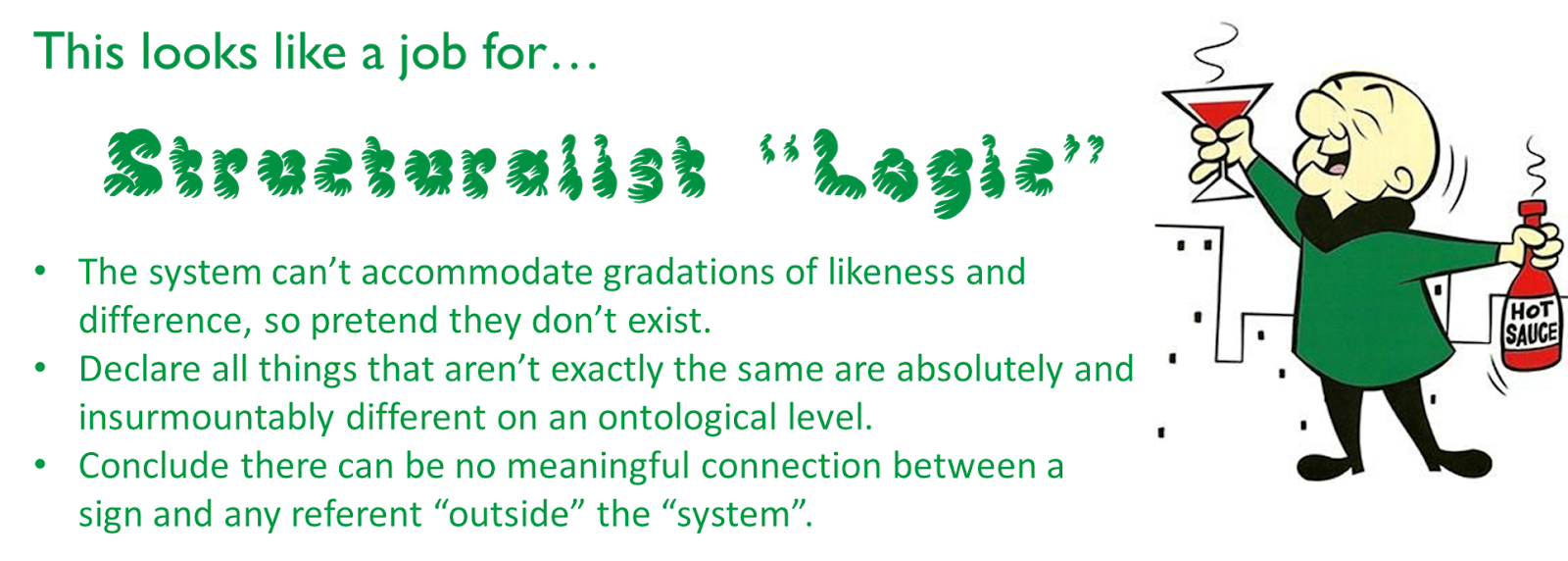
This is not the place for an in-depth analysis of postmodern fallacies, but their destructive consequences for modern metaphysical understanding make a brief consideration worthwhile. The case of Swiss linguist Fernand de Saussure (1857-1913) is sufficient to illustrate the metastasis of blinkered theoretical abstraction into postmodern reality theory. Saussure was a pioneer of structuralist linguistics, an early twentieth-century movement that preceded the post-structuralism and deconstruction that in turn provided much of the theoretical foundation of postmodernism. Structuralism was an analytical approach that treated language as a single structure and not a symbiotic aggregation of associative signs and syntax. Postmodernists pedestalized Saussure’s version for his concept of "difference", which became central to their claims of semiotic meaninglessness. To be clear, this difference is not an acknowledgment that signs and their references differ, as representational filtering recognizes. It refers to the difference between the appearance of words in a language system. That different concatenations of letters look or sound different from each other. This is generally true since signs must be distinguishable as discrete signifiers in order to bear meaning.[3] But the interpretation of Saussure taken up by postmodernists held that [internal difference within the language “structure”] and not [consensus association between sign and signifier] was how communication works. “Cat” is not meaningful because we positively associate it with a feline animal, but because the string of characters c-a-t is looks different from other English words. If it looked like d-o-g, there would be confusion. That this actually recognizes referential function should not escape the reader. Postmodernism was based on false conclusions from the jump.
A central implication for postmodernism was that the sign - historically a mediating element between viewer and world - was reimagined as totally "autonomous", meaning it has no essential connection to the thing that it represents. As the diagram shows, it is an arbitrary symbol or grapheme that triggers a thought in the mind of the reader or viewer. Note that there is nothing of the real world connected to the sign. It consists of signifier [the sign itself] and signified [the impression it makes in the mind of the viewer/hearer] but no referent [the real thing referred to].

The definition of autonomy as no essential connection may be the most important bait and switch category error in the history of modern thought. An essential connection refers to some shared essence or ontological commonality. Obviously a sigil is essentially different from a referent. It is essentially different from a writer as well, and that does not prevent the writer from using it to meaningfully articulate a thought. And what is a thought but a referent essentially different from the sign. By an "essential" standard, only synecdoche is could be thought of as truly connected to that which it represents. But postmodern thought was built on the fallacy that [no essential connection] means [no relevant connection at all]. An error of such magnitude that the reader is left looking for the real argument until realizing none is forthcoming.
The category error is assuming the type of all-or-nothing parametric distinction used in set theory applies to the full range of associative possibilities in human being-in-the-world. It turns up again and again as a cornerstone of every [representational matrices can ignore reality for our wishes] metastasis of postmodern ideology. Yet, basic physiology makes essential access to reality qua reality impossible even on the primary perception level. It simply is not relevant to human navigation of the reality that we are very much not autonomously disconnected from. Correct the error, replace essential connection with referential connection or just connection, and the entire pseudo-argument collapses.[4]
Saussure claimed to be discussing semiotics, but his discussion was really about language. This may have been by design because the argument for arbitrariness becomes even more preposterous in the face of mimetic representation. Pictures that signify through the perception of similitude to the thing depicted. Postmodernists will blather about the arbitrariness of pictorial conventions, or the difference between painters' brushstrokes, but none of this is relevant to the fact that visual signifiers signify through perceived resemblance. Put simply, c-a-t may not look anything like a cat, but this does:

The false binary between [how a word is recognized] and [what a word refers to] should have terminated this nonsense instantly.[5] A sign does have to be differentiable from the others or confusion reigns. It also must use that distinct identity associatively or it is a unique meaningless scribble. Both are true. The premise that recognizing the structural difference between signs was proof that the associative component could be ignored or rejected is outright fatuousness. Yet it became dogma in the great universities of the West. The argument goes like this: since language signifies by difference within an autnomous structural system, what we think of as positive or associative meaning is really just difference. Ergo, since meaning is difference, there is no positive meaning.
That was the underlying reasoning that structuralist linguistics bequeathed to post-structuralism.[6] Seriously. Reasoning so inept that it almost had to be bad faith elevated to the status of “theory” in the slag heap of twentieth-century academia. Deconstruction was the prestige wing of post-structuralism that tried to preserve the structuralist concept of difference while accounting for the inconvenient truth that languages are not fixed structures. They are constantly changing, with clear developmental histories and the continual addition of new words. Jacques Derrida (1930-2004), the Saussure of deconstruction, argued words still only signify through structuralist difference but language systems evolve diachronically. Meaning remained [difference within structure], only the structure continually shifts and changes, incorporating all the aggregated traces of past usage. The result is much more complex and arcane; signs of signs of signs in ghostly chains of traces moving through time in an arbitrary play of non-meaning. Difference referencing endlessly back to earlier difference without reaching positive association. A mise en abyme.
This is precisely what is meant by academic discourse not mapping onto anything real. At no point did anyone ask why books are written or term papers graded if signs are arbitrary and meaningless. What people outside the academic bubble miss is that correspondence with reality is irrelevant to the acceptance of academic dogmas. Academic theory bases legitimacy on the appendage of approved names to validate claims, and questions of true or false are largely irrelevant if the correct “authority” is cited. Saussure was elevated to name status, making his difference authoritative in the “theoretical” arm of the human sciences. The likes of Derrida, de Man, Irigaray, and other post-structuralists that followed could therefore use it without having to attend its empirical and logical inadequacies. And when enough names & associated nonsense dogmas aggregate, the result is

To anyone outside postmodern theory world, discourse means a somewhat formal dialog or presentation. But in the bubble, it refers to the accumulation of self-referential and arbitrary sign systems that make up putative knowledge domains as defined in academics. A vast web of intrinsically meaningless representations – an intrinsically meaningless meta-representation? - that replace the truthful representational filtering of reality. Discourse is the basis of the attacks on culture, morality, and truth as “discursive constructs” and not objectively real. Even the postmodern canard that our representations create reality derives from this. Since discourse is reality, as far as human being-in-the-world goes, whoever determines the discourse determines reality, practically speaking.
As a concept, discourse is not without value, insofar as it calls attention to the unstated assumptions that inform our socio-cultural practices. But like the structuralists and poststructuralists before him, Michel Foucault (1926-1986), the Saussure of discourse theory, drifts into that seductive brand of magical thinking that prioritizes mediation over what is mediated. Thus conferring ultimate power onto the critic. Discourse is posited as the sole means by which knowledge of any sort, or even thought itself, is possible. It is impossible to clearly define, since the means of defining it (language) is itself a subset of discourse, but this allows Foucault to impute any properties to it that he desires. Essentially, he makes up an undifferentiated category for everything that humans can know or think, and then claims his commentary on his thought experiment offers meaningful insight into the complexity of human being-in-the-world.
The commonality linking all of this is that representation produces reality. The genealogy is easy to follow:
Structuralist: since meaning is autonomous and predicated on difference, there is no positive referentiality to anything external to language. [6]
Poststructuralist: since there is no possibility of meaning outside of language, meaning is produced by linguistic operations. Therefore language produces knowledge.
Discourse: since discourse encompasses the possibilities of knowledge, the human experience of reality is produced by discursive operations.
Therefore discourse literally produces reality.
The “reasoning” is almost too absurd to parody. Because we can't know reality in some perfect ontological sense and the world is mediated by sign systems, discursive mediation transmogrifies into actual reality production.
Almost too absurd...

The ultimate absurdity of pretending mediation is the mediated comes home to roost when Foucault tried to insert some socio-political commentary. Despite constituting reality, discourse is somehow shaped by something called "power". Power does not refer to identifiable individuals as much as "systems" that constitute social control - the legacy of structuralism being baked into the DNA. This anonymous, systemic power sets the criteria by which discourse establishes truth or knowledge. It is the root of every postmodern nonsense claim about amorphous and poorly defined "systemic" anythings.
The final step in the Foucauldian shuffle is "commentary". This is the flow of text and other semiotic output that presents discourse as if it were natural external reality and not an arbitrary product of inhered power structures. Commentary presumes to explicate an objective reality, but is really just an expression of discourse, and therefore repeats and legitimates the arbitrary power structures that discourse hides. Reality, understood as discursively created, becomes a self-generating cycle:

Power structures create the discursive frameworks that produce the commentary that reinforces the power structures.
Note that the terms are arbitrary and poorly designed. This is a central tactic for postmodern deception. On what grounds are discourse, power, and commentary differentiated? How can discourse represent the conditions of knowledge, but commentary and power be somehow extra-discursive enough to be differentiated meaningfully? All this flimflam man offers is a crude concept diagram with impossibly broad, arbitrarily bounded neologisms that interact in the way he designed them to. In a series of texts. There isn't even a pretense of intellectual consistency. The truly radical thing is that this body of work was taken seriously at all. There are two possibilities. Either the world is a discursive simulacrum of some sort, or human experience is a mediation between a perceiving consciousness and an alien environment, however these are defined. If the former, everything is the fluid play of empty signifiers and Foucault's texts as much a discursive hiccup as everything else. If the latter, Foucault's categories would have to account for their own extra-discursivity to claim greater epistemological legitimacy than the nature he seeks to abolish.
What made Foucault's narcissistic confabulations so toxic is the inclusion of places for intervention and control. Regardless of how logically self-detonating for the concept of discourse. A poststructuralist like Derrida denied extra-linguistic meaning in linguistic systems, but his language was outside control. A better logician, he recognized that there cannot be an extra-discursive position if discourse subsumes all human reality. Foucault added nebulous power structures that are somehow not themselves discourse, but offer the potential for domination. While this internal contradiction may bother some reality-facers, it is important to remember that the whole [representation is reality] premise that all of it is based on is fake. And once impossible lies have been accepted as ontology, relative degrees of internal consistency are irrelevant. It is an imaginary world where the Dungeon Master makes up the rules.
If logical consistency matters, stick to what you can know and how you can know it.

The soupcon of ubiquity and absurdity that defines postmodern discourse is what tends to escape those dismayed at the current state of culture. Understandably so, given the sheer bloated scale of academia, its detachment from what most consider real life, its stranglehold on the popular perception of intellectual credibility, and the self-parodic convolution of its canonical texts. Breaking it down into succinct, clear components seems unbelievable to anyone laboring under the misconception that university is what mainstream sources claim.
- Academia is detached from the broader culture so that even the most well-informed people outside the social sciences and humanities are unaware of its nature.
- The obsession with pushing every young adult into “college” and requiring the resulting credential for positions of influence ensures that those matriculating into the positions are influenced by discourse. And the faux prestige of the institutions among these graduates turns postmodern philosophers into thought leaders in policy circles. Relative anonymity in the general public notwithstanding.
- Mainstream unawareness supports the mainstream assumption that societal systems of representation – laws, languages, cultural forms, etc. – are logically coherent representations of reality. Too many are still puzzled and dismayed that they are not.
- Those who are shaped by discourse – see #2 - assume the inverse of #3. That reality conforms to representational systems and any perverse or unreal vision can be willed into existence by controlling discourse.
- The dupes in #3 share blame. Consider the degree of stupidity required to expect everyone to attend an institution at immense cost without understanding what goes on there. Now extrapolate more broadly.
The discursive creation of reality could only appear where hermetic detachment from apprehensible reality is the norm. Where citing Philosopher’s Names replaces empirical substantiation, predictive value, or any demonstrable connection to human being in the world. A world where the self-detonating absurdity of teleological materialism is taken seriously when “Marx” is appended to it. Or history is discussed as driven by dialectical processes in spite of all actual evidence to the contrary, because “Hegel”. Human meaning making processes may not be an abyss of recursive arbitrary self-referentiality signifying nothing real, but academic disciplines sure are. This becomes dyscivic when people of influence try and impose these absurdities onto reality out of ignorance, atavism, and/or desire for gain.
There would be little in wasting time on something as vacuous as postmodernism if the [reality is subjective] misinterpretation of representational filtering had not proven so culturally destructive.
Deconstruction: using linguistic means to express the certainty that certainty cannot be expressed by linguistic means.

Future historians will be mystified that someone successfully asking Derrida to pass the salt at the dinner table did not strangle this idiocy in the crib. Institutions ought to have simply stopped paying the postmodernists on staff. Signs become meaningful in a hurry when grants or tenure is declined. Surely someone could have noted the self-detonating logic of arguing against linguistic meaning in books. Anyone who really acted as if signs were non-representational and truth subjective would appear to be suffering from some sort of extreme psychosis. That no one actually did indicates the fundamental dishonesty of the whole enterprise.[8]
Start with we can observe to be real. All our thoughts and communications are representations. This book is a series of representations. Anyone who has learned to read or speak distinguishes each word from the others and then uses that distinct word associatively. Vocabulary builds over time. New words are learned by learning the ideas and things they represent. We can even misuse a word – not properly accommodate its uniqueness – and still be understood contextually. The associative aspect of linguistic meaning that makes imperfect communication possible means representation has relative truth value. It is more or less accurate - more or less suggestive of the thing that it represents - without ever being the same as it. Our representations are also more or less effective in communicating actionable information. Someone passes the saltshaker. The reader gains insight. True knowledge of things or thoughts qua things or thoughts is not required for a representation to be good enough.
Not the same != unrelated
Consider also how language originates. That there is a point of temporal origin, regardless of one’s beliefs about the past. Unfortunately for the descendants of structuralism, we do have a broad understanding of the development of linguistic and discursive structures, and all signs point to human experience coming first. The standard historical narrative is that the earliest known form of language – cuneiform - developed gradually from pictograms sometime in the Bronze Age. Pictograms, and by extension words, are positively correlated associations between arbitrary signs and their references that coalesced into complex, flexible, abstract forms for poststructuralists to misinterpret.
According to the conventional narrative, the Sumerians were the first, but Egyptian hieroglyphics and Chinese pictographs followed a similar evolutionary patters not that long after. Alternative histories push the origin further back in time without denying that there was an origin.

From a Biblical perspective, Adam created with speech, and he immediately names the animals in an act of… positive association. "And out of the ground the Lord God formed every beast of the field, and every fowl of the air; and brought them unto Adam to see what he would call them: and whatsoever Adam called every living creature, that was the name thereof." (Genesis 2:19, KJV). If the Fall includes relativistic uncertain language, it is still the relativistic uncertain version of associated sign and reference. From any angle, individual language elements may be arbitrarily designed, but the existence of an external subject of reference is not.
After all, if language systems lacked common referents, how is translation possible?

The Rosetta Stone, granodiorite, 112.3 × 75.7 × 28.4 cm, with Egyptian hieroglyphs, Demotic script, and Greek script, 196 BC, discovered 1799, British Museum
3. External reality is independently and objectively real
It follows that if human being-in-the-world is representationally filtered, the world is what the filters represent. Any representation is a representation of something. Even postmodernists share their inane pomposities in words – words that they presume will meaningfully convey said pomposities to anyone unfortunate to have to read them.
Inability to directly access reality qua reality != not being able to
ascertain its existence
The objective existence of external reality puts paid to to spurious claims that reality is either “in our heads”, created by us in some way, or opaque to the point where further consideration is pointless. We exist within an objective external context that precedes us, outlasts us, and is not dependent on our perception of it. This should be obvious to anyone who experienced being born, although experience shows there is no limit to solipsistic self-delusion. Charles Sanders Peirce (1839-1914), the real father of modern semiotics, incorporated this fact in a simple theory of the sign that captures the full range of the representation process, including the person understanding the representation and the thing represented. We have translated it into graphic form:

Unlike Saussure's imaginary structure, Peirce observed how people interact and interpret signs in reality. His system is derived from and therefore secondary in authority to human experience. This allows him to look beyond language and consider semiotic relationships much more broadly. He actually identifies three broad classes of sign that include manmade and naturally occurring bearers of meaning. Note the awareness that the entire nature of the sign is to represent. Reference to something other than the semiotic vehicle is implicit.

The structuralist sign - language - is limited to the symbolic category, or what Peirce calls arbitrary signifiers. Saussure and his progeny completely omit Peirce's motivated signifiers - it is typical of the house of lies to ignore things that undercut false narratives. The first of these is the icon, which represents by shared character or likeness like the mimetic picture shown above. The index is evidence of something that doesn't resemble the referent, but isn't arbitrary either. Icon and index can function without interactions with others, or the construction of abstract representational systems.
Comparing the models directly fully reveals the dehumanizing nature of Saussure’s formation:

The structuralist removes representation from any meaningful relationship to the things represented. It is an autonomous system that abides by its own internal rules and is disconnected from any objective reality. This begets the increasingly complex but equally unreal phantasm of postmodern discourse. The insidious implication is that everything we think, say, do, believe, understand, etc. is subordinate to the operations of an alien, mechanistic structure without meaning beyond itself. The system comes before the human. With Peirce, the world (referent) and beholder (interpretant) are instantiated within the sign-vehicle itself. The "system" is relegated to its proper place as a human creation, not as the creator of the human. Saussure, in his desire for mastery, puts the cart before the horse. Pierce diagrams a process of making your way in the world, which is not a fixed structure, but an cumulative journey that is necessarily incomplete and abstracted. Which more closely approximates human development, both on the individual and societal levels?
.jpg)
Thomas Cole, The Voyage of Life: Childhood, 1842, oil on canvas, National Gallery of Art, Washington
Peirce is a case study in the blinkered nature of academic discourse. Although acknowledged now for his contributions to semiotics, his ideas were largely ignored during the twentieth-century development of postmodern “theory” discussed here. This is not surprising. Peirce derived patterns from observable realities of human interaction. He included the sign’s referent – the thing it represents – and the receiver who has to make sense of the sign for communication to occur. But an eclectic, reality-facing American thinker from the 19th century was so far from the academic pretensions of early 20th-century Europe that his ideas might as well have not existed. The simplistic distortions of Saussure and his progeny had the correct pedigree, and more significantly, was sufficiently divorced from human behavior to be weaponized against the humanistic leanings of Western civilization. This means that the postmodern deconstruction of intellectual culture was based on the deceptive oversimplification of semiotic processes that were already understood.
There is a difference between the multi-layered, self-referential semiotic representation that make up a society and the simple sign diagrams of Pierce or maxims like “representations are representations of something”. Complicated abstract terms are defined through the interplay of other complex abstract words. Culture is an incalculably vast web of tangled layers of representation – media, institutions, internet, fashion – all informing and contextualizing the meanings of each other. The sheer semiotic scale of modern actually makes the “signs are all there is” nonsense seem more convincing. A net is too big to untangle may appear to be all there is. But that mistakes difference of size for one of kind. The number of mediating layers is irrelevant to the fact that they mediate, and whether one or a billion layers, mediation implies between things. There is no limit on the complexity, but all of it derives from the designated external references of simple sign systems. The origins of language and other sign systems may not be perfectly understood, but the path from simple associations to more complex structuration is not a mystery.
.jpg)
Pablo A. Gimenez, photo, Cueva de las manos, Pinturas River Canyon, Santa Cruz, Argentina
Even the possibility of deception inherent in representational filtering confirms the reality of the external referent. Deception is only possible with associative representation. False representations fool because they are taken for the truthful ones they pretend to be. If truthful associative meaning was not possible, people could not be fooled with false ones.[9] Any doubt about the objectivity and independence of external reality disappears with minimal consideration of how language and representation actually work. It is a testimony to human solipsism that it was ever a question.
What representational filtering of objective reality does demand is disciplined attention to the semiotic filter. Consider this common thought experiment on the nature of reality.

"If a tree falls in a forest and no one is around to hear it, does it make a sound?"
Lack of definitional clarity as pseudo-profundity. The only real question is how noise is defined. If "sound" means the vibrations that ears transform into aural representation, the answer is yes. Reality is real and physical properties occur regardless of spectatorship. If "sound" means the internal aural representations caused by the vibrations, then the answer is no because a hearer is needed. Define the terms and the uncertainty vanishes. The real wisdom is recognizing that representational filtering creates possibilities for vaguery and ambiguity where misunderstanding thrives.
While the history and mechanics of representation are more than sufficient to demonstrate the reality of reality, basic human experience does so even more effectively. Perceptual stability, or the consistency of our perceptions of reality, is taken for granted to the point of being subconscious assumption. Material reality does not spontaneously change its nature without observable cause or catalyst. Even then, change is restricted to what is possible within the laws of physics or nature. Water evaporates at a predictable rate depending on the surrounding conditions. It does not suddenly double the rate or transform into milk. Naturally impossible change is miracle, and even there, a catalyst causes it.

Then and now photos of Seljestadjuvet, Odda, Norway. The changes can all be accounted for by human activity and natural processes. And the place is clearly the same.
Perceptual stability foundational to our being-in-the-world. The bedroom door is always in the same place in the wall and never spontaneously relocates elsewhere. It is metaphysically significant that this perceptual stability does not rise to the level of absolute timeless consistency. It cannot because the present configuration of perceptible reality is not eternal and absolute consistency never changes. At some future point, there will no longer be a bedroom or an earth to house it. Geological time may seem endless relative to human time scales, but it is not literally unending in the way logical abstraction can posit. This is not a pedantic distinction. The difference between empirical and logical representations of reality indicates different forms of knowledge generation:
1) inductive empirical epistemology that reflects the inherently inductive human understanding of the reality we are born into
2) deductive reasoning from abstract first principles.
The lengthy titles provide precision since induction and deduction are symbiotic in real life.[10] The relevant difference here is the relation to absolute unchanging truth, itself an abstract reality in an entropic, mutable material universe. In the first process, observations and experiences build cumulatively towards deeper understanding. Knowledge grows and refines but can never accumulate to absolute certainty any more than we can count to infinity by ones. In the second process, logical, unconditional truths like a math theorem or set parameter are applied to circumstantial things. In practical terms, the difference is not absolute. Math begins in quantity, an observable property of the material universe. And logical deductions are possible from observed patterns that fall short of eternal changelessness. It is not necessary to have foreknowledge of where the bedroom door will be a trillion years in the future to know inductively where it is tomorrow morning. Perceptual stability is sufficient to indicate the reality of material reality without needing the absolute exactitude of pure logic.
The difference between absolute and almost always, practically endless, any huge amount, etc. is an insurmountable gulf for ontological-level distinctions and largely irrelevant to our everyday lives. Ontologically it is the difference between perpetual and mutable essence. In practical terms, material reality including ourselves is mutable. Absolute changelessness is not part of direct human experience. Pretending that absolute philosophical or mathematical abstractions determine our being-in-the-world is the sort of category error that leads to [representations are not absolutely identical to their reference] = [representations are meaningless]. Abstract epistemologies are obviously applicable to material reality but in ways that accommodate the changing conditions of the latter. And even when abstract constancy does apply, the outcome cannot materialize the absolute precision that abstraction is capable of. This has metaphysical implications to be discussed further in the next chapter.

Induction is an iterative gathering of observations and then observing patterns in their aggregation. An example will clarify the difference between this and deduction from absolute principles. The consequences of touching a glowing red element on a stove can be extrapolated to every such item, and a second encounter nails it down like a rule. But inductive pattern recognition is not absolute immutable law, and it is easy to hypothesize an illuminated spiral that is cool temperature. What [glowing elements burn] does provide is actionable predictive knowledge when in a standard kitchen.
Deductive knowledge moves in the other direction by applying non-contingent abstract principles or laws that are already known to material phenomena. Calculating the length of a hypotenuse with the Pythagorean Theorem gives a result of materially impossible precision the first time or the thousandth, regardless of other circumstances. The combination of absolutely correct and materially impossible is not a typo. Both are true – it is the epistemological difference between logical abstraction and material observation that creates the discrepancy. Mathematical calculations use abstractions of pure quantity that do not materially exist qua themselves and as such are absolutely precise. We can observe eight things or a sign used to represent the number 8, but “eight” in itself does not materially exist. Nor can we manifest it exactly in a metric of our own invention, as in measuring the height and base of a triangle or cutting the segment for the hypotenuse with nothing other than zeros no matter how many decimal places.
Visualize. The angle can be calculated with perfect precision. The material realization cannot simulate that.

All measurements have uncertainty, no history finds the beginning, all structures decay, nothing lives forever, all judgments are contingent. We can conceive of things that are not limited in these ways, but they are not materially real. Absolutes are conceptually possible in ways that material form is not. Perfection is an abstraction. In the imperfect material world, we operate in shades of gray, but shades of gray can convey truthful information. Like representation, imperfect alignment with the truth is still more truthful then no alignment. And the more closely we align with the truth, the more functionally and aesthetically effective the outcome.

Put another way, here are two imperfect representations of perfect Pythagorean geometry. But only one attempts to align with higher truth and order:

Every measuring or cutting tool, every machine, has a degree of uncertainty. Accurate to the angstrom means .01 angstrom or .00000001 angstrom, or one to the negative google plex angstrom imprecision is possible. The potential number of significant digits is infinite while material accuracy is constrained by the physical realities of manufacturing processes and perceptual resolution. Mechanical instruments can improve precision without ever reaching absolute exactitude any more than counting can get to infinity. Objective reality as we experience it is necessarily fuzzier and more imprecise than the absolutes and immutabilities of logical conclusions. More open ended.
Ignoring the symbiosis between them, the difference can be summed up:
Inductive process moves from the material towards an abstract perfection that cannot be reached
Deductive process projects an abstract perfection onto the material that cannot be realized
One million sequential sunrises do not establish sunrise as an immutable law. Nor should it, because we know that the material world we inhabit is not eternal. One day there will not be a “sun” to rise. Conversely, the Inverse-Square Law is an absolutely precise geometric relationship applicable to the behavior of sunlight over distance, even if there is no sun to shine.
It is metaphysically relevant for reasons to be explored later that the empirical-induction / abstract-deduction opposition is not absolute. They can be defined as oppositional for analytical purposes but they are related as epistemological processes. Abstract certainties become knowable through derivation from empirical observations, while empirical observations are understood through abstract conclusions. To clarify, we are not referring to the independent existence of abstract or empirical realities, but to our ability to recognize and understand them. To codify them as knowledge. The laws of physics hold whether or not man represents them, just as failure to perceive an obstacle has no bearing on the pain it causes when bumping into it. The next axiom will look more closely at the coexistence of interrelation and distinguishability. What matters here is that accretive experience and logical deduction are different but related modes of knowing our perpetual stable reality. are related because both apply to the same objective reality but generate different kinds of knowledge.
Perceptual stability does not need to be an absolute abstract perpetuity like the Inverse Square Law to be observably universally consistent enough for predictive certainty. The question then is not “will the sun rise forever for certain?” The question is “can I predict its rising tomorrow?” Observed patterns can be reliably predictive circumstantially. Good enough to hold epistemological truth value. To be knowledge.

Frederic Edwin Church, Valley of Santa Isabel, New Granada, 1875, oil on canvas, Pennsylvania Academy of the Fine Arts
Object permanence is related to perceptual stability and the next sign that reality is real. The term comes from developmental psychology, where it refers to the awareness that objects exist independent of whether we can sense them at the moment. This extrapolates to other people as well - the same perceptually stable object permanence that exists regardless of our sensory perception applies to everyone. Every visitor enters the house through the same door. Object permanence is the foundation for human interaction in a shared material reality. Infants and animals grasp it as part of their natural growth.
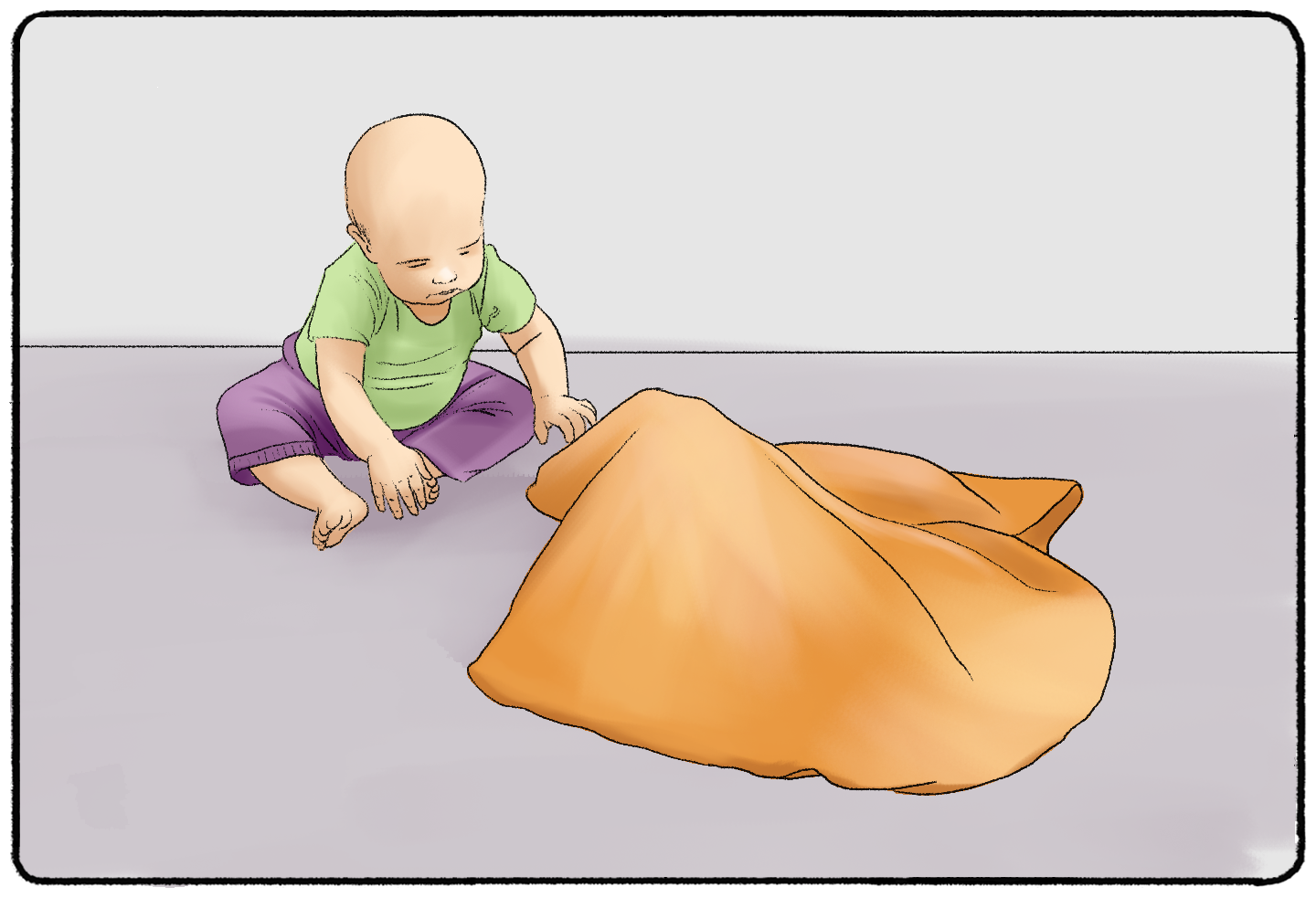
Perceptual stability and object permanence support a third indicator reality is real: shared experience. Full mutual collective immersion within the same objective reality is obvious every time we give directions. And in the assumption that if they do not work, there was an error in transmission or reception, not that the streetscape or a recipe suddenly transformed. Representations are often deficient, while reality does not spontaneously shift.
Cursory reflection on human existence is sufficient to show external reality is objective, consistent, and stable. Its physical properties exist independently of our whims and desires. It can support complex, reliable representational systems that narrate our shared experiences and thwart our most heartfelt wishes.

Héliodore Pisan after Gustave Dore, Newgate Exercise Yard, from London: A pilgrimage’ by Gustave Dore and Blanchard Jerrold, 1872
This does not mean reality is utterly independent of us. We are part of it, while possessing degrees of discretion or free will. Our physical bodies exist within the same objective reality that we observe representationally. We are able to transform our surroundings within physical limits. Moving objects, avoiding an encounter, and having a child are all discretionary alterations within our capacity. Aging means that all of us are constantly changing on the cellular and appearance level. On a more fundamental level, observer impact effects occur when observing something induces changes in its behavior. What we do not do is create the reality we effect.
It is not surprising that so much has been written about our relationship to the world around us. It is a complex and fascinating mesh of interlocking conditions that defies simplistic descriptions. We are objectively part of a stable perceptible reality and perceptual stable aspects of other people’s shared experiences. Simultaneously subject and object, observer and observed, actor and acted upon, representer and represented. All within the parameters predetermined by the reality that precedes us. Raising one more characteristic of our relationship with objective reality: belatedness. Belated in the sense of being born into a world that precedes and exceeds us. That was fully extant long before our first flicker of consciousness. That is vaster in every way than we will ever apprehend. That imposes psychological, physiological, and physical conditions to which we are inescapably subject. Belated entry into a preexisting world is why our understanding grows inductively and empirically, seemingly without end.

Vladimir Volegov, Moment of Discovery, 2008, oil on canvas
Together, the first two axioms - [representational filtering] and [reality is real] – foreshadow later chapters on morality by pointing to the importance of discernment. If objective reality can be presented falsely, determining when and to what extent is critical. The question is how to we ascertain the truth value of a representation if its subject is beyond our capacity for direct experience? The answer is aggregated pattern recognition. Discernment in both the assessment of logically consistent argument and actions precision and the empirical verity of inductive observation. Discernment, and awareness of metaphysics since we are speaking of subdivisions of reality between material experience and abstract certainty. And with that, decades of materialist academic inversion, endless books and articles, and whatever else constitutes discourse disappear in a puff of reality.
4. Distinction and Continuity are Constinctive in Apprehensible Reality
Part 2 of Chapter One next time.
Notes
[1] Kant was correct in describing a noumenal state of things in themselves that is ultimately beyond our direct apprehension.
[2] Postmodernism emerged out of twentieth-century academic critiques of an equally nonsensical tendency to treat signs as transparent bears of meaning. Arbitrary human constructions with potentially fuzzy or misleading meanings as reaction to the false legacy of Enlightenment rationalism. What neither perspective did was recognize that similarity and difference are aspects of semiotics. Referential similitude across essential difference. At best, the [signs partake of their subjects] / [signs are meaningless] choice was a false dichotomy, a misguided application of the all-or-nothing abstract distinctions of logic or math to the interconnected and qualitative nature of the “human sciences”. At worst it is wish projection and deliberate cultural vandalism. But in neither case does it align with what is real. What value there is in the postmodern enterprise comes figures like Jean Baudrillard or Guy de Bord who recognized that our fake, media-generated house of lies cuts us off from the truth. But the existence of a society constructed out of false representation is irrelevant to sign usage that does align with reality.
[3] Obviously, words with two meanings complicate this, but there are contextual ways to distinguish meaning in these cases. Saussure, like any academic in the human sciences, was under no obligation to conform to the realities of human communication.
[4] It is the shoddiness of the reasoning and unwillingness to consider how the model deviates from actual human practice that leads to charges of atavism. The slipperiness with the use of "essential" is typical of the sort of liar who wants to create the false impression that the world you believe you inhabit secretly is not that way. Since a straightforward argument would demonstrate the opposite of the fake claim, the argument becomes deceptive in ways that may escape notice. When the purpose of the false presentation is to deny the possibility of meaningful reference to truth, the atavism is obvious. Were it just stupidity, the outcome would not be so consistently negative.
[5] Consider the implications for “advanced thought”.
[6] Logic is not being used entirely facetiously here. The academic philosophy that postmodern theory distorts came pre-crippled by the history of its own disciplinary discourse – the technical language that defines it within the structure of the modern university. Theory – as used in the academic arts and social sciences – can be confusing because it tends not to appear in Philosophy departments as much as in other branches of the Humanities. It is a legacy of Continental academics, mainly German and French, with their “human sciences” conceived as echoes of the natural sciences. In the 18th and 19th centuries when the philosophical foundations of theory were forming, there was an attempt to ground the human sciences with the logical certainty accorded to the natural ones. Kant’s efforts to establish and extend a logical taxonomy of human judgment to aesthetics fits here. However, absolute [either/or] binaries apply to language neglected the ambiguities that define linguistic function. In reality, the differences between logical abstraction and material existence point to metaphysics.
[7] Olena Shmahalo, Multiverse, 2014, Quanta Magazine
[8] The situation was actually far more cynical. Academia in the postmodern age continues to run on the tacit assumption that reality is real and signs represent. Tuition is paid, classes registered for, promotions granted, leaves of absence taken, teams rooted for, etc. The postmodern crowd were therefore pretending truth was not real in the domains where it furthered their agendas and accepting it was when it did not. Consider what that tells us about the value, and values of “higher learning”.
[9] An effective lie presents something as being other than what it is. It misrepresents truth. Someone who believes the lie is induced to act or think in ways that reflect conditions that do not exist. They may wander into a trap, give their money to a scammer, or shoot themselves up with toxic experimental gene therapies – things they would never do if given accurate representations of reality. This is where lies come closest to magic because they make people behave as if reality was transformed. And the believer appears enchanted into acting contra reality, including their own best interests.
[10] See the Scientific Method.


