After some occasional teases and a recent introductory post, it’s time to start a journey into Christopher Langan’s CTMU or Cognitive-Theoretic Model of the Universe. Part One of what promises to be a several-post series.
If you are new to the Band, this post is an introduction to the point of this blog that needs updating. Older posts are in the archive on the right. Shorter occult posts and other topics have menu pages above.
Comments are welcome, but moderated for obvious reasons. If you don't see it right away, don't worry. We check regularly and it will be up there.
Fantasy City, digital art
This is not the first time the Band has looked at someone's ideas, but Langan's CTMU is a bit different. It's is a comprehensive theory of reality - in form and process - and our relationship to it. The main paper is only a little over 50 pages long [click for a link] but the scope of the ideas are as big as the last sentence sounds. It’s not his only paper on his link page, but is the foundation of his intellectual project. It's also really dense. So this will not be a quick or simple project, and will probably take several posts. Click for a link to the introduction so we don’t have to recap.
Clarify some preliminary points.
We’ve used some lightly confrontational images in the lead-up to this project, but we are absolutely not interested in rhetorical attacks on him or the CTMU.

Sean Nash, Fragments Of the Heart - A journey to the unknown, digital art
We have too much respect for his intellectual abilities and his willingness to lay out such an ambitious and personal project in such a direct way. We’ve also developed a favorable perception of him through the investigations and reflections leading to this post. His work demands an equally sincere and reasoned response.
We've avoided third-party commentary on the CTMU as much as possible. The idea is to avoid working from others' frames of reference and rely on Langan's thoughts on their own terms. Most critics don't engage the CTMU as much as launch rhetorical attacks anyhow. Anecdotally, cherry-picking quotes, pointing out that the cherry-pick differs from some established Science! dogma without so much as touching the underlying logic, then snarking seems a preferred method. We take issue with his conception of reality in its fullness that it theorizes, but find the cognition behind it imposing. Our readers know how we view the nature of reality. The plan is to consider his conceptions through our own.

The Band plays the CTMU...
Langan's psychometric profile, information density, and conceptual breadth are hard to grasp and triggering at the same time. All the more reason to hew closely to the challenge they present our own thought.
The Band also detests the pervasive gamma approach to internet disagreement. Where aspects of the beast system-House of Lies are unreflexively “defended” by some creature too dim and/or corrupted to perceive the fundamental dishonesty it defends. The snark and insults become unintentionally ironic because the "critic" can't see their own limitations.

Conversely, we aren’t emotionally crippled Dunning-Kruger poster manlets dependent on chits and positions for fake credibility.
We're talking unintentionally ironic rhetorical attack, not rhetorical shading in general. Our format with its reliance on pictures doesn’t change, and pictures lend themselves to rhetorical shading. Just not in the service of falsehoods. The Band is attentive to what we call semiotic - or representational- filtering. How the media we have to use for communication differ from and relate to the ideas they convey. Pictures and graphics crystalize concepts and their implications and enrich plain text as another way of presenting the underlying ideas. That’s how they’ll be used here.
And one other thing. We use brackets liberally to emphasize when clusters of words are to be thought of as characterizing one idea. Langan looks for analogies in structural relations between polyvalent concepts with multiple moving parts. Clumping the descriptors in brackets makes it easier to think of them as a single entity in relation to another such element. Like [language as process of reciprocal two-part self-generation/ transduction] from later in the post. It’s a shorthand reminder that he is referring precisely to a structural concept of language where the syntax and state create and regulate each other. And to not think of it as [the same as a spoken tongue] beyond that basic structural comparable. He's really information dense. Probably a factor of cognitive baseline being insanely capacious. We're altering our English a tiny bit to make it clearer for readers who find that overwhelming.

The first question is how to start. The CTMU presents structural, stylistic, and conceptual obstacles to a simple explanatory breakdown. We considered just systematically going through it and summarizing the main ideas, but the main paper isn’t entirely linear. It is a sequence of words and sentences that builds cumulatively. But it builds with conceptually superimposed and interlinked parts that refer to and support each other in a way that is simultaneously recursive and reciprocal. There are unified central processes that reverberate across scales from the personal to existential while being created/defined by their own products. Read that again.
Now where to begin. Maybe try and reflect the layered nature stacking introductory impressions.

The CTMU is a perpetual self-generating configuration with no obvious starting point.
This image doesn't depict the CTMU. But it does visualize the simultaneous expansion and contraction that defines Langan's conspansion - an important part of his self-generation process.
We’re already presenting conclusions about it before any consideration of how it gets there. Written communication is a sequential form, so descriptions of multidimensional things have to be converted to a cumulative linear sequence. Langan started by summarizing his main conclusions before laying out the parts and working back to the conclusions.
The best way to approach the CTMU it to think of it as as descriptive. Langan is describing what to him appears as a holistic conception of reality that he perceives mentally as a unified thing. So the linear description he is compelled to produce by written language isn’t a trail of bread crumbs leading to a fixed destination. It's a series of facets or aspects of that single whole that we are expected to hold on to and assemble in our own heads and consider in the holistic way he does. The problem is that his head is so capacious that what it can hold collectively exceeds most others.

This picture doesn't diagram the CTMU. But it does condition the imagination to start thinking about complicated, overlapping moving, self-generating structures as single but composite entities.
The comprehension gap problem from the intro post is relevant here. We get the impression that the CTMU is clear to Langan and that the facets fit in obvious ways once they're laid out. He’s not a great judge of when more clarification is in order and his leaps can seem disjointed at first. We found an annotated first reading followed by second and third distillations of our notes while cross-referencing the original paper revealed concepts and connections that weren’t apparent at first. After this we to checked our impressions against lengthy interview [click for link] that he considers accurate enough post on his own site. This process showed the CTMU as a sequential presentation of an integrated whole where beginning and end articulate common reciprocating structures whose fullness unfolds cumulatively between.
Turn that into two relevant starting observations.

1. Assessing the CTMU requires the ability to hold enough of the whole thing together mentally to see and assess the “picture” he is painting.
This means there is a conceptual ability floor that necessarily limits audience appreciation and makes meaningful summarizing hard.

2. Our own comprehension was accumulative and didn’t follow a single linear read.
Grasping the CTMU as a whole took multiple passes at different levels. Connections appeared from reading early parts with the later ones in mind.
We aren’t going to explain the whole thing in step-by-step detail. The structure is inherently complex enough that we don’t think putting it in our words would make it any easier to understand without stripping necessary complexity. And oversimplified straw men are exactly the kinds of rhetorical misrepresentations that we need to avoid. Since Langan starts by presenting his main conclusions before working through them, we will do similar. Start with some main assumptions and then lay out the broad reasoning that brought him there before reaching some final conclusions. Starting general and moving into detail while oscillating back and forth resembles the presentation of the CTMU and our understanding of it.
So what is he describing? Langan starts his CTMU paper by introducing a keystone idea for the whole project.
Reality is configured like a special sort of language.
Special because it's a self-generating and self-regulating language that produces its syntactic rules and informational content from each other without an independent external processor or speaker.

Colored version of Bobbie Carlyle, Self Made Man
Mutually and reciprocally self-generating and transducing language is a central pillar of Langan's entire vision of reality. Where combinatory rules/”grammar” create the informational content elements/”words” while the informational content creates the combinatory rules. Quotes because Langan’s concept of language is far more elemental than communicative content made of grammar and vocabulary. The image of spoken/written languages like English or Japanese is just convenient example for this internal reciprocal self-production process.
More to come – but see how easy it is to immediately fan out on tangents once we start to get into actual CTMU ideas?
So when Langan defines reality as a sort of language, he is not thinking within the constraints of our written or spoken languages. What he calls language is a productive process of reciprocally generative syntax-state interdependence. Language is obviously an example of this process - the grammar/syntax determines word usage and the words comprise the rules of grammar/syntax. But it's the process that's relevant, not the exact parameters of human language as a specific phenomenon. Reality combines rules/laws and material state in a parallel way, but has different properties from spoken language because it's a totally different thing. Ontically and phenomenally. It's the process of reciprocal two-part self-generation/ transduction that Langan is referring to by "language".
It might have been clearer to some had he used a different word to distinguish [language as process of reciprocal two-part self-generation/ transduction] from [language as generally understood means of written/oral communication]. But we aren't looking to spin misunderstandings into ironically self-immolating "critique". What matters is that this process concept of language is critical to the CTMU.

Note on Langan’s mind. His pattern recognition is so sharp that a similarity in structure or process makes the analogy instantly transferrable across any kind of contextual divide. Once seen, all the implications are obvious and no further explanation is required.

The reader also has to remember and extrapolate all previous logically sound implications of the pattern to whatever new example is introduced. You need to recognize the recurrence of the [language as process of reciprocal two-part self-generation/ transduction] connects the different parts of the paper into a single CTMU vision.
So the CTMU is built around multi-level analogous recurrences of the [reciprocal two-part self-generation/ transduction within a single entity pattern] that Langan is calling “language”. We've already mentioned that languages like English fit that pattern. But so does human perception in general – [cognition/mental data processing] generates [information/sensory perception] while information generates cognition. This will be important to the "cognitive" part of the CTMU.
The pattern extends to reality itself on both ontic and phenomenal levels, although Langan uses it to dissolve the distinction between the two. The CTMU combines objective reality and subjective perception into a single reciprocal theoretical apparatus. Ontically, the laws of physics are syntax for the physical universe's state, while the physical universe gives form to the laws of physics. Phenomenally, the laws of physics and physical universe are products of human observation and theorizing. So the [theory of reality] is also syntax for the [perception of reality/scientific observation]'s state. The subjective/objective or mental/physical distinctions associated with Cartesian dualism also collapse into mutual self-generation.

Note - there is an element of recursivity since the new state generates new syntax generates new state and so on. The gif captures some of that, but Langan's iterations aren't identical. Self-generation/self-transduction allows for change within parameters. Or evolutionary development. Imagine if each version that the hand draws was a little different.

Another Note - The conception of science as synonymous with [true knowledge of reality] is another tangent that is relevant but will have to wait. Readers know the Band's opinion of science as a modern beast system institution. But we need to stay with the reality is language introductory point. Not running down all the things that explain what he’s talking about.
We'll revisit Science! in due time.
Why does Langan need his language to self-generate and transduce without a generator or transducer? The catch here is that he defines reality theory as necessarily comprehensive - it has to account for itself logically without appeal to outside forces. There can’t be anything relevant to it a theory of reality that is external to the reality it theorizes.
Langan's logic is that any [creator of reality] obviously directly effects reality and is therefore part of reality. So it must be accounted for within a theory of reality. Hence nothing external.

Note - Go with it for now. This comes from the premise that "reality" is limited to our empirical and cognitive apprehension of it. If the theory can't account for it logically, it can't be relevant to reality. We take issue with this, but later.
If reality is self-contained and comprehensive for theoretical purposes, the [syntax-state reciprocal generation pattern] of Langan's language can’t include “speaker” to meld grammar and words into new statements. The process of universal self-generation is like a language without someone or thing to craft the sentences. Without a “syntactic operator” to generate/"write” reality into its evolving existence. That’s the self-generation part. The syntax-state process has to itself into existence without external factors somehow. Hence...
Reality is configured like a special sort of language.
It's special because it self-generates
More precisely, reality is what Langan calls a SCSPL or Self-Configuring Self-Processing Language. Here's the introductory description from the abstract with our emphases...
Uniting the theory of reality with an advanced form of computational language theory, the CTMU describes reality as a Self-Configuring Self-Processing Language or SCSPL, a reflexive intrinsic language characterized not only by self-reference and recursive self-definition, but full self-configuration and self-execution (reflexive read-write functionality). SCSPL reality embodies a dual-aspect monism consisting of infocognition, self-transducing information residing in self- recognizing SCSPL elements called syntactic operators. The CTMU identifies itself with the structure of these operators and thus with the distributive syntax of its self-modeling SCSPL universe, including the reflexive grammar by which the universe refines itself from unbound telesis or UBT, a primordial realm of infocognitive potential free of informational constraint. (page 1)
In other words, reality can be comprehensively and totally theorized logically as an SCSPL. The rest of his paper will show why and develop implications.

The way Langan instantly and seamlessly follows concepts across analogies takes some getting used to. But once you do, the [syntax-state reciprocal generation pattern] links his reality theory together.

But the connection between his analogs extends no further that the relevant analogous concept. The logic is precisely applied. Reality is only like a language in the [syntax-state reciprocal generation pattern]. Its syntax and state aren’t materially the same as grammar or words.
Langan assumes that total conceptual transfer across circumscribed analogies are obvious and don't need elaboration or reminders. This sort of automatic parametric homology has to become equally obvious for the reader to really get the CTMU. In SCSPL, the analogous concept with spoken language is [syntax-state reciprocal generation pattern]. But it is made different - not like spoken language - by the requirement of comprehensive self-generation. This has to be equally evident because of the definition of reality as comprehensive and self-contained. And the implications for what SCSPL has to be equally obvious.
The idea that reality shares qualities with language isn't alien to Christian thought. The Logos is generally translated as "The Word", making Creation a sort of metaphorical utterance. The big difference is that the Word has a divine Speaker external to any notion of reality that Langan's definition can't permit.
,%20Incipit%20page%20to%20the%20Gospel%20of%20John%20from%20the%20Book%20of%20Kells.%20folio%20292r.jpg)
In principio erat verbum (In the beginning was the word), Incipit page to the Gospel of John from the Book of Kells. folio 292r
In the beginning was the Word, and the Word was with God, and the Word was God. He was with God in the beginning. Through him all things were made; without him nothing was made that has been made. In him was life, and that life was the light of all mankind. The light shines in the darkness, and the darkness has not overcome it. John 1:1-5
The two-part reciprocally-generating formation has a history in Western thought – just not analogized to universal foundation. Or something that disappears problems of origin or the nature of temporality. Longtime readers will remember French structuralist Saussaure who divided language into parts that he called langue and parole. Basically grammar and vocabulary. But Sausaurre’s structure is a static picture. His critics noted that he didn't really account for origins, development, or change.
In the German tradition, it presents itself as a hermeneutic circle. Where the meaning of a word depends on usage or linguistic context, but the usage of a word depends on its meaning. Whether complex metaphors and allegory and basic meaning. You’re taught the grammar that dictates how the words are to be used... with words.

It's part of the nature of representation when complex composite ideas are made up of small individual units of meaning. The context determines the specific meaning of the units while the combined units determine the meaning of the context. The spiral version adds realism to the structure, because we don't just spin round and round. It's more like an oscillation were the meaning of both gradually form up. It does make it hard to figure out where to start an explanation. Chicken or the egg comes to mind.
Temporality is relevant because the revolutions around the circle occur in sequence and awareness of the meaning spirals out in time. The idea of sequential process is obvious in the diagrams. The idea of a Creator gives [reality as speech act] an ultimate starting point. SCSPL needs to make this internally and self-generated.
Unfolding reciprocal formation is the symbiotic structure that applies across analogies - to [laws of physics and physical reality] in the physical world and [cognition and perception] in our mental world. The CTMU will bring all these together, but for now we're sticking to the introductory SCSPL.
Langan extends the [syntax-state reciprocal generation pattern] to the logic of set theory to theorize the self-generation without an external transducer or creator part. A set has parameters that distribute uniformly over all the elements in it and define its existence as a closed, self-contained set. This is like theory or syntax that determines what objects/information make up the set. Meanwhile, the parametrically-defined set is made up of the elements that the parameters distribute over. Compare this to grammar "distributing" over the elements of language which make up the grammar in turn.

Bringing [sets as topological containers of their elements] together with [attribution as distributed "argumentation"] combines set theory and logic to define the same entity in terms of either [aggregated or accumulated points] or [parametric constraints]. Collection of elements or descriptive borders (page 25). He observes that these move in different directions - increasing parametric constraints reduces/limits the number of elements in the set and vice versa. The concept of simultaneous expansion and contraction within a single self-defining and self-processing entity is called conspansion and is a central piece of how the CTMU deals with the problems of self-generation and transduction without an external processor/creator. But that’s another tangent to get back to in time.
So let's sum up the starting premise...

Reality is a special kind of language or SCSPL. A self-contained, self-reflexive, self-defining, self-configuring, self-processing, self-transducing, self-generating process that recursively self-actualizes intrinsic potential. Within ontological parameters/rules reciprocally written by the operators/entities that they generate.
Read that again...
Since Langan starts by hitting us with SCSPL at the start of his paper – before breaking down how he gets there – we’re going to start with some general conclusions before taking readers through the paper. It’s the same problem. Our conclusions formed as we incrementally grasped the structure. They loop back with growing comprehension and evolve and build over time. To go through the paper now does so with an overall understanding that a first-time reader doesn’t have. Laying down some conclusions now lets the reader share where we are coming from in a way we can refer back to later. The SCSPL only reappears near the end of the paper. So set up the big picture than work back to it.
Start with what reality theory is. It became clear to us early in the first read that Langan visualizes reality differently than we do. If we are going to discuss reality theory, we need to understand what reality and theory are. Or at least how they are applied here.

This typical video production connects the idea everything can be fully explained to Einstein, but it's much older. Newtonian physics got it's rub by correctly predicting astronomical phenomena. The fact that this process is only getting more convoluted and far-fetched as time passes is the subject of an earlier post on the limits of human discernment and the fundamental category error behind the whole vain project.
Langan accepts that logic can capture the nature of reality qua reality - he actually defines "reality" to conform to that which is empirically and logically knowable. It's a tautological formation, but he is open about tautology as a basis for the CTMU. Supertautology, actually but that's another tangent for later. He is aware of the inherent problems with attempts to theorize everything out of a materialist science framework. But he derives his metaphysical aspect out of the state-syntax reciprocation of a conspansive SCSPL instead of ontologically prior to humanity and its context. This means...
The "reality" that Langan theorizes does not conform to what we call Creation.
We realize that postulating a Creator violates the “nothing external” requirement already mentioned. To which we would respond that human logic is inherently insufficient to capture the fullness of Logos in Creation. Meaning "something external" is intrinsically required by the limited, finite, Fallen nature of human consciousness.
About logic.

Symbolic or formal logic is an epistemological mode - form of knowledge production - involving the abstract study of propositions, statements, or assertively used sentences and of deductive arguments.
Propositional logic refers to the most basic propositions and their variations. Langan draws on propositional tautology as a foundation of the CTMU.

The symbolic part happens when the structure of these formations is abstracted into a concise form of symbolic notation.
The advantage of formal logic is that it makes clear what is true a priori from the starting identities. These truth values aren't observed empirically but deduced from what has to follow given something. If X is Y, X can't also be not-Y, to put it simply. Much like mathematical operations - themselves a form of symbolic logic - absolute precision and clarity are possible in ways that they aren't materially. That's why we differentiate logic and observation in the Ontological Hierarchy despite them being interrelated in human thought.
Here's our reservation about logic as ultimate arbiter of truth in the reality we inhabit. It's truth values are absolute within their frame of reference, but they do depend on a frame of reference. Langan uses the term syndiffeonesis - more later - to describe the necessary common medium required to frame any expression of difference. While he bases his reality on a tautology that condenses to reality is real, but to be meaningful, this has to be defined against that which is unreal. Figure-ground. And since logical propositions define elements that comprise logical propositions, the question of origin is implicit in the process. Where do the elements and propositions come from? He'd respond that they reciprocally self-create within an SCSPL with ontological parameters/rules reciprocally written by the operators/entities that they generate. More later...

Consider. Metalogic is either just more logic in an expanded frame or something external to logic on a abstract conceptual level. Something definitionally beyond the powers of our abstract [logical] reasoning.
But the CTMU requires us to imagine a logic language that perpetually self-creates, is perpetually self-created by us, and is also atemporal so that this procedure raises no problems of origin. This is the consequence of demanding reality be restricted to the parameters of human infocognition [Langan term for the syntax-state mutual self-formation of cognition and sensory perception] without acknowledgment of limits of discernment.
Langan refers to that basic suntax-state reciprocation in the SCSPL and elsewhere as a dual-aspect monism. Working through this oxymoron is a good way to see how sequential presentation piles up.

Philosophically, a monad is a discreet fundamental universal element. Instantiations of the [mutual self-generation within a single entity] pattern are also single, immaterial fundamental entities. That’s what makes language a good analogy – it is a distinct thing regardless of the workings of the inner components. The same applies to reality.
Discussing the inner workings doesn’t make the singular status of language or reality disappear.

M. C. Escher, Drawing Hands, 1948, lithograph
Dual action describes the inner working. Within the unified entity are two mutually generating functions. If the picture is the monad, the two mutually creating hands are internal aspects. So it's mutual reciprocal self-creation - mutual and reciprocal because two parts and self-creating because the monad is a single entity despite the two aspects.
The internalized reciprocal self-creation accounts for the developmental or evolutionary processes involving the monad. State and syntax are mutually generating/transducing so the monad is developing as a monad at the same time. And the total self-containment of SCSPL – total monad - means it doesn’t have an operator. So the simultaneous dual action monad looks like this

The question is how can this be. Langan takes a real process – language – as an analogy but reimagines it in a way that makes the way real languages work impossible. We observed that he is describing how reality has to function if it is what he declares it to be. That is, totally self-contained and fully logically comprehensible. But why does he insist on that? We'll break down the how in the next post. For now, we're opening with assumptions, so we need to consider why those parameters are necessary. We've already stated that we question their validity, but as we move into the paper we encounter his rationale.
His conception of reality is dependent on Science! And the problem is that that is an atheistic perspective that pedestalized unfounded human faith in the supremacy of human reason. As an echoing analogy, it's that foundational inversion that birthed the false, auto-idolatrous faith of post-Enlightenment beast system. The manifest vanity as secular transcendence that finite human minds can contain literal absolutes.

Langan shows an odd faith in House of Lies institutions for someone of his intellect. Academic science is one, the news is another. His black pilling online really never targets institutional beast narrative engineering superstructure. At least partly the result of the boomer's booming assumption that beast system socio-cultural constructs are the natural expression of unfiltered organic reality.
Ok. Just one rhetorical joking image...
This is where the observation that the CTMU is descriptive is important. Langan is describing how reality must be configured if it is going to be what he’s declared it to be. He’s not theorizing inductively from observation, although he is building a logical structure cumulatively. He’s reverse engineering what reality has to be theoretically for it to exist according to his preliminary assumption of what it is. It has to operate like this to meet the parametric demands of his initial definition. And since the parametric demands are stated a priori, the universe must be a SCSPL.
We'll see in the next posts that Langan builds his self-creating self-refining universe on logical tautology. But here's a distilled tautology that starts the whole exercise.

[NOTE – we’re not getting into the cognitive component of the CTMU yet. The role of the observer in the self-creation, self-ordering process. Stick to the SCSPL as self-generating atemporal dual-action monad idea for now.]
The catch – as is so often the case – is in what is assumed given a priori. Where do the putative axiomatic true natures implied in the starting point come from? In a revealing appeal to authority, Langan simply states necessary concepts for a "true description of reality" laid out by "celebrated physicist John Wheeler" [page 7]. We are informed Wheeler is "an eminent and highly capable representative of those familiar with the advantages and deficiencies of our current models of reality" and that "virtually everybody seems to acknowledge the correctness of Wheeler’s insights". [page 7 & 11]. In other words, all the acolytes of the atheistic post-Enlightenment self-proclaimed auto-idolatry of secular transcendence agree.
In Professor Wheeler’s own words: “To me, the greatest discovery yet to come will be to find how this universe, coming into being from a Big Bang, developed its laws of operation. I call this ‘Law without Law’ [Or ‘Order from Disorder’]. (…) imagine the universe with all its regularities and its laws coming into being out of something utterly helter-skelter, higgledy-piggledy and random …

This is what we mean by Langan's uncritical acceptance of modern Science! as unquestioned arbiter of the truth. He shows no awareness of the discursive limitations of modern epistemology or the fundamental dishonesty that increasingly defines its [keep spamming hypotheses at an increasingly opaque universe in the hope something sticks as long as we never acknowledge a Creator] modus operandi.
The Band recognizes that logic is capable of absolute truths within given frames of reference. And that science and engineering have proven capable of enhancing our understanding of the world around us and devising ways to materially improve our existence countless times. To think otherwise would be retarded. But we have also noted that using logical and observational tools to account for the origins of the ontological frame of reference within which logic and observation exist and depend is categorically erroneous.
That someone trapped in a shoebox can exhaustively describe the inside of the box and logically infer that an "outside" must exist without being able to comment logically or observationally on the nature of that outside at all.

Only with the lid closed...
The transition from science as a method of better understanding our being-in-the-physical-world to science as a meta-physical explanans is a philosophical bait and switch. Regardless of the complexity of the equations. Where something contingent is passed off as an ontological foundation. And that's just secular transcendence with better math.

It really doesn't matter how many people operating within Wheeler's discursive paradigm agree with his axioms if the discipline is founded on unsubstantiatable claims presented as True a priori. Since the existence or non-existence of a Creator can be neither falsified nor verified empirically or the nature of the metaphysical determined logically, his dicta fall outside the Scientific Method.
They are epistemologically assertions of faith. The Band has no problem with faith as a form of knowing. But pretending statements of faith aren't is a foundation of secular transcendence and the beast system. We don't believe Langan is deliberately lying. But he should know better.
We accept our fallen human nature with its inherent limits of discernment on faith. [Click for a post] We believe that these limits are empirically and logically consistent, but our acceptance of them as fundamental given truths is epistemologically based on faith. Put another way, limits of discernment do conform to what we can see and logically induce. But their status as absolute existential condition can't be falsified empirically nor definitively proven logically. Click for part 1 and part 2 of the posts outlying our basic thought.
This presents two possibilities.
1. We are wrong and there are no ontologically meaningful limits to human discernment.

Take Langan's term for mutually generating and supporting logic and observation - infocognition. If there are no limits to discernment, infocognition is sufficient to fully grasp the nature of the universe qua the nature of the universe. This means that the increasing oddness and inchoateness of our theorizing and observation can [and perhaps will] be overcome. And a conclusive grand unified theory established once and for all.
Langan himself is too smart to fall into that maelstrom of hubris. As we will see, he includes human infocognition as a foundational part of his reality theory. The ultimate nature of reality is partly what it appears to be to our infocognitive apprehension. This will raise other problems - we've already pointed out the self-limiting tautology of a concept of reality that is restricted to human conceptualization. More later.
2. We are correct and ultimate ontological-existential foundations and origins transcend what we can conceptualize.

In this case, the best we can ever do is is narrate our own subjective perceptions of ultimate foundations that we can't fully access.
This is closer to Kant's idea of the noumenal, which Langan rejects because it's too logically detached from what we can apprehend. Bringing us back to the tautology that reality qua reality is constrained by our perception of reality and faith in logic as the ultimate arbiter of metaphysical truth.
Put another way, what we call limits of discernment - the inability of human infocognition to apprehend onto-existential foundations - becomes the onto-existential foundation. And because human limits of discernment are woven into onto-existential foundations, there can't be anything beyond them. Logic is an essential part of our aperception and limits of discernment define logical limits too. But if logic is isomorphic to ultimate truth, then any limit of logic is the limit of reality.

The Band's ontological hierarchy can be conceptualized as an ultimate reality that is external or beyond human logic and/or observation "extending" ontologically from the metaphysical. There is a point where it becomes apprehensible - we mark that as the possibility of time sequencing conceptually and by the highest abstract moral principles philosophically. But the necessary first cause - to crib Aristotle - beyond that can only be knowable by faith.
Perhaps there's a semantic problem - this ultimate reality doesn't "exist" in the sense of knowable material existence. Thus it may fall outside a theory of reality as that self-limits to existence as knowable to us through logic and observation. This is a perfectly acceptable subject if transparently defined.
But where we differ from Langan is in our assertion that this ultimate reality - what we call God - very much does influence the reality we can apprehend out to our limits of discernment. It's the source. It just exceeds our capacity to theorize on the basis of logic and observation.
Langan doesn’t include faith in his epistemology. As noted, he works from a conflation of logic and observation and explicitly rejects anything external to their scope [page ]. He theorizes a metaphysical dimension to reality, but as generated through those means alone. In other words, not ontologically prior. So his declarations about the given fundamental nature of the reality resemble atheistic thought in that "God" is more of an emergent property of the telic processes of SCSPL reality formation - apprehsible to infocogition - then the pre-"existing" Creator of the reality that is knowable to us. As he claims - following Wheeler - the universe has to essentially create itself in ways that are fully comprehensible to us.
This means the starting assumption that the CTMU is intended to theorize is a product of Science! Something that the Band has called out for onto-epistemological self-contradiction from the beginning. Something categorically incapable of answering metaphysical questions because it is constrained by human intellect and physical means.

The Band views materialist atheist accounts of the universe as manifest secular transcendence. Projected vanity and satanic hatred of God pretending that abstract absolute anteriors can exist within material finite posteriors. Better the impossible retardery of creation ex nihilo than the causal logical necessity that an apparently moving and evolving time-sequenced creation come from something. Litterally nothing is better than acknowledging a Creator.

There's a reason why the Ontological Hierarchy reaches its lower terminus in Sorathic evil. This is another absolute and not a materially accessible state - one of complete dissolution. Anti-Creation. We use the term Logos to describe the metaphysical thread tying the levels of reality together for a number of reasons. It references both Christ as the Biblical Logos and the idea of logic as intrinsically truthful up to its limit of discernment. Its the conduit pathway that allows Fallen opaque material existence to move morally and conceptually towards the Good, the Beautiful, the True, and ultimately God.
But the nature of Fallen material existence includes the option to reject Logos and wallow in vanity, solipsism, and other forms of self-destructive evil. Note how Logos ends in the material on the graphic.

This fundamental rejection of Logos is literally Untruth. It also is the defining impulse behind the logical impossibilities of secular transcendence that the self-deifying auto-idolatry of the post-Enlightenment House of Lies is built on. Including the pretense of Science! as metaphysical explanans. Click for the post where we work through this.
Langan explicitly positions the CTMU as a solution to Science!’s shortcomings. He correctly identifies it as a purely materialistic enterprise and therefore incapable of accounting for “metaphysical” issues – like the origins or nature of the reality that its processes are constrained within. But he mistakes an idealistic definition of what science is for ideological reality and ignores the foundation in false discourse upon which it bases its concept of the universe.
Science for Langan is a truth-seeking weave of observation and logic. "A scientist employs
empirical methods to make specific observations, applies general cognitive relationships from
logic and mathematics in order to explain them, and comes off treating reality as a blend of
perception and cognition" [page 12].

Ideally that’s true – the Scientific Method is systematic empiricism leading to inductive theorizing. Where further experimentation and predictive outcomes continually refine the theory. It's worth pointing out that there is an evolving [syntax-state relation] in the way theoretical frameworks and empirical experimental processes mutually refine each other.
But the CTMU isn’t built this way. It's starting assumptions come from a spurious ideology of secular transcendence promulgated by converged institutions.
Bringing us back to his bizarrely incongruous argumentum ad authoritas for the axiomatic status of Wheeler's twee auto-idolatrous musings. The prominence given these at the beginning and end of the paper elevates them to Langan's own onto-epistemological starting point. The late 20th-century fantasy that human scientific reasoning could answer ontological questions external to scientific methodology. That finite humans trapped in a materialist shoebox declare on their own authority that they can see beyond the shoebox that they themselves are products of. There’s no empirical or logical rationale for this. The analogy is something like because engineering works and electromagnetism is predictive, equations can model existential antecedents to the conditions upon which the conditions depend.
But the real logic is much simpler, though largely unrecognized.

We decided we hate the idea of God.
Therefore we decided we are arbiters of things that only an ultimate reality or God can account for.
That’s it.
Seriously. Otherwise someone can point us to where the Scientific Method and/or mathematical reasoning demonstrate where ultimate reality is logically or empirically falsifiable/disprovable.
We’ll wait.
Although to be fair, the universe is a computer hologram theory shouldn't be confused with the equally Scientific! universe was created by an advanced alien civilization in a lab theory.
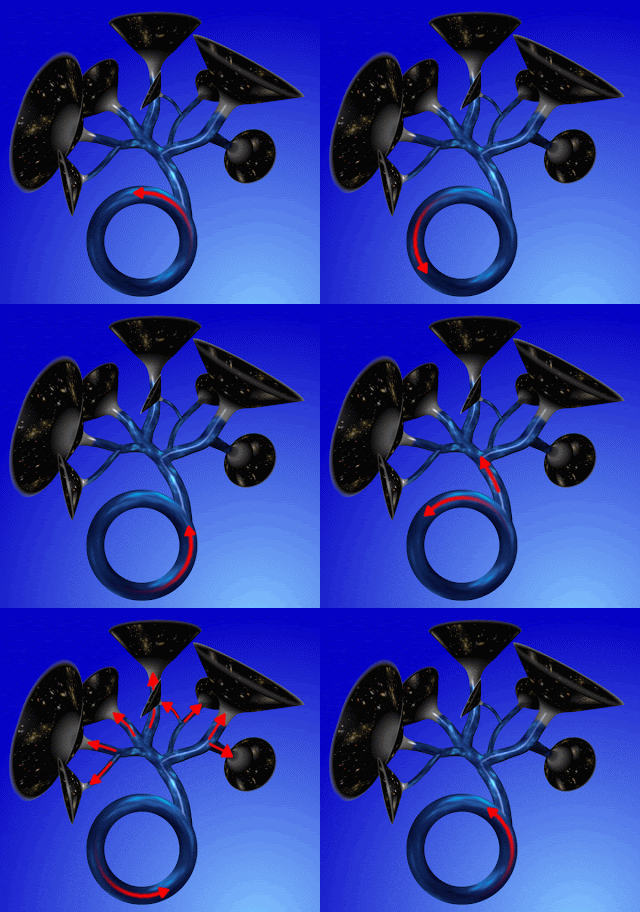
There's also variations of "self-creating universe" based on "closed timelike curves" spawning a tree of infinite branching universes... On the plus side, it doesn't rule out the laboratory creation theory - since the initial time-loop universe could also be created by an advanced civilization. Or time travel.
This totally realistic picture describes the infinite tree of time-loop universes.
Exercise pattern recognition. The modern beast Science!-based quest for onto-existential origins can be described as making up things, then representing them with quantitative semiotics - math. Essentially anything goes, so long as the absence of God is the starting point. Perhaps "the violent irritation of the vacuum" creates "baby universes". But the important thing to note is that the theories become more wild and far fetched as the earlier simpler models collapse under their own failure to account for even the limited and attenuated instrument-based experimentation we can perform.
The result is that the models have to get more bizarre and arcane as we try an answer onto-existential questions of origin with the intrinsically limited discernment of our logic and observation. This is a modification of a question from an earlier post with the self-creating multiverse above. The question is only more relevant.

It's worth noting that our limits of discernment can be falsified on beast system terms. Use some combination of observation and logic to either conclusively disprove the possibility of a metaphysical Creator. Or use some combination of observation and logic to lay down ultimate onto-epistemological foundations that pass every test and conclusively account for any and all subsequent developments. Langan claims that the CTMU does that. We'll disagree.

Asides relate to but are not necessary for the main post, so if you are finding it long, this isn't essential. It's probably best for readers new to the framework we've been working out over the last few years.
One of the limitations of the Ontological Hierarchy is the rigidity of separation between levels of reality. Cosmological numerology is based on the premise that a mathematical model and empirical observation are equally materially "real". Consequently, things like quantum uncertainty - which we can't observe directly - have to be reconciled with the experience of reality that we can. The Band would argue that contradictions between [the material world as it appears to us] and [logic-based epistemologies associated with abstract reality] are essentially different. Both are representations of a sort, and there are places where they overlap. But they aren't interchangeable representations of the same onto-epistemological "thing".

This graphic just rotates the earlier version of his [syntax-state reciprocal generation pattern] we've been using to better show the difference between his dual aspect within monadic unity and our hierarchical recognition of onto-epistemological difference. Poorly qualified as they are.
The concept of mathematical infinity is a good illustration of the overlap and difference. Math begins in quantity before moving to logical operations and quantity is based conceptually on observing material things. The idea of a number line comes from a simple count. True infinity can't exist in the material universe as it appears to us. But we can express it in terms of a number line that never ends.

In other words, something that is materially real allows us to represent something that can't be. Somewhere the idea of infinity involves an onto-epistemological crossing. Whatever and wherever that is.

There's a reason why the Band spends so much time on how knowledge and communication are dependent on representation of different kinds. What we call semiotic filtering. Take another look at the semiotic filtering graphic we keep turning to. The representation doesn't have to be a Bible - this post is a representation. Likewise your mental impression of it, but stick to the external forms for now.

Because everything is communicated in symbolic representations it's insanely easy to overlook two things.
1. Expressions of any form of idea or thing are different from the idea or thing. This isn't Langan's claim that the Kantian noumenal is too detached from infocognition to be meaningful. It's that even brute material reality is unbridgeably different from our expression of it. There are only more or less accurate representations.2. Representation reduces fundamentally different things to an illusory sameness. The Ontological Hierarchy uses words in the same font on a single graphic to represent differences as absolute as "God" and "earth". This creates an impression of sameness for conceptualizations of things that are the opposite of the same.
We'll look at how Langan tries to get around this with his concept of syndiffeonesis in the next post. For now, we need to consider where the authority comes from for this idea that materially constrained human knowing is the ultimate arbiter of the onto-epistemological foundations of... everything. Langan pedestalizes Wheeler, but he's standing in for a transformation in physics that happened...
wait for it...
...in the aftermath of the 60's

"Today, quantum information theory is among the most exciting scientific frontiers... [but] this cutting-edge field has a surprisingly psychedelic past. ...an eccentric group of physicists in Berkeley... studied quantum entanglement and Bell's Theorem through the lens of Eastern mysticism and psychic mind-reading, discussing the latest research while lounging in hot tubs. Some even dabbled with LSD to enhance their creativity.
It should be sufficient simply to point out that the material utility of quantum information theory != access to onto-existential antecedents. That a more accurate representation of a certain aspect of reality has no relevance to what is antecedent to the reality upon which the representation depends. But not only is it not sufficient. Enormous amounts of attention has been wasted by extremely smart people on the categorical impossibility of plumbing ultimate reality with "physics". Either the actual scientific discipline or the unsystematic spray of "Easterm" mysticisms and drug-induced fantasy.
It's worth noting that “Eastern” hokum has been a consistent way for beast narrative-huffers to avoid hard ontological questions. When the obvious limits of discernment in a secular transcendent epistemology appear, just reintroduce the metaphysical by calling it "Eastern". Remember that secular transcendence itself is onto-epistemologically incoherent auto-idolatry, so it doesn't matter if random supernaturalisms get stirred in. Just so long as they aren't Christian.

Obviously the Band is not adverse to integrating the epistemology of faith with logic and observation. The Ontological Hierarchy is based on it. But we are honest and transparent about what we are doing. And are just as direct about why we believe that our faith-based knowledge claims are consistent with what can be observed and logically determined.

And if this is reminiscent of our occult posts on the psychedelic occult...
Our hippie physicists would fall into the secular transcendentalist wing of our taxonomy from one of those posts.
A couple of notes. We are not calling Wheeler a drug-chugging occultist. From what little we know of him, he seems a respectable and accomplished academic. It's the parameters he lays out for a self-creating, self-ordering, self-observing universe fully accessible through human reasoning that puts him in this larger paradigm. That's the thing about "disciplines" that we covered in the past - click for a recent post. They're a form of representation that come to be taken for the subject matter that they were set up to represent. And once a discipline inverts into the end in itself, it's arbitrary terms and constraints get substituted for that subject matter. Once the discipline of physics makes this turn, those operating within the discipline follow. The point isn't Wheeler. It's just another example of Science! as something very different from the arbiter of truth it pretends to be.
.jpg)
Most people assume "disciplines" determine what is studied. The truth is that they also decide - and limit - how it's studied.
Jacking disciplines and twisting them from subject knowledge to preset beast assumptions and lines of inquiry is how our institutions were corrupted and inverted. But this is a bigger issue.
Langan is too smart to fall into the fantasy trap that pure scientific materialism can reach ultimate reality. The obvious gap between the complexity of his thought and what he brings in from Wheeler is one of the most striking things in the CTMU paper. We first started working through the paper as a sort of advanced homeschool-intellectual engagement project with the smart Bandling - the one between .5 and 1 SD of IQ east of us and an ongoing challenge to fully engage. SB called the transition from Langan to Wheeler "jarring". The irony is even his limited acknowledgment of metaphysical necessity precludes beast disciplinary acceptance.
Langan does acknowledge ultimate reality and even a “God”. But it’s an property of the [syntax-state reciprocal generation pattern] on the universal level and not an ontological prior. The primary teleological operator of the syntactically self-distributed, self-reading, and coherently self-configuring and self-processing SCSPL language of reality, in a quote given elsewhere. Teleology - the atemporal embedding of the future in the past that guides SCSPL function on the universal level - is the "will of God". We think this will raise problems of time sequencing. Though it does avoid having to acknowledge the supremacy of the Lord. The real problem is that departing from Wheeler also departs from his discipline’ paradigmatic assumptions about the nature of reality that we just went through.

According to the CTMU paper "...the Telic Principle is not without what might be described as theological ramifications. For example, certain properties of the reflexive, self-contained language of reality – that it is syntactically self-distributed, self-reading, and coherently self-configuring and self-processing – respectively correspond to the traditional theological properties omnipresence, omniscience and omnipotence. While the kind of theology that this entails neither requires nor supports the intercession of any “supernatural” being external to the real universe itself, it does support the existence of a supraphysical being (the SCSPL global operator-designer) capable of bringing more to bear on localized physical contexts than meets the casual eye." [page 38].
We'll break it down more in posts to come, but for now we're working through assumptions. So the SCSPL is the construct that is offered in fulfillment of Science!’s demand for self-contained self-generation and ordering. But Wheeler/CTMU also demand that the mind of the observer be brought into the process. From page 8 of the CTMU paper...

The Band's understanding of semiotic filtering and ontological priority order has problems with these axioms, but that's for later. Langan addresses the demand by conceptualizing the universe as a sort of self-awareness - the Mind of God - and crediting spectators with localized telesis within the universal telesis of the SCSPL. It's not easy to depict graphically, but we'll try.
First, the working of the human mind also conforms to the [syntax-state reciprocal generation pattern].

The CTMU also folds this into SCSPL by applying the same pattern to [observer theorizing] and the [informational content of the theorized universe]. So it isn’t just an objective laws of physics – physical universe [syntax-state reciprocal generation pattern], though it’s partly that. It's not just a thinker-observer [syntax-state reciprocal generation pattern] either, though it's partly that too. There's a human consciousness-physical universe [syntax-state reciprocal generation pattern] at work that puts the observer in the theory of reality.
Looking ahead, it's also central to another CTMU supposition - that the theory is potentially isomorphic to the universe itself. Something the Band - in a nostram culpam moment - at first thought was Langan tripping over the ontological difference between a [theory as product of human intellection] and external reality. The CTMU is built logically, so the isomorphy is conceptually structural. Ontologically analogous but logically isomorphic.
It looks sort of like this if we stay consistent.

But reality is constrained - remember the self-transducing process he calls telesis is atemporal because it's future-guided by his teleology. Or to stay with the brackets, teleology as [potential outcomes limited by future optimzation embedded in the past] working like an anthropic principle. His analogies are structural and precise.
Unbound telesis is a state of pure infocognitive potential reciprocally fixed through telic recursion. And the Telic Principle is a form of anthropic principle - a universal predisposition to produce humanity - guided by embedded future outcomes in the past. This is how Langan sails between the Scylla and Charybdis of determinism and Postmodern subjectivism. There is a universal coherence – stability of perception – and we do create universal phenomena through our choices and actions.
Telesis is built on his structural isomorphism.

We tend to think of his parallel [syntax-state reciprocal generation patterns] like analogies because we approach things in terms of levels of being and differences across them. So ontological differences jump out at us instinctively. It's just how our wide pattern recognition is wired. But logically, they're the same.
Structural isomorphs that therefore can be taken as the same thing within the same logical frame of reference. Regardless of ontological difference. With telesis, it's the [syntax-state reciprocal generation pattern] between the observer and the observed that is isomorphic. Combining our perspectives...
Langan's logical isomorphy expresses simultaneously through our different ontological states.
There's something vaguely familiar here for those familiar with the Logos expressing itself appropriate to the level of reality in the Ontological Hierarchy. Because Langan hews to logic, the CTMU has an internal commitment to truth in those terms. He's not a deceiver. His motivations are sincere. Like we said at the beginning, he's describing something that makes sense to him seamlessly. Given his initial assumptions. We would say that ontological distinctions matter. Because our being-in-the-world is material, logical isomorphy coexists with empirical or experiential differences in our material existence.
There are two "levels" of telesis - universal and local. Universal being the full SCSPL structure of reality itself. What Langan associates with "God".

Universal SCSPL telesis in the CTMU unfolds according to future outcomes already embedded in the past. This is akin to an anthropic principle because those outcomes include the production of an observing humanity. Link for graphic source.
SCSPL telesis according to a general utility principle – towards or pulled by optimal future outcomes. That's the embedded future in past potential. Telesis then is SCSPL generation constrained to a certain degree by yet-unrealized state. And since individual level telic operators are mutually self-transduced by the universal, they also combine variability and constraint. This accounts for the restricted freedoms of human free will and natural chance.
The future that is being created moving "forward" in time follows future outcomes moving "backwards".

The coexistence of future outcome in past potential is the source of Langan’s atemporality. This is something that we will look at more closely, but for now it’s enough to point out that the actualizing of telic potential isn’t just a one direction move from past to future. The future is contained from the beginning, so standard ideas of temporal movement don’t really apply.
This is one of his more complex explanations, and since this post is long enough, will wait for next time.
Local being individual sentient creatures fixing infocognitive potential into localized aspects of reality. Through localized telesis limited and constrained by the telic operations on the universal level. Whether divine will or laws of physics. [Choice within boundaries] would be Langan's Free Will to universal telesis' "Mind of God". To slide between analogies.
We’ll get into more of this later. What matters now is the idea that dual isomorphic telic creative processes coexist on different scales. Universal telesis creating the rough parameters that constrain the forms reality takes and localized telesis adding the subjective creative input of the individual. And thus accounting for Wheeler's participatory dimension.

The self-excited circuit concept is interesting [click for overview]. This is a graphic that Langan adopts from Wheeler to show how the universe self-develops the capacity to observe itself. And in self-observing, defines itself as an existing phenomenon.
The idea that "ancient" light responds to current observers indicates that material reality directly empirically experienced is different from how we experience it instrumentally. And that our discernment is not consistent across levels of "perception". The unanswerable question becomes whether this is an intrinsic limit on our understanding or an intrinsic subjectivity in "objective "reality. Is it us or the universe? Wheeler's insistance on fundamental binary distinctions - it from bit - implies it can't be both.
Langan complicates this by differentiating between individual observer telesis on a localized scale and SCSPL telesis on a universal one. As we mentioned at the beginning, there's a lot of sliding between logical isomorphies - or levels of ontological analogy - going on here. The universe is self-fashioning and we self-fashion it theoretically in a convergent process. But at the same time, our ability to determine reality - individual level telesis - is limited by external reality - universal level telesis. Break the graphic down in two concepts.
First the analogy slide. Just replacing the [observer theorizing] and [reality] concepts with graphics of the [syntax-state reciprocal generation pattern] that makes them up. Just a straight-up substitution that better shows the intertwined isomorphic logical structure.

But the individual telic operators also work symbiotically within the universal where they are limited by it. Here it's the universal self-transduction that constrains the potential of localized telesis. Like this, if size represents ontological priority.

This is where Langan becomes more metaphysical in a sense. The human mind is an isomorph of the divine mind - we're structurally the same only constrained in another way by its universality. We are part of a perpetually self-creating self-aware cosmos - made in "God's image" and able to create in "God's image". Internet interview quote -
So the CTMU is essentially a theory of the relationship between mind and reality. In explaining this relationship, the CTMU shows that reality possesses a complex property akin to self-awareness. That is, just as the mind is real, reality is in some respects like a mind. But when we attempt to answer the obvious question "whose mind?", the answer turns out to be a mathematical and scientific definition of God. This implies that we all exist in what can be called "the Mind of God", and that our individual minds are parts of God's Mind. They are not as powerful as God's Mind, for they are only parts thereof; yet, they are directly connected to the greatest source of knowledge and power that exists. This connection of our minds to the Mind of God, which is like the connection of parts to a whole, is what we sometimes call the soul or spirit, and it is the most crucial and essential part of being human."
We’ll wrap up with this [phenomenon is only a phenomenon is observed] formation that is common in many areas of thought. Though nowhere where anyone actually behaves in real life as if it were true. Because reality is - as Langan notes - perceptually stable. That it appears consistent regardless of who the observer is. The way everyone passes through the same gate without anyone perceptually opening a different passage through the wall...

We all exist in the realities that we perceive. And there are subjective differences between those. But there are also objective consistencies that don't change. It's why the postmodern idea that we create reality through "discourse" was retarded enough to cancel out the institutional credibility of "university".
Our subjectivities are embedded in an external stable objectivity.
It is true that we only know reality through our perceptions of it. And that out perceptions are products of accumulated sensory interface with a subjective dimension in an objective and stable - if directly inaccessible qua itself - perceived framework. We just disagree with the assumption that finding logical isomorphy between [our perception of reality] and a [material reality that factually preexists the temporal genesis of our senses, consciousness, and us in general] makes their ontological differences insignificant.
For Langan, the disharmony between participatory universe and perceptual stability is accounted for with interacting and embedded teleses. Subjective perception fixing reality locally within perceptually stable parameters fixing reality universally. And with “past” potential narrowing and optimal “future” proliferating in conspansive simultaneous self-generation.
For the Band, disharmony between logic and perception indicate limits of discernment behind the representational limitations of semiotic filtering. Semiosis includes causal relations, but sequenced. And that looks like a form of temporality. Staying with the brackets, temporality as [inherent structural necessity of one-after-the-other sequencing in the semiotic nature of symbolic logic].
Bringing us to the last of the starting assumptions.
We noted the Science! pattern where no onto-existential model is too far-fetched, so long as it disallows God. Methods can include unacknowledged unverified faith-based claims, "Eastern" supernaturalisms, acid, creation ex nihilo - pretty much anything [not Christian]. Now consider that the occult as a conceptual system also has a foundational need to reject Christian metaphysics.
There’s another pattern we've noticed over the last several years. This one is in occult thought. Where "higher truths" aren't more refined or clearer versions of our blurry material perceptions. They're "revelations" that [what we think we see] is completely opposite to [what is secretly true].
Christian teleology moves from a point of Creation to a terminus under the un-fully-knowable will of God. This exceeds our perception of sequenced causality in time, but is not inconsistent with it. Science! presents abstract models of time and space that contradict our empirical perceptions. “Occult” secrets that reduce the conditions of human existence to fundamental meaninglessness and error. One might ask the real practical purposes of such exercises. Readers have an inkling…

Rejecting a Creator means our perception of sequenced causality in time becomes a problem. Hence the various attempts to postulate a gamma secret [true nature of reality] where things can be sequenced and time eternally recursive at the same time!
Like the universe as hypertorus. Or Langan's teleology as future outcome steering past potential setting future outcome...

The idea that temporally sequenced actions are actually recursive does contradict Christian temporal similarities between the metaphysical and the material. But they have a long history in occult inversion.
Just a pattern...
Actually atemporality would be simultaneous and unsequenced. An actual "infinity" unimaginable to human intellect because the very nature of human ideation is time-sequenced. The ultimate ground against which [thinkable] is defined. On the ontological hierarchy, we'd place it beyond the last limit of discernment. True transcendence within which human materialisms unfold. The Real Presence in the apophatic darkness of the mystics. But that's only known by faith.
Enough assumptions - his and ours. And enough big picture so that we can start looking more closely at the main steps and ideas in the CTMU paper next time.