Showing posts with label vertical ontology. Show all posts

Sunday, 17 April 2022

Approaching the Colossus


We've mentioned looking into Christopher Langan’s CTMU reality theory on a few occasions. This post will introduce that project.

If you are new to the Band, this post is an introduction to the point of this blog that needs updating. Older posts are in the archive on the right. Shorter occult posts and other topics have menu pages above. 
Comments are welcome, but moderated for obvious reasons. If you don't see it right away, don't worry. We check regularly and it will be up there.

Image adapted from Colossus by Alex Olmedo.


There are a few things to consider before examining Christopher Langan and his CTMU (Cognitive-Theoretic Model of the Universe) reality theory. It represents a singular challenge for us and is not something done lightly or in a single post. This will lay out those considerations - the whats and whys as well as our own relevant strengths and limitations. The Band usually avoids being explicitly personal, but that same singular challenge forces us to be more self-conscious for reasons that will be clear. After this post, there is some scheduled business to attend to before returning to Langan and the CTMU. Another installment to the arts of the West and a wrap up the recent tour of the House of Lies with some implications. But by then we should have finished enough of our long-running preparation to come back around and get into the CTMU directly. 

Start with who Chris Langan is, what his reality theory is, and why the Band is interested in looking at it. The first two lead into the second – his intellectual profile as world's smartest man and the ambitious nature of his project make it a formidable challenge to the Band’s essentially Christian world view. Click for a link to the main CTMU paper that we are working from.


That relatively few people can even understand the CTMU makes this more important to address. The opacity lends a mystique to the theory that isn’t Langan’s apparent goal – in our experience he is as direct as his material allows – but exists all the same. Not being able to read it means not being able to assess it. This is apparent in the whiffing of his critics, whose dismissals reveal their own comprehension limits and will be addressed in a moment. But it also means that those not given to triggered gamma self-immolation can't determine how it relates to their own beliefs either. Awareness that someone of Langan's ability has declared a conclusive answer to the nature of reality becomes more rhetorically potent if that answer is unreadable. We propose to read it.

That gets to the challenges his thought presents for us, and how we can work around them. The CTMU is Langan's signature achievement, and that same intellectual profile that gives him his credibility eclipses our not insignificant cognitive abilities. This means our reading cannot claim to be definitive, nor can we comfortably second guess Langan's intentions. Unavoidable artifacts of being eclipsed...


But challenges also bring benefits. Engaging the CTMU forces us to push our limits and stretch our thoughts in unfamiliar ways. A recent post on parameterizing the concept of church over time would not have occurred to us without reading Langan. Likewise the addition of deontology to our Ontological Hierarchy. Before we start, we expect to further refine our ontological hierarchy as a way of visualizing basic relationships of reality as broadly conceived. Even our definition of reality emerges as something in need of clarity.

Plus it’s really interesting. The inherent challenges of the CTMU means it gets way less attention than it deserves. If we can remedy that in our small way, then we should. 


Take the  "conspansion" diagrams from the linked CTMU paper. This refers to how objects and events "shrink" internally through the parametric production of future states within present ones over time. So that the universe appears to expand relationally. Con-spansion - simultaneous contraction and expansion.


The mechanism of conspansion is akin to how further defining a set simultaneously increases the number of elements while attributively contracting the range of possibilities. This is an important aspect of Langan's conception of the universe as reflexively self-fashioning, and it's derivation is typical of how he melds knowledge domains.

Langan is someone we’ve mentioned on a few occasions. He's sometimes billed as the smartest man in the world, and with an IQ that may top 200, there’s no point quibbling with the provability of that claim. It’s certainly close enough to give an accurate indication of the scope of his intellect. Just reading his CTMU and contemplating it in its totality is sufficient corroboration of his cognitive profile. 


The numbers may not be exact. But it puts things into perspective.

To be fair, that is a flacid definition of genius at the top. The Band defines genius as intelligence plus accomplishment. High ceiling and something memorable achieved with it. 


We are not interested in debating whether the CTMU is a work of genius-level accomplishment - it may well be. But his pure cognitive firepower is overwhelming. The conceptual shifts, complexity of integrated structure, intensity of information density... The sheer scale and integrated scope of his vision - if you can see it - is awesome.


The Band realizes that the masses tend to be most impressed with mental feats, and he has plenty of those in his bio.


But Rain Man-type savants also perform amazing mental feats and no one really cares about their opinions otherwise. Let alone looking to them for theories on the nature of reality. And that raises the central problem for Langan’s public profile and the related lack of attention on the CTMU. He's too intelligent for most of his critics to even grasp what he's saying.


This is where the comprehension gap comes in – the inability to meaningfully communicate or comprehend beyond a certain difference in intelligence. 


The comprehension gap problem is exacerbated for Langan by the Dunning-Kruger effect, the related currency of false authority that makes up "academic expertise", and Vox Day's socio-sexual hierarchy. The first refers to the tendency of the mildly clever to think of themselves as much smarter than they are. And since they can't meaningfully "see" past the comprehension gap, they can't perceive their own limitations. This is endemic in university where such midwits obtain mastery of some "discipline" - itself a flawed silo that at best partly represents aspects of reality - and confuse it for actual comprehensive understanding. Like physicists blathering about numerological solutions to questions of existential origins. Highly proficient within a certain disciplinary silo, but too limited to see either the intrinsic limits of themselves - or their silo - for the problem at hand. 


An IQ of 130 is pretty rare. Most physicians don't have one. Neither does the average professor. It's also inadequate for the sort of theorizing that the Band does. Let alone the likes of Langan.


Vox Day's socio-sexual hierarchy is an immensely useful concept that we've posted on before. The comprehension gap problem is compounded by the extraordinary number of gammas in that midwit zone and in the appeal to "scientific authority" camp. Not only can they not perceive the difference between modern institutional scientific presuppositions and the scientific method, their entire fake self-perception of "genius" is predicated on the misperception.

When confronted with things outside their little silos that contradict their assumptions, retarded ironic defensive rage ensues. And they mentally and psychologically can't see it.


Langan's combination of incomprehensible intelligence, embrace of physicality, and complete disdain for credentialed authority is a trifecta of gamma triggers elevated to Platonic Form tier.


Here's a perfect example of a not all that bright gamma taking issue with the idea of the communication gap. Click for a link. This gamma's certainly not a 130 - probably closer to slightly above average. A 110 perhaps. Note how the headline promises a "myth" before moving into a tepid appeal to methodology as the metric of reality. It ends in a quibble, conceding to common sense that intelligence gaps impede communication "but that this always does happen once a specific difference in IQ points is reached seems doubtful”. We can't guarantee a precise magic number... is a conclusion considerably different from the impression given by the headline. And almost certainly by design since a journal knows better than most that more people skim headlines than process articles. Being well more than 2 SD north of said gamma, we'd guess the motivation is a mix of misunderstanding and butt hurt. 

Imagine what Langan has to deal with...
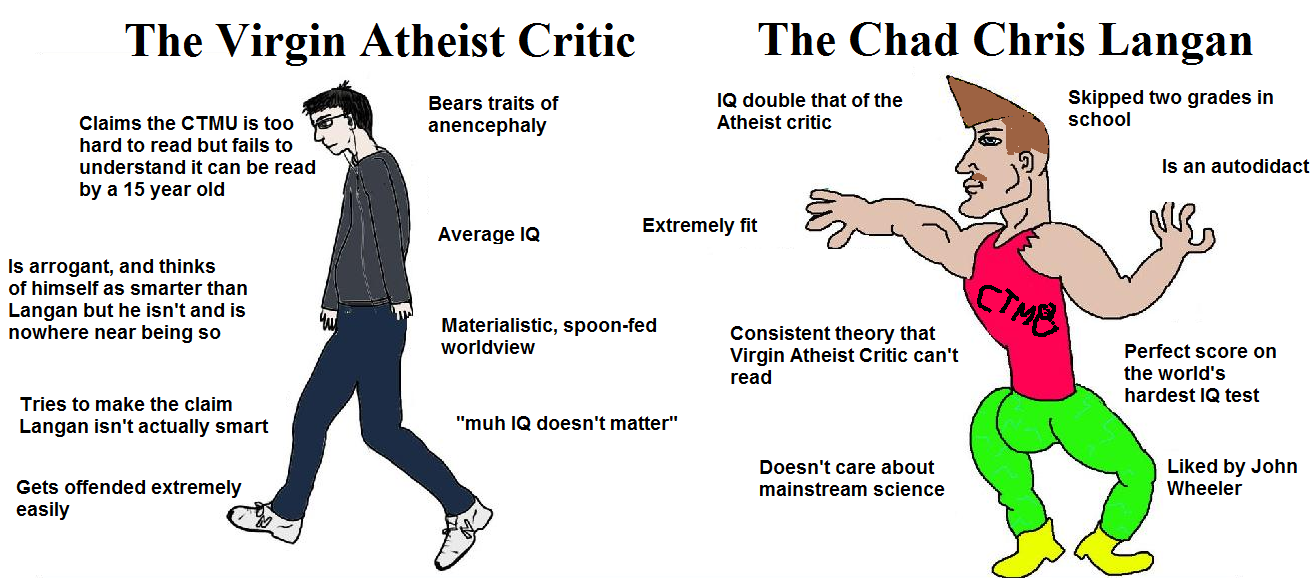


Perhaps we can rephrase.

It is impossible for much smarter people to discuss smart things with significantly less smart people. And painful to learn through experience that they can’t. 

This is neither arrogance nor insult, any more that noting a giraffe can see further than a porcupine. IQ has some inexactitude that comes with any assignment of a precise number for a multifaceted attribute. But differences in overall cognitive ability are painfully clear. If this is troubling or upsetting, that’s a measure of not being that smart. If they were smarter, it would be as obvious as sunrise. The alternative model is the midget opining emphatically on a shelf he can't see.


Drop below a certain point and metaphoric thinking isn't possible.

If that's not the case, it's easy to grasp with a visual metaphor - the big one doesn't fit in the little ones.


The two standard deviations difference in IQ, or about 30 is a rough measure, not "mythic". IQ is a general summation while individuals have aptitude peaks and valleys within that. In some areas they overperform and in others underperform. Nor does it mean that no communication is possible – the Band has shared basic information and instruction across about a 6 SD gap or ~90 points. What is means is that beyond a certain gap, unfiltered full capacity of thought isn’t meaningful communicable. The composite frame of reference, interlocking conclusions, shifting secondary implications, and conditional consequences can’t be cogently grasped. The person on the upper side of the gulf has to slow down and simplify, and this isn’t intuitive either. 

Some perspective.

We aren't just blathering. At peak, the leader of the Band has tested at slightly above 4 SD over the US average of ~98. 


The most generous evaluation of our absolute peak, graphically presented in maximal gamma triggering format.


Thought experiment. This is highly speculative for several reasons, but consider that an approximate range of 30-50 is applied to chimpanzees. Very approximate and not uncontroversially - species differences undermine the applicability of a human metric to a non-linguistic animal. Adding to the imprecision - the Band was a relatively late bloomer rather than a prodigy, meaning the relative gulf peaked in the later 20s. On the other hand, animals exhibit some pattern recognition, basic cause and effect logic, and reality-based learning  that human FTS-2 doesn't. That skews the comparison the other way. So very generally...


If we take that as a rough marker, the gulf between us and our average classmate was at least comparable to that gulf between our average classmate and a chimp. Basic communication could be bewildering, group interests inexplicable, and over time we learned through negative reaction what and how we could say things. We also became adept at detecting thought structures and capacity in others. Fortunately, once we realized what was happening we learned quickly. 

Think about that for a moment though. The need to "learn" people has nothing to do at all with psychopathic coldness. It's an illustration of how much of a factor the gap can be on interpersonal experience.


Now we instantly disengage the moment some contention or dispute reveals a limited comprehensive capacity, There's no point in continuing because it's not an issue that more information can fix. The gap also means is that someone in the middle of the bell curve becomes incapable of even recognizing extremely high intelligence. Because it falls outside their ability to process or comprehend. They can't think it, so they can't "see" it. The highly intelligent can be shocked at what registers as “smart” to the masses. That's because it has to fall within rough gap range from the average - otherwise it doesn’t register at all. 

This is where mental feats come in. They seem like little bursts of mental magic totally beyond the powers of even what passes for a smart person to the masses. Ways to make the otherwise invisible register. But from our perspective, the exceptional intelligence tells are functional. Information processing speed and capacity. Working memory. Ability to combine ideas across knowledge domains to generate insights. Pattern recognition of all kinds. Logic. Learning curve and adaptability. The list goes on, but it makes the point.

Now, Chris Langan has an IQ between 2.5-3.5 SD above ours


We had to extend the graph. And it shows. We are way outside of his gap. On the wrong side. Talking intensely with us would prove tiresome and limiting for him in significant ways. The chimp analogy starts to become uncomfortable. But the whole point of getting unusually personal and sharing out experience above was to point how widely we can see. Especially when it comes to the wide-scale associative conceptual abstraction and association we’re best at. There's tons of technical knowledge and ability that we are ignorant of, but we are not accustomed to struggling with well- presented complexity. And we can barely see what he's doing in a holistic way. Taking in his conceptual scope, intricacy and information density maxes us out in an unfamiliar ways. 


No one not to the far east of the bell curve could write the CTMU.

Let alone present it as cogently as he does. We certainly couldn't have produced it. It’s all we can do to keep it in sight at times. And yes, we are aware of the charges his wording is unclear or there are too many neologisms. How else does one use language and concepts derived from disciplines to address questions that the disciplines are incapable of addressing? That's precisely what we are talking about when we bring up comprehension gaps.

Speaking of triggering...


The scope, information density, and conceptual richness are simply too much even for most smart people to hold onto. So they quibble with isolated aspects that they can grasp, while missing how those are subordinated to the larger structural logics. But “disciplines” are self-evidently insufficient on their own - otherwise they'd have answered the big ontological questions they've instead whiffed on. Most of Langan's critics can't even see the onto-epistemological limits of the disciplines they base their critiques on. That they self-actualize through. Making them incapable of the critical stance they profess to take. 


Instead we hit limits of discernment and make-believe. And as any exceptionally intelligent person has experienced when "arguing" with someone who can't grasp the limitations of their frame of reference knows, the problem isn't lack of information. It's a lack of processing capacity. They can't simultaneously grasp their disciplinary silo and it's place in larger integrated infocognitive frameworks. Making a meaningful sharing of ideas impossible. If capacity limits could be surmounted, they wouldn't be... capacity limits. There's a parallel between the limits of disciplinary range and the limits of the discipline-huffers who can't see them.

But instead of recognizing limitations, beast-huffers prefer self-indicting rage over the reality that people more intellectually capable than them are aware of realities that surpass them.


A crude analogy is attempting to explain to a baby in a certain developmental stage that it doesn't become invisible when it covers its eyes. The conceptual capacity isn't there to process the necessary contextuals to grasp the why the frame of reference is inadequate. 


In various interviews and other comments, Langan has expressed annoyance at being ignored by the mainstream knowledge industry. What a sham academia must be if there is no place for someone of his obvious intellect. He is correct that it is a sham, but that’s not the only issue here. He’s too smart. Consider what the Band has written about university in the beast era. Where on earth would someone 5 SD north of the professoriate even be understood? Or as the smart Bandling - the one east of us on the bell curve - pointed out, what discipline would he teach in?


This isn't the operant principle in practice that official science - Science! - actually runs on. That dances to beast narrative. Honest description or identification of what is objectively real is not at all the point.  


If there is one thing Langan appears to miss about beast science, it's that the free-wheeling gonzo physics that captured his imagination in the 70s has nothing to do with academic science as an institution today. There are the odd intellectual outliers scattered hereabout. But they work in self-absorbed isolation. They certainly aren't charting the institutional course. The system itself exists to perpetuate beast narrative atop a self-evidently fake materialist onto-epistemology. It doesn't want to identify reality. So there's no place for someone who does. And the sort of self-indicting atheistic clown posturing on the internet is definitionally not one of those intellectual outliers. Meaning the [recognize the gap and disengage because it's pointless] axiom has to kick in.


The CTMU is described as a “reality theory” or theory of everything, although trying to classify it hides as much as it reveals. Most attempts at a grand theory of everything to explain the totality of reality and our existence in it start from purely materialist assumptions. This means they can never answer the question of origins in a satisfactory way and are necessarily DOA. Necessarily because the origin is the most important element. And if limited to material causality, the genesis of the material is outside the possibility of explanation. 


But one miracle means no longer operating in the strictly material. And that means that the system now has to account for the role of metaphysics. Failure to do so renders the game pointless. Lucrative, and lots of titles, accolades and nice buildings, but pointless.


The pretense that a purely materialist framework can address the origins of the material makes ultimate answers impossible. Which keeps the massive institutional grift paying out until the wheels finally fall of systemically. And that means a steady market for endless flings of made-up spaghetti at the discursive wall. None of which will ever stick - because they can't - or even be remembered in a few turns of the cycle - but are  good for the resume in the moment. Click for an example that is actually revealing, just of things other than claimed.

With sufficient cognitive horsepower, a pattern emerges in the materialism grift where the theorists’ primary purpose appears to be denial of human significance. 


It’s a fundamentally satanic perspective where rejecting the metaphysics of Creation or the inborn sanctity of man is the goal. This invariably consists of manipulating some equations, then declaring them keys to the fundamental nature of reality. While assiduously ignoring how this structure came to be.

And believers in this mythopoeia will attack the CTMU as not being empirically verifiable or predictive...


Langan sees through this ontologically-gelded myopia instantly and set out to build the CTMU to consider the physical and the metaphysical. Including the problem of origins. But that means rejecting the entire flawed onto-epistemologial and semiotic frames that modern institutional Science! takes as starting axioms. A non-starter. And an example of being too smart for the discursive silos that make up modern academe.

Then throw in the Dunning-Kruger gammas...


The CTMU is built completely differently. It accepts certain scientific premises, but is an attempt to theorize the totality of reality by working logically from what that must entail. Given that there is a reality that we can perceive and engage in some fashion, what is necessary for that to exist? This leads him through a dizzying array of ideas and conclusions that we’ll try and break down when we engage the it directly in the posts to come. 

And this gets to why we are motivated to address Langan and the CTMU. Readers of the Band know that our world view is fundamentally Christian. We do accept that there are aspects of scripture that are allegorical and limits to a fallen intellect looking at a valley of shadow through a glass darkly. But we also believe the account to be essentially True. Divinely inspired Truth, in fact. Creation, the Fall, and the necessity for redemptive sacrifice. Over the course of the Band we have reasoned to our satisfaction that what can be known logically and empirically of reality is consistent with those metaphysical aspects that are beyond our apprehension. Click for a post.


Different context but the point stands. We have no problems accepting limits of discernment and understanding. We're finite and fallen.


The CTMU acknowledges the metaphysical, but conceives of it's relationship to the material in a more continuous way that we would. It arrives at a concept of God, but with a recursive tautological account of universal self-creation that isn’t compatible with directed Christian Creation. This means that the smartest man in the world has devised a reality theory that differs from Christian dogma in significant ways but can’t be dismissed out of hand like the materialist numerology of beast Science!. A much more serious thing that it would be were it granted the academic attention Langan has mentioned. That's onto-epistemological erasure. This is much different.

Given that the Band’s motto is what can we know and how can we know it, we are almost compelled to visit such a creation. Not to try and “disprove” it – we aren’t capable of that without misrepresenting the complexity. But to ascertain how and why it differs from our Christian notion of Creation. And to see if there is anything that we can learn from the exercise. 


Readers are also familiar with our Ontological Hierarchy – the graphic representation that ontology and epistemology are layered and related from a human perspective. 

This is the most up-do-date version of it, with binding logos between ontological levels, the extension into self-erasure of evil, and the related epistemological and deontological tiers on the right. The need to add explicit objective morality came to us from an earlier reading of Langan. The Good, Beautiful, and True are old Platonic terms that just refer to abstract qualities of ultimate reality as it crosses into the capacity for temporally-sequenced human conceptualization.


The Ontological Hierarchy isn’t a reality theory per se because it acknowledges a noumenal or transcendent “level” that can’t be theorized beyond the necessity of its existence. Nor are the transitions between levels perfectly quantified, partly because theoretical quantification isn’t applicable to understanding all levels of reality. It’s a form of abstract epistemology that is of limited descriptive value for empirical reality and not of value at all for ultimate. This is one assumption where we diverge from Langan. Different but interrelated and tied together by Logos describes the aspects of our being-in-the-world without comprehensive theoretical unity. 

We also assert that there are intrinsic limiting filters to the human ability to grasp onto-epistemological clarity. 


Langan does address we're calling "the viewer’s share" – the reality that reality only exists to us in our perceptions of it. His concept of telesis implicates us in the formation of the universe as localized telic operators or telors. We would suggest that this improperly conflates representation and reality. Langan suggests the reality and representation are isomorphic to the point of conflation. More to come in later posts. 


Quantum uncertainty involves a viewer’s share as well. Though there, the incompatibility between the abstract formulas and human perceptual experience suggests opposite sides of an Ontological Hierarchy divine. Or limits of discernment, where abstract quantitative reasoning fails to correspond with fallen empirical perception. Langan doesn’t differentiate between onto-epistemological levels but prioritizes logic in a single unified conception of reality. This is also something we’ll take up in detail later.

The other is something Langan doesn’t take up and yet another thing we’ll look into further. That’s the semiotic filtering – the communicative reality that our discussion of any level of reality is dependent on material signs. 


Letters, numbers, and pictures. Reality may only exist to us in our perceptions, but our perceptions only exist to others in our signs. And representation is materially different from the thing represented. Even if the conceptualization that results - the mental picture - is the same.


Langan conceptualized reality in linguistic terms – not identical to human language, but an SCSPL or Self-Configuring Self-Processing Language. Where processing and configuration, syntax and content and mutually generate in total self-containment - to the point where SCSPL "linguistic" expression is perfectly homologous or identical with the reality it describes. Reality becomes infocognition - information "content" and cognitive processing "syntax" as one indivisible reciprocal reflexive self-fashioning. Where theory of reality and reality are isomorphic. What we call semiotic filtering would add that his act of theorization results in a material construct intended for readers. Is this significant?  

The Ontological Hierarchy is not a reality theory because it doesn’t offer an comprehensive explicatory theoretical account of reality. It is a descriptive visualization of how reality appears to us, meaning that the viewer’s share is built in. We aren’t dependent on any philosophical model because philosophical models are inherently limiting. But if we had to find the closest analogy it would probably be phenomenological because we assume an “objective” – meaning external – reality that temporally precedes our existence in it


Bernard Jean Corneille Pothast, A Happy Family, 20th century, oil on canvas, private

This is what we mean by “material reality”. A physical environment known empirically with apparently consistent properties that we are born into and come into consciousness in. Catch a ball, hear a noise, bump your head – all are purely material aspects of being in the material world. Infants and animals respond to physical stimuli. Before we can think, we are.


Robert Hannah, Master Isaac Newton in His Garden at Woolsthorpe, in the Autumn of 1665, 1850s, oil on canvas, The Royal Institution

Abstract thought – logic – extends thoughts beyond the purely sensorial material. This is where we hypothesize things that can’t be seen – everything from moral principles to… well… reality theory.


The Ontological Hierarchy is hierarchical because the things known abstractly that can’t be perceived directly are considered “more” true or real than the material things that can be. This is the epistemology part of onto-epistemology – the modes of knowing abstract realities are considered to be of greater truth value that the subjective and unreliable senses. Abstract reality itself is timeless and unchanging - unlike entropic, shifting material reality. This is how we get to ultimate reality as the most True and faith the most certain.

Langan recognizes that a noumenal ultimate reality in a Kantian sense is external to his logical-empirical account of reality and excluded as a result. Faith doesn’t really enter into his work.


His ultimate reality/God is the level of reality that has no ontologically or temporally prior explanation or situatedness. But he does assume that it can be adequately framed through conceptual structures of abstract human logic. And like the parameters of a set, distributes across all reality "below". Another point for closer scrutiny.


The Band perceives the levels of ontology and modes of epistemology as appropriate to their own domains. If you need to eat, material activity is more pertinent that mathematical formulas. But obviously there is overlap – mathematical formulas can lead to higher material crop yield. This means that there are continuities as well as differences along the OH. Humans themselves have aspects of all three – body, mind, spirit – despite inhabiting material space and communicating with material signs. We realize that we can be accused of a dodge - claiming not to be a reality theory lets us off the hook by leaving the connections somewhat vague. But that's also the recognition of our intrinsic limitations. We are not being clever when we sidestep ontological continuities. We aren't clever enough to fully grasp them.

Another motivation behind looking at the CTMU is to see how someone much smarter addresses some of these questions. The hope is that it may clarify and refine our own descriptive efforts.

Then there is the issue of temporality.  


Empirically, time seems basically linear – we are born, days pass, we age, days pass, we die. Consciousness begins and ends. Whatever happens after is after. Temporally sequenced. 

The problem emerges when we attempt do translate the experience of time into the semiotics of abstract quantification. The language of math.  


Physicists can show that mathematically, time is neither constant nor theoretically linear. 

Higher dimensions likewise allow for the possibility that our perception of temporal linearity is a limit of our three-dimensional existence. And yet...


Sequencing still happens. The theory postdates the theorist. The world precedes the perception of it. We don’t exist materially prior to birth. After birth, we do. We are small before we are big. And any creation is preceded by its creator. These are material facts of existence. And any string of numbers or printouts that say otherwise are a) largely irrelevant to material existence and b) things that come into existence after the person who created them. 

Thought experiment.


Yahoo Serious, Young Einstein British Quad Movie poster, 1987; Salvador Dali, Profile of Time, conceived in 1977, first cast in 1984, bronze


Consider the paradoxical results of  material-abstract relations with theorizing the relativity of time as an example. The physicist has to appear before the theory. Therefore time either exists objectively and prior to the physicist with extant properties awaiting discovery or the relativity of time is created - spoken into existence - by the act of theorizing because reality is created by the observer. Since the stability of the perceptual universe is an anchor of Langan's theorizing, we suspect he would lean towards the former. But in either case, the sequential arrangement of material physicist then abstract theorizing supersedes any relativistic conclusions the theory draws. Relative rates don't effect priority order. And sequencing implies some sort of temporal dimension.


See the differences between linked onto-epistemological levels? Their importance becomes clearer when we realize that theory is a semiotic artifact that appears at a moment in time.


Langan theorizes reality as a self-generating linguistic process where the syntactic operations and content are mutually recursively self-creating. His formation is actually much more complex than that– we are not doing it justice at all and will be more through in posts to come. But even with temporal recursivity in what he calls telesis – the reality-forming work of telic operators general and localized – verbs are used. Descriptive action. And that implies some sort of sequencing. Bringing us to  temporality.


This is different from what the Band refers to as true a-temporality. The absence not only of time as a physical property, but of any sort of before-after sequencing at all. We associate this with ultimate reality. Before the Creation. It is something we cannot even conceive of because thought itself is sequenced. But the definition of a temporal sequence presumes the preceding a-temporal originary state from which it comes. That's what the Band calls God qua God. Not the identity of an extant reality, but the apophatic ground against which Langan's totalizing definition of reality is positively conceptualized. The latter is closer in relative ontological scale to a Neoplatonic world-mind or demiurge than true transcendence.

And if the smartest man in the world - who juggles knowledge domains like data points and acknowledges the necessity metaphysics as well as materiality reasons out an alternative to our Christian framework? That's something we have to address seriously. Because not many can

We're not 100% sure we can. And that brings us to why this has taken so long. 


We may not be smart enough. 

The Band does possess certain attributes that do equip us for this sort of task. Like Langan, we see the intrinsic limits of “disciplines” and recognize the need to treat knowledge and thought as unified wholes. We are also comfortable combining disparate types of concepts to build composite structures and insights. For example, we don't care whether he uses "set theory" in orthodox ways, only the meaning of the ideas his usage expresses. But the IQ gap means he is far more capacious in what he can bring together and cognitively powerful in generating structures and insights.


In our thinking about thinking post we described how greater intelligences can pull together more information and connections and by holding more together at once, see broader and more complex patterns. Langan can encompass so much at once and manipulate vast fields of data through overlapping lenses. We get the impression that the whole CTMU exists in his head as a fluid logical totality. And that he can work on it in that totality. We can't hold the whole thing. Where he is holistic, we have to become sequential and rely on extensive notes. This means we don't see it the same way, opening up all kinds of possibilities for misunderstanding.

It is true that IQ is a general measure and that individual aptitudes within it vary. 


These sorts of breakdowns always understate the interrelated aspects of intelligence. But it does a good job of pointing out how many components there are to it.


The Band is especially strong at broad abstract conceptual visualizations and pattern recognition across domains. The skills most needed to follow something like the CTMU. In these areas, we may even scrape the bottom of the gap between us and Langan. We are also inclined to think past and across disciplines and recognize the limits of materialism, making Langan's approach intuitively sensible to us. This mix of aptitude and attitude is not common - it's why we observed there are not many who can take this up. But it still may not be sufficient.

A general average means peaks come with valleys.


 As the interminable typos in our work show, we are less inclined to fine detail and precise accounting.  We can barely glimpse his big pictures but his information density just blows us away. At times, the CTMU seems fairly clear and at others it’s a fog of symbols.


The time has been necessary to even try and do it justice. We only have limited time for the blog. And there's never a point engaging a straw man of your own making. In addition to the CTMU paper we’ve watched an in-depth video - which is something we never do – in order to better understand. But ultimately we are on the unfamiliar ground of not being sure we haven’t misunderstood an important idea or missed a significant implication. As such we will be more cautious and less aggressive than usual. 

We can't critique his logic. The nature of the CTMU is that it subsumes anything sententially real. And anything that isn't sententially real is excluded from the reality that the CTMU theorizes. Tautology - true statements in any circumstances, or statements that can't not be true - is a basis of Langan's theory. 


But we can discuss some assumptions and framing. So that's where we'll be focused.

We respect Langan’s work and his self-evidently vast intellect. We even hope to learn and evolve from him. The encounter is humbling. But it’s also necessary. And we don't need to discuss ourselves any more, but please feel free to share any comments.

We hope our readers will enjoy it.


Montague Dawson, Galleon in Moonlight, 20th century, lithograph


Monday, 18 May 2020

How Words Mean - the Power of Symbolic Communication


Lilly Martin Spencer, Reading the Legend, 19th century

If you are new to the Band, this post is an introduction and overview of the point of this blog that needs updating. Older posts are in the archive on the right. Shorter occult posts and reflections on reality and knowledge have menu pages above.
Comments are welcome, but moderated for obvious reasons. If you don't see it right away, don't worry. We check a couple times a day and it will be up there.


A couple of posts ago, we thought about what art means in the West and put together a rough framework [click for link]. This was needed if we are going to understand the road through modernity. But this raised an even more basic conceptual question - how do words "mean" anything at all?


Why does it matter if some pictures are called "art"? How does naming something have any effect on its nature if a name is just a label? These aren't idle questions. The main theme of this blog is what we can know and how we can know it - we spend a lot of time sorting out ways to find meaning in the world around us. And all this is done through words - other sign systems too but words mainly. We can use "symbolic communication" if we want to be more comprehensive.  But by any name, false attitudes to language and symbols are something Postmodernism and the occult have in common.

The importance of symbols and meaning goes beyond personal interest. Language guides thoughts along conceptual trails - control it and you control how people understand the world. We can put this one alongside the 'what is art' post as conceptual housekeeping - sweeping out cobwebs of deception and clarifying central ideas so we can understand what was really going on with Modernism.


John Singer Sargent, Gassed, 1919, oil on canvas, Imperial War Museum, Lambeth Road, London


The enemy has layered defenses to keep you from reality. Something as vast and monstrous as the inversion of culture doesn't unravel with one pull of the thread. There's nonsense within nonsense to deal with. First we needed a coherent working definition of what art is. Now we need to show why coherent working definitions matters and how they can be made. Understanding how symbolic representation works is critically important to every aspect of culture-building. Especially its protection from lies and perversion.


A lot of space has been wasted on 'what is art' and 'is it art' type questions. Pretty much all of it accepts the soulless modern notions of art then spirals inanely to explain why any of it is worth our time. Like the flyweight where this picture came from.


The same applies to representation in general. Pictures and other symbols aren't necessarily languages but they also stand for or represent something other than themselves. We aren't talking about linguistics or grammar but what it means to represent something on a deeper level . What it means to translate thoughts and observations about reality into some kind of symbolic form. And how these symbolic forms exert a persuasive power of their own.

This is not a comprehensive account. Countless people have written countless books on meaning and symbolism, language, representation, semiotics, etc. But most are wrapped in the nonsensical secular transcendence that infects modern learning and letters like a plague. We are laying out some basic observations about how we relate to the reality around us that are consistent with what we can know and how we can know it.


Postmodernism is based in a large part on the notion that forms of symbolic representation create reality. 


Ditto Satanism and magic. The details are different - magic words really change reality instead of Postmodernism's ordinary words forming an illusion of reality. But both invert the priority order of the symbolic representation and the reality it represents. 

This isn't a coincidence, and both are wrong.


Start with the simplest observation. It may seem obvious, but we need to start with the basics to avoid being bamboozled by the errors and vanities that doom Modernism and Postmodernism in opposite but related ways.


Frederick Arthur Bridgman, The Young Scribe, 1873, oil on panel, private collection

No matter who the writer is, he comes into being in a world and with a language that is already there. He doesn't create reality. He spends his life trying to master a reality that is always ahead of him. Then he dies. 


The necessity of language and other sign systems for communication complicates understanding because it acts as a filter between us and whatever we are trying to understand. Human awareness is inherently subjective because of our spatial, temporal, and mental limits. Now throw in the fact that everything we know and think is done through - mediated by - symbolic forms of information transfer. Language doesn't "make" reality, but there is no understanding - not even the concept "reality" - without it.

There are two overlapping different subjectivities to deal with - the ontological and the semiotic.


Sanford Robinson Gifford, The Artist Sketching at Mount Desert, Maine, 1865, oil on canvas, National Gallery of Art, Washington

The ontological covers the inherent limits of human nature


Master of the Judgment of Solomon, The Philosophers, 1620s, oil on canvas


The semiotic the inherent limits of human communication.


Two subjectivities, one seen through the other.

In an early post we blew out the abject idiocy of "structuralist" semiotics with less difficulty than a birthday candle [click for a link]. But in doing so, we found a better model for thinking about signs, although it also has limitations - that's nineteenth-century American Pragmatist Charles Sanders Peirce and his three-part model. We've included the diagram we made because it makes it clear how it works without having to go back and read the original post if you're not interested. Here, the sign is made up of a arbitrary signifier - the word "Tree" - the thing in the world it refers to, and the person who interprets the meaning.


The diagram shows that the sign requires someone to make sense of or recognize it as a sign. Also notice that his mental picture created by the sign is not the same as the real world item that that the sign refers to. What's incomplete is that the initial user of the sign - the person who said "tree" - is left out. But for now, we'll stick to this model for simplicity and focus on the hearer or reader of the sign.

What we see is that words or signs involve the interplay between different subjectivities and objectivity.


Grant Wood, Parson Weems' Fable, 1939, oil on canvas, Amon Carter Museum of American Art, Fort Worth

The sign [Tree] is based on something objective - in this case, a tree - perceived subjectively by people. 

Then it is exchanged with other people who apply its reference to their own subjective experience of objective reality.


The sign [Tree] is not the same thing as the tree - one is a collection of graphemes on a page or soundwaves in the air, the other is a tall woody plant. The difference that structuralists and Postmodernists inanely claimed was the basis of language function is simply a comparative assessment of two nouns. We already went through this is in the linked post, so we'll just point out that were language a system of difference, neither pictograms nor translation would be possible.


The Rosetta Stone, granodiorite, 112.3 × 75.7 × 28.4 cm, with Egyptian hieroglyphs, Demotic script, and Greek script, 196 BC, discovered 1799, British Museum

From the earlier linked post. A famous key to decoding ancient languages. If the structuralist system of "difference" was the basis of linguistic signification, it would be impossible to match words across languages on the basis of reference. 

One of the most eye-opening aspects of going back over our nonsense post-Enlightenment "thought" is what intellectual minnows so many names were. Egregious errors of logic, humiliating oversights, and endless appeals to equally flawed authority. 


Seriously. Think about it. The entire Postmodern 'there is no truth' absurdity is built off this retarded notion that language is based on difference and is therefore not associative with anything. As a hermetic isolated system, any external reality it alludes to has to be its own creation. We could just point out that the existence of a communicative system necessarily presumes something to communicate. Or we could be more specific and observe that the idea of communication as a meaningless play of difference utterly contradicts the foundations of Western epistemology - reasoned observation and Christian faith.


Kish Tablets, around 3500 BC, limestone with Sumerian pictographic writing, Ashmolean Museum

Historians tell us written language developed from pictographs. This may be the oldest example of written language, but it's hard to say since humans have been making marks for as long as there have been humans. 

Pictograms are stylized resemblance. If the essential nature of language is difference and not analogy, then this historical account is impossible. 


Adam Naming the Animals, from Jacques Christophe Valmont-Bomare's Dictionnaire raisonnél universel d' histoire naturelle, 1775, National Library of Medicine, Washington

Adam's naming of the beasts in Genesis defines language before the Fall as truthful reference. By this account, linguistic subjectivity and relativism are perversions of the Fall. 

If the essential nature of language is difference and not analogy, then this Biblical account is impossible. 


It's fake faith. Language can't develop naturally contra the empirical evidence - it has to be given somehow. But it can't be Christian, because that's Western metaphysics and post-Enlightenment globalist Flatlanders despise Christ and the West. Typical of Satanic inversions, Postmodern theories of symbolic communication demand submission to the observably untrue and the repudiation of Christian faith for an upside-down perversion.

Signs are arbitrary. We could have picked whatever phonemes we wanted for a tree - or anything else. This doesn't make them meaningless - it creates fields of meaning with some range but conceptual limits. Like a request, where the person asking has something specific in mind, but the word only gives a general sense what that is. The question is whether the general sense is sufficient.


The person filling the request doesn't have to know exactly what the requester had in mind. They just need to know enough to be able to identify it. The vase isn't the same as any of the possibilities in the picture above but the range of possibilities still allows it to be distinguished.


At this point a Postmodernist - call him "gamma" - would spring for the ankles with an ill-considered gotcha: 'the blue skeleton distinguishes the vase from the other things - that''s difference!" Except you can't distinguish something by name if you don't know which one of the things has that name. And consider what happens if the word isn't sufficient...


Matylda Polak, Still Life with Vases, oil on canvas

You add adjectives and other descriptors. That is - clarify the association between the representation and the reality it\s describing. 


So language is arbitrary and different from its real world referent, but bridges that difference associatively. Which is why when I say bring me the vase on the table, you grab the vase. Even knowing that the word "vase" is different from the object, you blow out the intellectual ceilings of Postmodern "thinkers" and overcome that gulf through the magic of literacy.


Signs are arbitrary choices... but once chosen they aspire to stable relationships with objective things


The interpreter is a subjective filter. You could misunderstand the word "vase" and bring a stapler. There can be two vases and without clarification, there is no way to see which one I meant when I asked. Say the word "Tree" to a group and everyone pictures something different. Words also trigger unexpected associations. You have a sense of how your words should be taken, but no way to ensure that they are.


It's a system that attempts to represent the human and natural worlds but is subjective in use. Now broaden "language" to include symbols, pictures, diagrams, and any other form of representational sign. All that we know - all that we can even think - is made up of symbolic structures that reference the objective world but are used and interpreted subjectively.

Our relationship to reality is brokered through sign systems. We can think of this as an ontologically "horizontal" relationship because it is taking place on the same plan and looks like this graphically. Set aside the specifics of Peirce's account, consider the user, and this is the basic relationship:


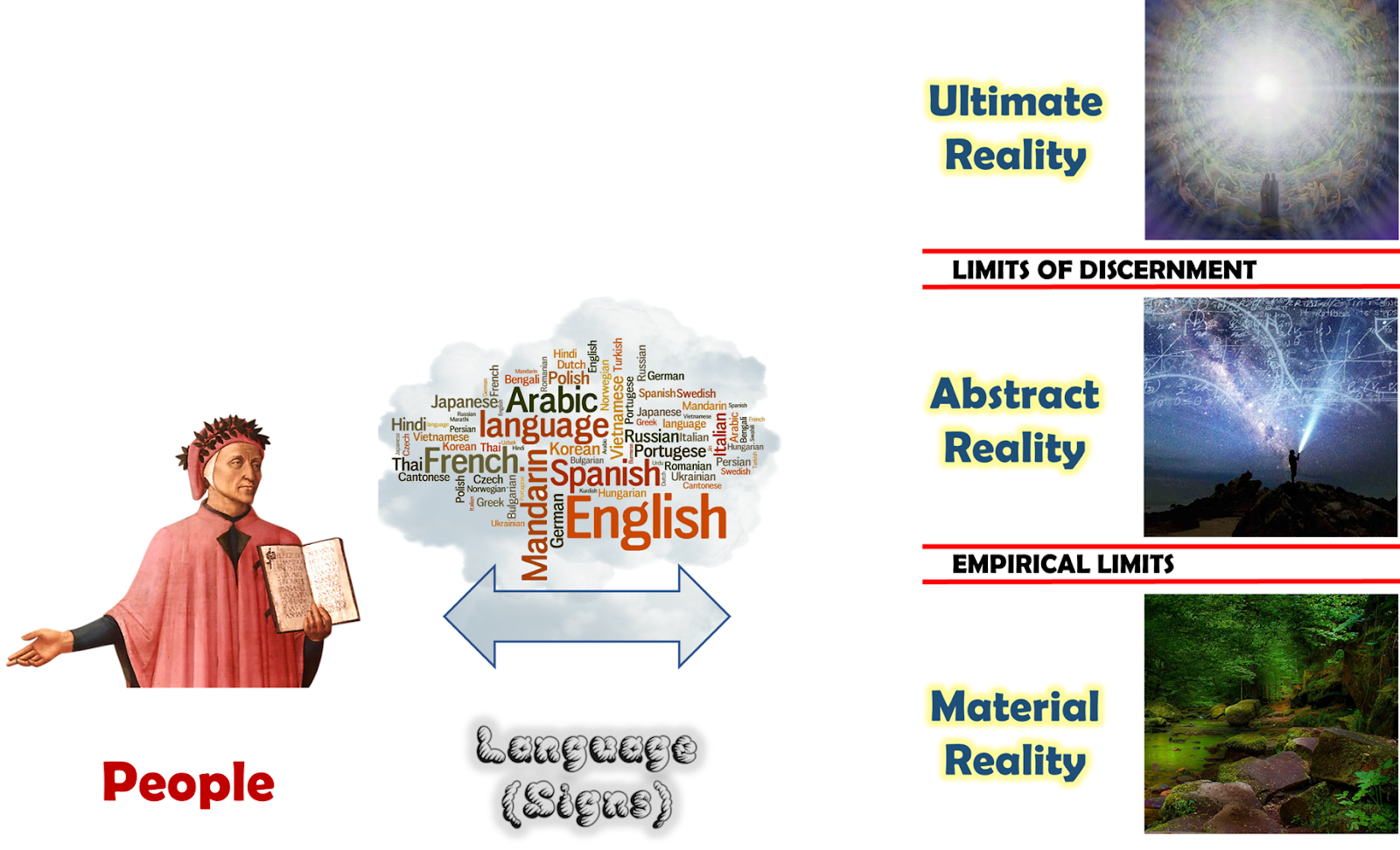
Language and other sign systems are like a screen between us and reality that we operate through. And speaking of reality, we can plug in another old graphic to better account for it - the ontological hierarchy. If we are screened from reality by language in a "horizontal" relationship, the ontology and associated epistemology of that reality would be vertical. Switch the hierarchy into the horizontal language graphic and it looks like this:


Every aspect of reality - the whole vertical ontology - is known through the horizontal filter of language. This is what makes language and media in general so powerful. It's not just the connection between words and other signs and reality, but how the words and signs filter every level of reality for us.


Lie authoritatively enough about a mild respiratory virus and countries will shut down their economies, jack their health care systems, seal the elderly away to die in isolation or with tubes stuffed into their lungs, and generally cause exponentially more harm to life, liberty, and happiness than a cough could. 

The words all refer to objective things, but by misapplying them, a fake scenario can be made to appear real.


There are actually two deceptions at work here, and the China flu debacle is a good illustration of both. We can call them Modern and Postmodern fallacies of language.

Modernism pretends words are perfectly objective vectors of outside meaning. That transparent truths about timeless essences come in subjective arbitrary man-made sign systems. The deceptive projections vomited out of the big pharma shills in their asinine lab coats are a legacy of this fake faith. 
Postmodernism still pretends words convey truth, but the ironic truth that there is no meaning. The outcome appears opposite to the Modern - creating meaning instead of transmitting meaning. But they can toxically work together.


Corona-scam brings them together - the Modern fake faith in symbolic Truth leads low-energy protoplasm to believe a lying globalist puppet like poison dwarf Fauci. 

And the Postmodern fake faith in symbolically-created reality can be seen in the attempt to engineer this "crisis" with shills and lying media. 


Postmodernism is like low-effort magic because it inverts the sign/reality relationship. Signs are limited mechanisms for representing the reality that is there. Magic flips that by claiming that they change reality into something new. Postmodernism denies independent reality altogether - because the whole fullness of reality is filtered through language, this somehow means that there is no reality without the language that filters it. Mediation is magically transformed into substance.


The lens becomes the specimen.


Keep in mind that Postmodern is "theoretical". Meaning it was made up by arrogant midwits and frauds and not something observed or logically derived from observation. Meaning reality doesn't actually work that way. The magic isn't real.


Corona-scam shows this as well. If lab-coated frauds and globalist handlers fabricate lies and sheep follow, the lies might as well be true. Because acting as if they are makes reality what it would be if it were true. Like magic, making things up and uttering them makes them real. 

But unlike magic, the lies of Postmodern language collapse in the face of reality. 


Because in the end, they're just sign systems.

So the Modernist wants to ignore the mediator, the Postmodernist wants to ignore the associative referent. Both overstate the power of human communication, both are wrong. Anyone still think "higher education" is worth 6 figures?


One thing we've noticed is that people often struggle to grasp the gap between the surface complexity of Postmodern theory and the banality of the ideas. This isn't criticism. It is weird to see such a big discrepancy between appearance and substance. Here's the intellectual apparatus behind the entire Postmodern war on the true, the beautiful, and the good for the last half-century:

Signs and representations are different from the things they represent. 

That's it.


Graphemes, thought pictures, etc. physically aren't the same as material things. And as we know in Postmodern gamma world, 'not the same' somehow means 'utterly and insurmountably incommensurate'. 

This isn't hyperbole - the sign is utterly differentiated from reality with no meaningful possibility for overlap. Therefore signs have no connection to reality. And since what we know as reality is known through them, they ARE reality.


Ponder that for a moment. Signs are different from subjects so there is no objective reality. And the intellectual culture of the West completely rearranged itself because this was phrased difficultly. Seriously.

Part of why this seems so retarded is because we understand vertical ontology. People and language are material-level things. And we know that we experience the world as a valley of shadow - a place defined by entropy and limits of discernment [click for a post]. Here, things aren't absolutely mathematically precise. Every measurement comes with uncertainty. No matter how much we refine our observations we can't reach the beginning or edge of things. The absolute black-and-white binary of Postmodern language - either exactly the same or utterly incommensurate - has no place in a material world of blurry borders and shades of gray.


In the material world, measurements and calibrations are good enough. 

Measured to the angstrom level, the bolts are all different sizes, but on the construction scale, they are interchangeable. See that? Different, but good enough to be practically interchangeable. That's how the material world works.


The different but practically interchangeable nature of material reality applies to language - despite the inhuman theorizing of Postmodern freaks. Like asking for the vase on the table and applying descriptive detail as needed. Accumulative accretion is how we build knowledge in the material world in general. Continually adding pieces and improving the quality without ever getting to the limit of things. Why would our language be any different?

But Postmodernism is a Flatland joint. It has to compress the vertical and the horizontal into a single plane. When you read poststructuralist linguistic theory, you see the ontological/ epistemological and the semiotic - mashed together to create confusion. They can't see that our subjectivities are "vertical" as well as "horizontal", so they can't understand why everything won't fit in their one dimension.


We have no trouble classifying language as an imprecise material system of representation that can reference things beyond the material. The higher you go though, the less capable it gets.

You can see this myopia in what passes for Postmodern philosophy. Take Derrida - he's the smartest of them, and his Deconstruction was a core component of academic Postmodernism in the West. Consider: he's most famous for his writings about language and other modes of representation. Semiotic systems, or horizontal subjective-objective relations. But his thought structures are built off the ontological reflections of Kant and Heidegger - vertical subjective-objective relations.


He pretty much ignores epistemology - which is why he tried to deconstruct textual meaning with texts.

As in this - maybe the seminal statement of Postmodern 'there is no meaning' madness.


If anyone cares, here are the basic components - there's obviously a lot more to Derrida, but these are two huge themes that run through his main work. Keep in mind that he is a snake and a trickster. He never plainly states where he's coming from - never plainly states anything, really. But patterns do emerge even in his tortured, convoluted prose, and these are two pillars:

Pillar 1: Kant's argument that our experience of reality is a set of subjective impressions, not objective knowledge of the things-in-themselves. Things-in-themselves - real things existing independently of our knowledge of them - are of a noumenal ultimate reality beyond our perceptual or cognitive grasp. Here's our graphic from an older post [click for link].


Kant recognized that our understanding of reality is subjectively filtered. Both through the material, biophysical properties of the senses and again through the mental organizing of raw sense data. His Noumenal world - pure essential being - corresponds with ultimate reality on the ontological hierarchy and is beyond direct human knowledge. 


Pillar 2: Heidegger's description of ultimate reality - his numinous Being - partially flickering temporally into material reality. Click for the Band's take on Heidegger and Being.


As beings we are extensions of Being, but Being or noumenal ultimate reality is eternal and we are temporal. This puts Being-in-itself beyond our direct grasp. We only know ontological absolutes by their limited manifestation in the time-bound material world.


So Kant gives us the insurmountal separation from ultimate reality/Being - including Truth and other objective principles. Heidegger shows what we describe as noumenal is just a temporal impression - the subjective impression of meaning and not meaning in itself. We have no trouble placing these vertically on the ontological hierarchy - subjective limits of material observation and the ultimate objectivity knowable only by faith.

But Derrida applies vertical ontological relationships to horizontal semiotic ones - to the person, language, reality trio. 


Here's the arrangement again. 

Ontology is a word, meaning it is an imperfect representation of a property. That the word isn't the property-in-itself is irrelevant to the characteristics of the property that the word imperfectly represents. 


As if the ontological distinction between noumenal Being and material subjectivity is the same as the associative distinction between sign and referent. Don't get put off by the twisted phrasing. Read it closely. Derrida presents the difference between a sign and what it refers to as the same as the difference between you and God. Because he can't appreciate the differences in kind. Because he lives in Flatland he can't even see the conceptual landscape. Apologies in advance for this, but he can't differentiate the differences between differences.

Now you can see the why we call Postmodernism an inverted faith. It's undifferentiated, primordial soup of an ontology pretends our relationship to ultimate reality applies to language. The sign system is the Creator of reality, words are the Logos, and the man-made becomes divine. Although without divinity because Derrida is also a nihilist.


Heidegger's Being is utterly remote but somehow echoes in time, so semiotic reference is also utterly remote but somehow echoes in language. Derrida's "trace" is the echo, except there is no "Being" beyond the material sign systems. Language is all there is, so the "echoes" are really just self-referential loops within the system. What looks like meaning is just more language - endless references to references that never leads anywhere ontologically real. An abyss,  the lack of meaning that language hides. 


Distinctions "beyond" the sign system wouldn't matter if sign systems were impenetrable, but sign systems aren't impenetrable. They're analogous. And analogous signs can be combined into more complex networks that can describe abstract things. And this brings us back to our Biblical metaphors for the limits of discernment - the valley of shadow and the darkling glass. Language is a veil that obscures a clear view of the truth, but you still see something through it. The vehicle that really goes no where is the all-or-nothing false dichotomy of the Postmodernists.


So far we've described how language filters our experience of reality and dispensed with the destructive Postmodern fallacy that this prevents objective meaning. We do have a mediating veil, but satanic-globalist explanation doesn't explain it. Consider what is really going on in order to get why the manipulation of symbolic communication is so powerful and essential to the elite.

Languages are interplay between generals and specifics. This is obvious with a bit of thought - the whole purpose of sign systems is to let specific ideas or impressions be generally understandable. But the systems themselves are based on generalizing the specific then specifying the general - defining categories with words or other symbols, then using those to describe personal thoughts.


First, the sign generalizes specifics - our shared experiences of specific things into symbolic forms.

All the vases fall under the word vase.


Then other generalized signs are piled up to modify that generalized sign to communicate a specific thing.

Like describing an individual vase.


Piling up description with other generalized signs is objectively not an endless abyss of meaningless references. It is an attempt to differentiate one thing from others, but does so associatively - by designating qualities. This is describing - differentiating through the accretion of characteristics until enough information is transmitted to make the distinction. That's right - information! Applicable, referential, meaningful information that manages to come through without ever pretending to have to be the thing being described.

Remember - words or other signs have ranges of meanings within conceptual limits.


"VASE" covers all of the endless versions of vase out there, but rules out the wine glass and fruit.


What we have isn't the perfect alignment of sign and reality - it's categorical fine tuning. Stacking the limited range of each quality accretively.

Specifying...


Like a Venn diagram with each descriptor narrowing the range of possibilities. Each one gets more specific in meaning, but there's no pretense that they're anything more than references. 


The whole point of symbolic communication is to record and transmit information that wouldn't be possible otherwise. That's what representation is - making it as if something was present that isn't. Not "present" in the ontological sense - it's obvious words and signs aren't actually what they refer to. They're referential. They re-present - make it so that things are 'as if present to a good enough degree'.

This is the source of the power.

The power is a function of difference - not in the ontologically retarded Postmodern sense, but in the real semiotic one. Sign systems that are good enough are meaningful, but aren't ontologically complete. They aren't the same as what they're describing. The Venn diagram stack of semantic ranges can't ever be whatever it is they're trying to make 'as if present'. That difference can be manipulated by the sender and the receiver.


Charles James Lewis, Reading by the Window, Hastings, 19th century, oil on canvas, private collection

There's always a gap between the mental picture of what's being described and the reality of it. The stack of generalized descriptors never equals the thing-in-itself. This is where the subjectivity comes in.


Description is a necessarily incomplete reflection of the communicator's reality - whatever they are choosing to communicate. Necessarily incomplete. That means they select what descriptive terms to offer. But you also make selections when you fill in the gaps imaginatively and turn the description into a fully-resolved mental image.

First the sender or writer of the message. If the world is known through generalized symbols, a statement is a selective reading from that symbolic world. This makes it a variation on what Tolkien would have called a sub-creation - a man-made creation that highlights some aspects of our reality for attention.


If interested, we went into Tolkien's sub-creation in our Silmarillon posts. It comes from his essay On Fairy Stories and is useful [click for a link to one of them]. We introduced sub-creation is a different post linked here on Tolkien and "modern literature".  He used sub-creation for works of fantasy that deviate from the "real" world in certain ways but draw attention to deeper truths.


Symbolic communication in general is obviously not linked to a specific genre like Tolkien's fairy stories. But we can take a conceptual structure from one place and use it to light up another because we aren't pedantic. In this case, a selective representation that is analogous to and different from the fullness of the real world and calls attention to a chosen aspect. Now consider - symbolic communication is an accumulation of descriptors that is necessarily incomplete. Symbolic communication doesn't have to be a narrative or story, but it is a selective representation that is analogous to but different from the real world and calls attention to a chosen aspect of it.


It's like our example graphic. The symbolic communication is the description. It is analogous to the actual vase, but doesn't replicate it in its fullness. It selectively calls attention to the chosen qualities that the speaker thinks will make it easy to identify. 

Like a literary sub-creation, the symbolic communication is analogous to and different from reality in a simplified way.


The purpose of making an analogy like sub-creation to language and other symbolic communication isn't just because parallels are interesting. A good analogy lets you see something that you would have missed without the analogy. Thinking of language or symbolic communication along the lines of a sub-creation makes us consider what a sub-creation does. How a simplified imaginary world lets us see things that would be obscured in the messy complexities and ambiguities of reality.

In other words, sub-creation teaches us to see the world differently. If it is effective, it transforms how we see the world by transmitting a selective and simplified analogy of it.


Ted Nasmith, Queen Tar-Miriel and the Great Wave, 2004, gouache on board

Like the ruinous connection between vanity and evil in The Silmarillon.


This is also what language and symbolic communications do. And this is where the actual power or magic of words comes from. The ability to selectively re-orient and re-frame your understanding of the world you're in. The words don't actually change reality - going back to our earlier example, the China virus would have been a lot more deadly if they did. But they bring forward some things and obscure others so that you think of reality in the desired terms.

But the power goes further than this. One of the wonders of the human imagination is pattern recognition - in this case, the ability to fill in missing information around a representational outline. This is really important.


A good analogy is this drawing. Look how little information is actually there. The hair is a little over a dozen wavy lines, with a few more marks for features and neck. Just a fraction of the visual data of a real face. Any yet there is no trouble seeing it as a woman. 

Your brain - your imagination - is able to make up for all the missing information if given a selective representation that is good enough to work off of.


Apply this to linguistic communication and you get the imagination picturing the sensory details of an account - what a scene looks like, how a character sounds, what the context is. Two people read the same account of a historic speech and both picture the scene quite differently. The reason why this is important is because they are visualizing the text in terms familiar to them. If a shopkeeper is described as good looking, you each picture your notion of a handsome man. If a savage dog is mentioned, you each picture the canine image that most scares you.


So when you hear or read a statement, you are hearing or reading a selective emphasis on certain things. A selective emphasis that you make more personally appealing by adding personally meaningful visuals in your imagination. Both sender and receiver manipulate the message. It isn't quite magic - words change how reality is seen while magic changed reality in itself - but it is easy to see how one is just an extreme form of the other.

The question for symbolic communication - as with sub-creation - is does the selective representation of reality align with the True? Does it seek to reveal and inform or mislead?


Does it have Logos?

Katy Grierson, The Evening Star, Lord of the Rings card art for Fantasy Flight Games, 2016

Here in the valley of shadow we can't see Truth. We are limited to logic or faith seen through more symbolic filters. Moral reasoning anchored by Logos is our best defense. But that is vulnerable. In the Fallen world, deception is everywhere, and there is no certainty in any words of man.


It's easy to see how both the Postmodern lie that sign systems construct material reality and the magic lie that sign systems physically transform material reality invert the nature of sign systems. Pretending that the representation comes before the represented is as mindless as inverting cause and effect, although Postmodernists try that too. It's not just error, because it's intentional. And there are immediate personal benefits because both are self-empowering. But does the inversion sink to the level of Satanic inversion? Click for a post on satanic inversion.

Consider - Creation is a divine speech act. Genesis narrates God speaking reality into existence. Let there be light. Because at the level of ultimate reality where God is desire, expression, and existence are the same.


Albert Chevallier Tayler, St. Francis of Assisi Preaching to the Birds, 1898, oil on canvas, private collection

In fact, many have looked at reality itself as a material expression of God's thought, will, or plan. The whole system of natural theology is takes the world as a sign of a providential will.


What this tells us is that the ability to reverse representation - to turn symbolic communication into reality - is a divine property. Not human. Consider further.

Earlier, we pointed out how before the Fall, Adam is able to name the different animals without needing to be informed first.


Adam Names the Animals, 12th century mosaic from the south cupola, west arm of atrium, Basilica di San Marco, Venice

'And out of the ground the Lord God formed every beast of the field, and every fowl of the air; and brought them unto Adam to see what he would call them: and whatsoever Adam called every living creature, that was the name thereof." Genesis 2:19, KJV 


What makes this account important here is the setting. The naming of the beasts takes place before the Fall, in the prelapsarian Garden where man spoke with God directly. Adam's clear and perfect knowledge of creation is interpreted as what language would be like in an unfallen state - clear, transparent, inherent natural connection between symbol and thing. No darkling glass, no valley of shadow, no linguistic relativitism or subjective projection. Just an undistorted conduit linking directly to the truth.

But even Adam's prelapsarian ideal "true" speech is nothing like God's creative "speech acts". God's brings something that didn't exist into reality.


Jan Brueghel the Younger, God Creating the Sun, the Moon and the Stars in the Firmament, 17th century, oil on copper, private collection 


God makes present, Adam represents.


Adam is a useful comparison for simplicity's sake because he skips the semiotic problem. We don't have to deal with the difference between knowledge in itself and the representation of that knowledge in arbitrary languages and sign systems. It gives a clearer view of the essential distinction -  it's God's speech that makes what IS. At best, perfect human speech knows what is. You can see it in these pictures - one showing God the Creator and the other with Adam between God and his Creation representing with symbolic communication.


Yes, Postmodernism and magic are satanic inversions.

Now here's the analogy for art.

The Band often says we come closest to God when we create. What this means isn't that art is a replacement for faith or devotion. It means that from our point of view, God's singularly most important action was Creation. Bringing this reality into existence out of formlessness. If creation represents His thought/will/whatever we can call it, it's the first representation. The first manifestation knowable to us of whatever the unfathomable impulses of ultimate reality even are. More accurate from a material point of view to call it a presentation. Not re-presenting something already here but making here present for the first time.


Mike Ploog, cover to Frankenstein #1, 1973, Marvel Comics

It's what makes Frankenstein and other Promethean creation tales satanic inversions. An artist represents. A painter or sculptor or programmer makes an image of a figure. But the figure isn't real in the sense of being alive. It's God that makes present. In claiming actual creative power, the human literally assumes God's place - the basis of any satanic inversion.

Crediting it to "aliens" is no better. It's not putting man in particular in God's place, but it is materializing ultimate reality. Just as big an inversion ontologically with what we call Flatland - the pretense that ontological distinctions don't exist - the outcome.


The artist is a secondary creator. What Tolkien could call a sub-creator. He uses the reality that divine Creation made present the first time and rearranges (literally re-arranges - as in arranges again into a new form) it into a something original. The artist doesn't create material reality from nothingness - he creates works of art from the material world already present. This is representation as in re-presentation - making present again.

With language, the presence being represented is the meaning of the words - with whatever limits that brings. The mental picture that the reader or listener forms is another kind of personalizing - everyone's Shire is uniquely their own. Think of the words as a symbolic system version of the bare bones drawing of the face up above. A selective imitation that's good enough for the imagination to do the rest. 


John Flaxman, Juno Commanding the Sun to Rise, copperplate 24 for John Flaxman's Iliad, engraved Tommaso Piroli, 1795 after a Flaxman drawing from 1793


Everyone has their own version of the same story. Each one a selective representation that is analogous and different. 


God's Creation is bound together through Logos. The Word. Absolute Truth. What is. God's "speech" creates reality from nothingness. Adam's encodes true knowledge of a reality that's already there. One is Logos, one is logos. One presents, the other represents. They are ontologically different.

In our fallen entropic present, clear true knowledge is replaced by the darkling glass. That finite state of having to piece it together cumulatively and never getting there.


Title page of Sigmund Freud's Zur Psychopathologie, 1904 first edition

Plus human creators lie. We need to use moral reasoning to ascertain the small-l logos or truth in representations. The Fall replaces Adam's top-down truth with bottom-up incomplete observations. Having to try and figure things out instead of just knowing them like Adam.

An effective lie is a well-crafted selective representation that people uptake. Then they fill in the picture that the symbols represent so that it's customized personally. 


What doesn't change is that "presenting" reality - making something present the first time - is a property exclusive to God. Magic usurps this reality-creating power. It's of a kind with all the other luciferian 'will over reality' ontological inversions in that it puts the human above the divine. Ditto for Postmodernism. The shift was in the placement of the lie, not the nature. Magic lies about mastery of reality. Postmodern lies about there being a reality.

But both can do so because symbolic communications are veils between us and Truth. And they're just tools - ambivalent about truth or lies. If the lie uses selective representations associated with truth or good, people's imaginations will make them more attached to it. This is the power of language - using distorted representations to make people act as if the lies were true.


There is a reason why we used the word "uptake" with the previous picture. 

Mass media uses distorted selective representations that each drone personalizes through their own fear hamstering. 

The amorality of language is why moral reasoning through logos is a never-ending process. 


That's the difficulty in dealing with the meaning of a word like "art". It's been framed so forcefully in different ways and inverted so thoroughly that it's hard to look with fresh eyes. So many lies have been taken in and personalized. The definition of "art" is a series of dishonest fake subcreations - all with their own preset ways of thinking. Each pulling us further from reality - from aligning with the True, the Beautiful, and the Good - and walling off other lines of interpretation.

But the truth is on our side.


Peder Mørk Mønsted, Winter Landscape, 1920

Language sets the terms of engagement by putting pre-formed thoughts in the head. But it does so with symbols, not reality. It's webs of delusion have no substance. We can look at cultural artifacts and the historical record without the endless theoretical blatherings that clutter up the arts with pomposity and inversion. 

Imagine an art without the hideous definitions of modernity. An art based in skill, beauty and logos. This is from 1920 - when Modernism supposedly ruled!


We do have to be conscious of the symbolic nature of our own communications. We can't take language as anything more than an arbitrary and imperfect system of representations. But if we keep these things in mind, we can look at what the sign systems do say and use our own moral reasoning to come up with an honest picture. What do the stacked ranges of meaning define?

This is why we went back to the roots of the West and worked out the vertical definition with the Greek terms. 

We found art in the West to be more process than thing. Variable in form but united in function - expressing truth - higher principles - materially.


Théodoor Galle, The Invention of Oil Painting, 1591, engraving after Joannes Stradanus,The Art Institute of Chicago

This gives us a starting point outside the web of lying fake sub-creations definitions that is constant with the values, history, and metaphysics of the West. 


And the larger lesson? Words have power, just not the way Modernists or Postmodernists say they do. They're a veil we have to work through.

The globalists are lying. Logos matters.


Ivan Konstantinovich Aivazovsky, Jesus Walks on Water, 1863, oil on canvas, private collection


Most Popular Posts