Showing posts with label belief. Show all posts

Saturday, 4 January 2020

Prometheus and the Occult Pt. 1 - The Set-Up


If you are new to the Band, this post is an introduction and overview of the point of this blog that needs updating. Occult posts like this one - posts on the history and meaning of occult images - have their own menu page above. All  posts are in the archive on the right. 
Comments are welcome, but moderated for obvious reasons. If you don't see it right away, don't worry.


Jean Delville, Prometheus, 1907, oil on canvas, The Royal Library of Belgium, Brussels

Prometheus is a character from Greek mythology that has been used as a symbol of occult wisdom and human enlightenment. He's a lot like Lucifer in that he represents the fantasy that we can deny reality, but he lacks the historical connotations with naked evil that make the fake "morning star" off-putting to most people. This is the first of several occult posts that will look at the history of this figure and what it means to claim him as a symbol. 


One thing that keeps coming up when we interpret occult symbols is the importance of belief. Not just what the people using them believe - although that's important too. Belief in general is a bigger deal in today's globalist Skinner box society than it used to be. Click for an earlier post on belief.


This is because authorized globalist popular culture is more openly de-moralized and pervasive than ever. It has no logical or even coherent morality. It rejects the possibility of objective moral standards for nebulous rhetorical idiocy like opposing "hate" and feeding appetites.  There is no value here


So for many, even realizing something is satanic gets little response, because nothing really matters. Not in that metaphysical supernatural sense anyhow. So long as they aren't breaking any laws, satanic images aren't hurting anyone. It's just edgy.  Only crazies think its serious... 

... except it is. 


This is a typical NPC shilling the mainstream narrative. And here the confirmation of the McMartin school tunnels that shills claimed was "paranoia" while mocking victims [and the archived version].  We don't know what actually happened, but we do know that the authorized narrative is false. Think about that for a moment. The mainstream shills willfully lie to cover up evil of this magnitude than attack the innocent to support their lies. They are complicit. 

The Band has taken to calling this fake materialist modern media culture a beast system because it actively fosters evil. It's why we are motivated to show how it works to help people recognize it. The question for those under the spell: now that you know you are being lied to, do you start rethinking things, or keep clinging to objective falsehoods? 

Once you know better, it becomes a moral choice. 


Occult means secret and the occult imagery posts were started to show the history behind some of the more nefarious ones. We noticed some patterns right away. But what we noticed was that the whole de-moralized globalist culture resembles an occult secret - a spell that hides a more truthful relationship to reality. We used the word "glamour" in an earlier post to describe the collective illusion. And we saw that it is materialist and de-moralized. It lacks the conditions needed to even set up a moral judgment, let alone chart the right course.


People get so baffled with ever-changing nonsense preoccupations that simple truths become hard to see. 

Here are top preoccupations according to EducationWorld. What does any of this have to do with the existential issues facing the West? Nothing. It's all mindless emotional stimulation intended to keep people ignorant and helpless - too wound up to walk away and chart their own course. 


But simple truths are actually not that hard to see - if you drop preconceptions and really pay attention and think things through. We know we are dependent on our subjective interpretation of empirical observation to understand the world around us. We are aware of abstract truths that don't map perfectly onto this messy material world. And the abstractions points to the logical necessity of ultimate reality - the source, foundation, origin, etc. of all that can be. What IS. God in Christian terms, Truth in philosophical ones.


Healersmoon, Heaven's Light 

The Band takes a basic Western perspective that there is a continuum that ties these together that we call Christian Logos or the order of reality. This known in ultimate reality by faith, abstract reality by logic, and applied in the material world as morality. 


Ladder of Divine Ascent, 12th-century icon, Monastery of St Catherine, Mount Sinai

Morality, then, is alignment with Truth as we can understand it in situations that are often shades of gray. 

The point isn't that we always get it right. The point is that we orient towards objective Truth to the best of our discernment. So that our general direction is the same. This is where public, social, or collective morality comes from. Individuals with common moral orientations forming polities that reflect the perspectives of their constituents. 


The beast system is the inverse - a top-down mass culture that denies this absurdly simple relation for an endless spray of ever-changing de-moralizing lies. Where it's always year zero, but the progress never ends. There is no one "answer" to a system this centralized and all-pervasive. Other than disengage from the lies as best as possible.


So belief is a fundamental issue on multiple levels. What you believe determines whether or not you perceive something is even "a problem" and whether you feel nihilism and despair when the deceptive nature of the system becomes undeniable. Regular Band posts try and show where and how the beast system hall of mirrors comes from and where to look for the truth that it has hidden from you. And the one pattern that we've seen repeat more than any other is inversion. This is so constant that we call it satanic inversion and wrote a post on it as the occult archetype.


Gustave Doré, Farinata degli Uberti addresses Dante (c 1857), engraving from Dante's Divine Comedy canto X

The satanic inversion takes many forms but fits the same pattern - self over reality, whim over Truth, desire over Logos, man over God. The metaphysical emptiness of do what thou wilt, and the pathos-in-the-face-of-mortality of be your own god. 

Of course, the one truth in their web of lies is the one they don't mention - in a world ruled by will and desire, the winner takes all. 


The thing that makes inversion so universal is that it's like Logos - it can play out on every level of reality. Invert faith by pretending personal greviences are moral absolutes. Invert logic by fudging models to fit preconceptions. Invert empirical reality by lying about what happened. This last one can help anyone see the problem with inversion, regardless of what you believe. You don't need complicated morality to understand that when someone is inverting what is, they are dealing dishonestly. They seek to exploit by rejecting what is true. From there you can extend back out to morality and see how the inversion of truth is a measure of evil


Once we see inversion is rooted in the rejection of Truth., it's obvious why it is so common in a fallen beast system. Evil by definition rejects Logos, Truth, reality, Being - whatever you want to call ultimate reality. All that is, leaving it with not-is, or all that isn't. All it can do is corrupt and invert.

Like Pedowood.


So set aside endless wrangling over belief and look for inversions. You aren't guaranteed to find evil, but you are on its turf. And if the inversion just happens to elevate "Man" above reality...


Paul Manship, Prometheus, 1934, gilded bronze, lower plaza, Rockefeller Center, Manhattan


...you have Prometheus.

The Titan from Greek mythology connected to intelligence, craft, and human advancement that became a modernist kewpie doll and a symbol of occult enlightenment. Here's Infogalactic on Prometheus and a good overview of the occult symbolism of the Manship, and the Rockefeller Center.


Philomon, from Jung's Red Book

This is not the first time we've seen the same pattern play out in mainstream authorized culture and in what is conventionally dismissed as superstition or fringy nonsense. Like pioneering psychologist Carl Jung's mystical dream guide speaking through automatic writing

When you think how inverted the mass culture bubble that surrounds us is, this pattern is not surprising. But that assumes you are aware of the glamour. 


It does seem that reality is catching up on the glamour, and the beast system becomes more and more absurd and deranged as the deceptions unravel. The Band is only one - a small one - of many voices shredding the webs of lies that have made us into far less than what we could be. And once you've seen how feeble and transparent the nonsense narratives are, it becomes harder to believe anyone could take them seriously and easy to just tune them out altogether.


The problem with that is that there are still a lot of people who buy the glamour and actually believe mass media reflects reality. Even many who know they are being lied to and manipulated a lot of the time foolishly place credence in some of it. 

It shouldn't matter if individual facts are sometimes true or some show isn't utterly pozzed - the entire system is a projection of soulless, materialist globalist will to power. You don't have to dig far to find inversion and de-moralization. But too many still consider the lies the work of bad apples and not fundamental to the system.


You've witnessed this every time one of these victims is triggered by some glaring hole their rice-paper narrative or the self-contradictions of a cathode head. The violence of the reactions indicates that there is some visceral doubt, but they're committed to believing mockingly-transparent lies from people that openly hate them.

It's those points where occult and authorized mainstream reality overlap that reveal the inherent dishonesty of the beast system and it's "evidence-based" lies. Serpent audience halls and psychedelic "enlightenment" are just moments where the sham shows through. Prometheus is another. Like glitches in the matrix telling us where to look.


Erik Johansson, illusion


What is so interesting about Prometheus as symbol is that the inversion of what he represents started before the ancient world came to an end. The earliest source of his myth is Hesiod - a Greek poet active sometime between 650 and 750 BC, and along with Homer, considered a founder of the Greek literary tradition. But by the classical period in the 5th century BC, Prometheus has been changed quite a bit. This is important for understanding his meaning in more modern times.


Edmond-François Aman-Jean, detail of Hesiod Listening to the Inspirations of the Muse, 1890, oil on canvas, Los Angeles County Museum of Art

Hesiod's works aren't as famous as the Iliad or Odyssey, but he is  a pivotal figure in one of the main pillars of Western culture and our best source for Greek mythology at the beginning of the Archaic period. Prometheus turns up in best known poems - the Theogony and Works and Days as a trickster/champion of humanity and foil to Zeus, the king of the gods. 


The Theogony describes the creation of the gods and the cosmos, beginning with the spontaneous generation of Earth and other entities from Chaos. These spawn the Titans who seize control of the universe, only to be overthrown by the better known Olympian gods. The main focus is on the genealogies and relationships between the gods and other superhuman entities - it uses these as a way to tell the story of creation. Greek polytheism mixed gods with personalities with names that seem more like pure personifications of natural forces. Hesiod doesn't really differentiate.


Jean Auguste Dominique Ingres, Jupiter and Thetis, 1811, oil on canvas, Musée Granet, Aix-en-Provence, France. 

The Theogony is in the form of a hymn to Zeus and the Muses, so the power and authority of Zeus is played up and the details not worked out as systematically as we would like. But the basic account is the backbone of our understanding of Greek myth heading into the Classical era. Click for a description and for the full text translated in prose and in verse.


Hesiod's Prometheus is a Titan, but doesn't take part in the war with the Olympians, and avoids the banishment of his fellows to the netherworld. His appearance in the Theogony is brief - his parentage is given then his terrible punishment is described before we are told his crime. He aided mortals in a dispute with the gods - presumably over the rules for sacrifice - and tricked Zeus into accepting bones and fat as the gods' share. Zeus is angry, so withholds the gift of fire from man. Prometheus counters by stealing "the far-seen gleam of unwearying fire in a hollow fennel stalk" bringing about the ghastly punishment.
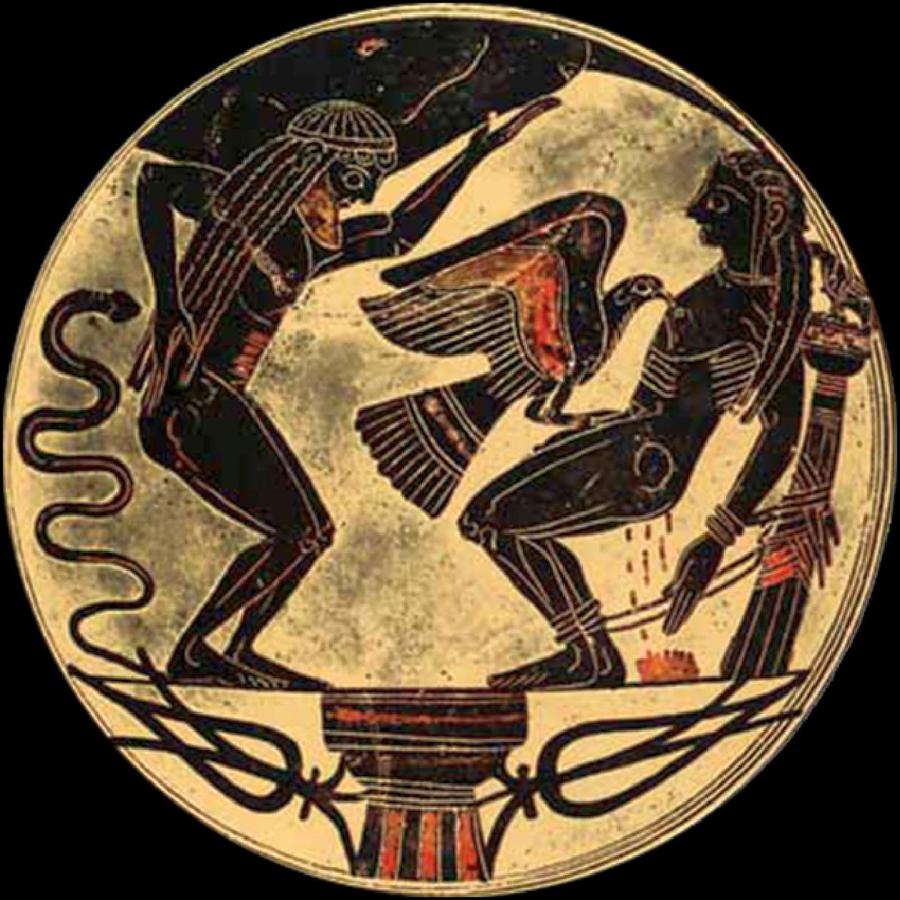


Atlas, Typhoëus, Prometheusm, around 560-550 BC, black-figure ceramic bowl, Vatican Museums  

Prometheus is chained to the rock where each day an eagle devours his liver which regenerates because he is immortal. Hercules eventually releases him, but not until after ages of endless torment..


This story is developed a little in the Works and Days [click for prose translation and for an overview]. This poem is different from the Theogony - described as part almanac, part agricultural treatise, and part homily - but also addresses mythological subjects. Hesiod frames the story around dispute between him and his brother over some farmland and a condemnation of corrupt judges before moving into a mythic history of the nature of justice and evil and the Ages of Man. The details about the sacrificial portions trick are omitted, but the story of Pandora is elaborated. Here's the opening of the Prometheus story:


Prometheus stealing fire from the Gods, Liebig card, from a series on the legend of Prometheus, published late 19th or early 20th century.

"For the gods keep hidden from men the means of life. Else you would easily do work enough in a day to supply you for a full year even without working; soon would you put away your rudder over the smoke, and the fields worked by ox and sturdy mule would run to waste. But Zeus in the anger of his heart hid it, because Prometheus the crafty deceived him; therefore he planned sorrow and mischief against men. He hid fire; but that the noble son of Iapetus stole again for men from Zeus the counsellor in a hollow fennel-stalk, so that Zeus who delights in thunder did not see it. But afterwards Zeus who gathers the clouds said to him in anger:

`Son of Iapetus, surpassing all in cunning, you are glad that you have outwitted me and stolen fire -- a great plague to you yourself and to men that shall be. But I will give men as the price for fire an evil thing in which they may all be glad of heart while they embrace their own destruction.'"


This passage is  important to later occult interpretations, because it broadens to gift of fire to "the means of life" but in an ambiguous way. We aren't told what the means of life is or are, and the story quickly switches to fire. Hesiod frames it in terms of labor productivity and earthly fertility - if we had the means of life, a days work would give a year's food, and the nature of society itself would be changed by the abundance. It isn't explicit here, but this is the opening for what will develop into the claim that Prometheus didn't just give man fire, but gifts of technology and other labor-saving modern processes.


Avril Brand, Old Family Bible and Psalm Book, oil on canvas

One major difference between Greek mythology and Christianity is that the Greeks didn't have a set holy scripture like the Bible. Hesiod frames his poems as divinely inspired, but they aren't subsequently taken as holy writ - they change and evolve over time. Obviously Christianity has also changed a lot, but the Bible fixes certain basic tenets. The free-flowing Greek myths don't even have a consistent creation story, and stories like Prometheus have variants - none "canonical". 


Consider Hesiod's account of the creation of man following the Prometheus story in the Works and Days. He describes Five Ages of Man - the Gold, Silver, Bronze, Heroic, and Iron Ages - created one after the other, and all by Zeus. But before the end of Greek antiquity, it's Prometheus credited with creating mankind and not just helping them. There is nothing in Hesiod that points to this - it's just the sort of change that occurs when there is no canonical account to refer to. But Prometheus as creator adds another symbolic dimension to the character that we'll take up in the next post.


Thomas Cole, The Titan's Goblet, 1833, oil on canvas, Metropolitan Museum of Art, New York

The lack of canonical stories and characters is a real challenges for interpreting mythology-based occult symbols. The occult is slippery at the best of times, but these figures have no fixed identity from the start. Hesiod's Prometheus is different from Plato's, who is different from Aeschylus' or whoever wrote Prometheus Bound. A fluid figure like  this is ideal for conversion into different symbolic meanings. 

The next post will look at the later Greek versions of Prometheus. We'll wrap this one by looking at some implications of Hesiod's original.


The first problem with Prometheus as a more modern symbol is the source. Ancient Greek culture - not the stylized Neoclassical versions of it - is not "Western" in the "Western culture" sense. Greco-Roman antiquity is one of the historical roots of the West, but it predates it. It lacks the Christianity and European nationalities that are the other pillars of Western culture. Aspects of Greek thought are formative for the West, there is also a lot in their world view that is alien and even incompatible. This is clear in Hesiod's attitude towards divine authority, reality, and human existence.


From a Western perspective, the divine, reality, and human existence are unified and coherent. God encompassing ultimate reality and Truth that flows through Logos and morality into experience. This picture doesn't really capture it, but it does give a sense of the unity in creation that is the result. The deceiving thing is that God is presented as an old sky god - like a Zeus type. This is purely metaphorical since he transcends the very concept of physical form. 

Greek myth is the opposite - especially in Hesiod's archaic period, centuries before the Greek philosophical schools started working out the abstract logic that would be their great contribution to Western civilization. There is no fundamental order or Logos in Greek mythology beyond force. 


JuanSan, Zeus punishment

The Theogony describes a universe without higher meaning. It is born of chaos - heaven and earth and various chthonic entities spontaneously generate with no purpose or motivating will. Generations of gods and monsters contest for domination until Zeus establishes control through his overwhelming might. Order or rule is based on what can be imposed by force - power is the fundamental principle.  

This picture shows Zeus defeating his father, the Titan Chronos, and seizing rulership of the universe. The old man-sky god look in this case is is their actual appearances because these are physical beings. 


The easiest way to frame the comparison is that the universe is within God, whereas Zeus is within the universe.

Readers are likely familiar with feebleminded complaints about God's "temperament" in the Old Testament. Feebleminded because they assume that the ultimate reality from which all things extend can judged by the limited subjectivities of his creations. We can't "see" God the Father directly, and accommodating him as a character in terms that are comprehensible to us is necessarily unsatisfactory. But Zeus is just another created being - at best a third generation usurper. The only "argument" for his righteousness is Hesiod's sycophancy hymn. No reason is given why he's a rightful ruler other than his ability to scorch things with lightning. He is as far from ultimate reality as any creature in the universe, and his conduct is as capricious and immoral as any tyrant.


sirocco-rc, Pandora's Box


Consider Zeus reaction to humanity getting fire - Pandora, with all the evils and ailments that plague the world. Mankind really did do nothing wrong, but suffers eternal punishments because Prometheus tried to help them. And unlike Christianity, there is no path to salvation.

You can start to see the inversion in applying Prometheus' rebellion against this cosmic thug to a universe that runs on Logos.


In Greek myth, humanity was created in an adversarial relationship with the gods. Actually consider what Prometheus' sacrifice "trick" actually entailed. First there is the dispute itself - it is a given that humanity has to share the fruits of its labors with the gods - not because they are Truth or the Good or expressions of Logos, but because they're too powerful to deny. It's an extortion racket, where the new muscle demands an undeserved cut, and the only discussion involves percentages. So Prometheus used cunning to get the best outcome for his side within the rules in a "contest" where the terms and conditions were imposed entirely by one party. Who also happens to be the judge.


Carl Bloch, The Sermon on the Mount, 1877, oil on copper, The Museum of National History, Hillerod, Denmark

A legitimate creator God simply establishes the rules of reality, with consequences clearly spelled out for those who break them. 

But what sort of gamma freak makes up a fake rigged contest, still loses, then wrecks eternal vengeance? Logos suggests that Prometheus was correct to resist such a monster, though the consequences may have been too high.


But if we accept this idea of Prometheus as hero-rebel, then we also have to accept that his heroic rebellion is against the opposite of Western metaphysics and morality. It's against a emotion-driven cosmic usurper and rapist that is opposite to any notion of unified Truth or Logos in Creation.


Gustave Doré, The Triumph Of Christianity Over Paganism, 1868, oil in canvas, Art Gallery of Hamilton, Ontario, Canada

In fact, Christianity expunges this perverse demon.


But there is another way to look at this.

A more figurative take, where the mythical creatures stand for concepts rather than as beings in themselves. There is a tradition going back to the Middle Ages of using ancient figures to symbolize essentially Christian ideas. This is part of the integration of Classical heritage into the developing West. From this perspective, Zeus' monstrous character is less relevant then his role as a symbol of divine authority. If we look at it this way, then Zeus has to be inherently correct, since he is standing for the notion of a Logos-driven creator God. He is a symbol or allegory for a foundational Truth on which reality is predicated. This means that Prometheus' actions are necessarily morally wrong. They take the limited perspective of a created being within reality and elevate it over the divine plan for creation because the snowflake thought it seemed right.

So there are two possibilities - either Prometheus is a hero because he opposes a demonic system that inverts rightful divine authority or a villain for attacking rightful divine authority.

And this should start to shed light on the sort of individuals who might uphold him as a model in the Christian West.


Sunday, 19 May 2019

What do you Believe? Introducing the Psychedelic Occult


For more posts on occult symbolism, click hereFor an intro to the Band see the featured post to the right or check out the archive

Other links: The Band on Gab


This post starts a look into what the Band is calling the psychedelic occult, or the weird fusion of drugs, counterculture, and esoteric beliefs that took hold in the 60s. This is important issue, and not just because our namesake was deep into nefarious activity. We've always known that music is a powerful vector for cultural subversion on countless levels, and modern pop music was called out for immorality from square one. But the critiques are superficial and simplistic. They miss the complexity of the inversions and the larger patterns that tie them together. These posts will look at the psychedelic occult on a more fundamental level - how the moral inversion works and how to make your own moral assessments of pop culture.


Tina Carpenter, Dark Star, giclée print

Part of a series of Tarot cards designed by different artists after Grateful Dead songs. Dark Star the song is an extended period of meandering formlessness, even by their legendary standards. Hearing it live was a badge of honor among fans because it was so rarely played after the Haight-Ashbury era. Probably because it was so offputting to most listeners. A link for those inclined to listen, but it's not good.

Before we can look into this, we have to ask what it means. Is it occult? What does that even mean? It is a striking image, but what it represents depends on what your underlying beliefs. This is what makes it hard to talk about the occult - it means different things to different people. This post is sets the stage by identifying the problem inherent in defining the occult in the modern world and why this ultimately doesn't matter when you see the pattern. 


One thing that keeps coming up in writing occult posts is how hard it can be to pin down what "occult" means. Old symbols like owls and serpents are easy, since their connections to black magic are overt. Comic books and Ouija boards are more ambiguous, or at least seem that way. Esoteric symbols like the compasses raise the question of whether they count as occult. Satan or Lucifer? Does it matter? It's become clear that the underlying problem is frame of reference. What is technically considered occult boils down to faith - what do you believe?


Ludolf Bakhuizen, Christ in the Storm on the Sea of Galilee, 1695, oil on canvas, Indianapolis Museum of Art


The Band has posted a lot on how we can know things based on simple observable facts. These are collected in the epistemology page above this post at the top of the site if you are interested. It's not necessary to delve into the details because unlike the inversion and deception that surround us, the main points make sense on the surface level as well. No need to tricky explanations and wizardry.


Rune Guneriussen, A natural selection2008, c-print/aluminium
The first source of knowledge is empirical sensory perception of the environment around us. Grasping logic and causality allows us to build brute observation into higher-order understanding about the world. But this is by nature limited - starting with ourselves and building outward into a world that is beyond our comprehension. 


It's like an unbounded function in math - you can add to it forever and never reach the end.

Or trying to find the limits of an expanding universe...


Sir Isaac Newton experimenting with a prism, engraving after a picture by J.A. Houston, around 1870, The Granger Collection, New York

We can use logic to devise instruments and make projections that extend the range of our direct sensory perception. But as we are finding out more and more, these have limits. Beyond this, the only basis for knowledge is faith. 


Faith is a funny word to hear in today's "secular" public forum because it is usually associated with  "religion" as opposed to "scientific facts". Webster's Dictionary, the benchmark for American English, is worth looking at. These are from the current and the 1828 free on-line versions of Webster's. The level of literacy is also striking.


1828 Webster doesn't mention religion until after the first two definitions and the etymological background. Today's Webster bumps it to #2 and condenses 1, 2, and the background into #1. To be fair, 1828 has a long definition with lots of religious usages, but belief on the basis of non-evidentiary authority is frontloaded. Today still has this, though bumped down to #2b. This is the way that the Band refers to faith - belief in something without empirical evidence.


Note that we didn't say empirical, because much of what passes as Science! today has little to do with objective facts. Global warming is such a good example because the scumbags keep slithering and shifting the goalposts. 

We have been told ad nauseum about an ice-free Arctic. Here is one proven liar blathering about submerging Bangladesh in 2016, with bozos commenting about "carbon sequestration" as if any of it were real. Perhaps the sequestered carbon can be used by the Mars colony... Here's one from last December explaining that the growing ice is offset by summer melt. And here's some Russian satellite data from 2008 and 2018 on ice thickness, with the dark brown being "old ice" or ice that is more than a year old. That is, survived the summer melt. 

The empirical data does not support the belief. This is literally the "assent of the mind to the truth of what is declared by another, resting on his authority and veracity." 


Except it isn't even that, because veracity - the truthfulness of the authority - isn't a factor. It's blind, cult-like faith in a bogus story concocted from historically false claims to serve globalist ideologues. When you think it through, you realize that anything that isn't empirically-sourced is an article of faith. Our lives are full of such things. Religion is really a subcategory. The real questions are:


This is so obvious when you think about it that it's almost funny. But never underestimate the human ability to twist and invert reality for vanity and greed, even to ourselves. Modern culture is so toxic because it is built on lies, and anyone who actually thinks like a builder knows that a foundation of sand can't hold much weight. And one of the biggest self and cultural deceptions in the sand pile is the myth that finite, limited, building-out human knowledge has insight into the ultimate nature of existence. As ridiculous as this is when stated plainly, history is a series of fake claims about how things "really are".


Notice how "ultimate" reality keeps changing. This is because it's people making them up. And finite creatures can't add their way to the infinite. What we have are a series of extrapolated observations: there does appear to be an order to things; the ancients do have something to offer, reason can be an effective tool, experimentation does reveal material facts, and language systems are arbitrary. 

All have a degree of truth value. None of them say much about Truth. Which is why all have failed when elevated to an article of faith.


When it comes to the big questions about ultimate reality and timeless principles, empirical approaches can't work. So the only honest position on knowledge that truly rejects faith is strict agnosticism, where you can build practical knowledge endlessly without ever reaching a final conclusion. There are problems with this.


We live in an entropic universe where everything ends in death. We will never figure it all out in the time we have...


... making nihilism a constant danger. 

But the larger danger is relativism. Empirical understanding always has a subjective interpretation, if from nothing else than the investigator's priorities. We are points in literal and figurative space. That our perspective on the whole is relative is mathematical fact.


Strict personal agnosticism is rare and self-terminating, and doesn't really need elaboration. Virtually everyone bases some of their understanding of the world on faith in something, whether acknowledged or not. The only question is what.

This is not empty philosophical speculation, but how we understand what the empirical world that we live in means. Our faiths set our moral foundation, and that determines how we act out our real lives. If your faiths point in different directions, the same empirical facts and situations inspire equally different reactions. We inhabit the same world, but we don't live out the same worlds. Which brings us around to attitudes towards the occult, because the thread that connects all the variations on that vague term is the supernatural. And the supernatural is by definition that which is outside of the natural material world. It's metaphysical, and metaphysics are knowable on faith.

In short, what do you believe? Your understanding of the supernatural will define what this means to you:


It is impossible to try and tease out all the different interpretations of this dreck, because the reality is that there is that there is just about as many perspectives as as there are people. There';s no point getting bogged down in subtle variations in meaning, and most occultists are fundamentally dishonest anyhow, so it's best to keep things general.


John Singleton Copley, Watson and the Shark, 1778, oil on canvas, National Gallery of Art, Washington

To simplify, let's stick to the sorts of people who are of the West, or at least compatible enough with it to be part of a cultural revival. The history is complicated.

Basically reality-facing characters that don't don't want to be fed things that are empirically untrue and who function well in a high-trust, orderly society. 


We can rule out the dyscivic fantasists on the "left" and "right" - themselves dinosaur categories from a 20th century media show that wasn't real. That means the rabid lies about imaginary intersectionals and projected self-loathing AND delusional pipe dreams of stateless markets and magic documents. The point of this isn't to waste time on beliefs that are empirically false, but to look at how different faiths in things that are legitimately beyond empirical certainty determine what the occult is to you. Basically, we are looking at two rough groups:


1. Modern, secular America! - where faith is reserved for any number of "scientific" absurdities, so long as the alternative dimensions, proposition nations and blank slates aren't "supernatural".


What are those values? How do they maintain intellectual coherence with human relativism, self-interest, group dynamics, and deceit? 

Though the symbolism of a complete misrepresentation of the orbital structure of an atom is perfect. 


There is a typical pattern of deception here, where specific untruths don't matter in themselves, so long as they are untrue. Secularism pretends to be empirically sourced - it isn't - but if you look at its historical patterns, its color of its ideology is anti-Christian.


Put another way, secularism has spent way more time "debunking" spirituality than than it has building a culture that is intellectually consistent or reflective of human nature. 


It is a negative ideology because its identity is based on opposing something rather than building out from a positive foundation like empirical observation or Christian faith. Secularists can be wrong over and over, so long as they remain opposed to to the spiritual.


It doesn't matter how many alternative dimensions, dark substances, magic strings, universal oscillations, or totally realistic photos you profess to have, so long as you refuse to acknowledge that some of the unknowns are metaphysical.


2. The American branch of the Western Christian tradition - or any other religion that recognizes and is able able to address the empirical reality of evil in an entropic universe (click for a complicated post if you are interested).


Edward Lamson Henry, A Chat After Meeting, 1868, oil on canvas

Christianity provided social cohesion while technological levels changed. This is the source of the high-trust, low-regulation society that made America's incredible prosperity possible. This may be uncomfortable to some, but it is historical reality, and any profession of empiricism begins with accepting what is real. 

What many miss is that this can't be forced. The outward forms come from inner faith. Deceivers hate sincere Christianity because it is indifferent to the thoughts of others. It is the opposite of virtue-signaling because it begins with what you truthfully and privately believe. You are or you aren't. 


Both our groups are happiest in the same sort of environment, but how they relate to that environment - their moral compass - is not just "different" but fundamentally inverted. The Christian recognizes the link between American society and American values, while the secularist is a parasite that wants to sap off the historic bounty of the American nation without facing the moral responsibility to build and pay it forward.


Eastman Johnson, Sunday Morning, 1866, oil on canvas

Morality builds out from family and faith then carry out into the world. Obviously this group didn't have to deal with the temptations and distractions of modern mass culture. But the basic formula of moving from the personal to the familial before navigating the social hasn't changed. We've seen the alternative.


The honest secularist has only observation to go by, meaning that his perspective is limited to his frame of reference. If the highest virtues are materialist, that the measure of virtue is the "success" of oneself or one's group - advancing your herd relative to the others.


Norman Rockwell, Home for Christmas, 1955, oil on canvas

American "secular" ethics are denatured Christian principles and situational "common sense", neither of which offers any anchor against malevolence or moral entropy. You can't really measure yourself against the past either, because everything is based in your experience, and your knowledge of the past is filtered through the the historical record. All moral relativism is is applied subjectivity, and morality becomes subjective when there is no objective base.

Superficially, we have family and a traditional Christian holiday. But why "home" for Christmas? Modern society is already breaking up communities for "careers". And the Christmas symbolism is all secular or materialist - holly and gifts. 


.
Don't take the Band's word for it - use the empirical observation that is the only pathway to direct knowledge of the world that we do have. Children's world views are sexualized with institutional approval. How effective are the slippery relativistic rule of secular morality?


Nik Helbig, Adam and Eve, 2013

Christian metaphysics recognizes that the human grasp of ultimate reality is limited, but provides an order or logos that compliments what we know empirically about the world around us. You can still behave badly, since knowing the difference between good and evil has never been an impediment to the wicked. 

This is the point of the story of the Fall. What Adam and Eve eat is fruit from the Tree of Knowledge of Good and Evil. They trade a state of innocence that prevented them from doing wrong for awareness of the alternatives. They think it is empowering, and it is in a way, because it makes them fully responsible for the path they choose. 

The lesson is that moral knowledge is fundamental to Christian ethics because an objective understanding of evil is needed to choose virtue.


Intellectually honest Christians can commit evil, but they can't claim is that it is all relative, or that in this instance the situation is different, or it's only a problem if everyone does it.


This moves ethics from something measured internally against a fixed standard to something drifting in the shifting mores of others. When your morality is objective, it doesn't matter who is watching or if you can get away with it. Public opinion is irrelevant. Christian society works when the members are internally-motivated Christians moving individually together, if that makes sense. It doesn't work when Christian-themed ethics are imposed by frauds. But secular morality is entirely imposed. How many laws do you ignore privately because they are "stupid" or corrupt? You have no personal attachment to them and they fail as objective standards because you can see the creeps that drafted them.


Morality based on group standards erodes. Slippery slopes - really just gradual change - are natural. Adaptation is everywhere. Call it tolerance, drug resistance, training effect, skills development - it is common for threats or challenges to become banal with exposure. Moral slippage is similar - without a benchmark, there is nothing to check downward drift.


Subversives take advantage of this and accelerate cultural decline by constantly pushing acceptable cultural limits (click for a recent post). 


But even people who don't want to tear things down are vulnerable because their experience is subjective. They see the world from the perspective of their experiences and cultural formation.Their standards are personal. This is a problem because morality becomes subjective without objective checks and boundaries. In short:


It is simply an observable fact that people tend to assume others have similar motivations and standards as their own. This makes sense, since we know the world subjectively. A righteous person can find it hard to fathom the extent of malevolence and depravity in the world, so unless made aware of it, they don't believe it. And even when it does sink in, the instance is taken as an anomaly. This opens up a vulnerability to deceivers in a 'no one could really be that bad' sort of way.


Christians often mistake the notion that everyone has the potential for to be saved with the objective falsehood that people are inherently good. When you think it through, the two ideas actually contradict - were we good, salvation would be unnecessary. The whole point of the Fall is confirmed by empirical observation - humans are limited and self-interested. You have to actualize your potential for redemption by consciously choosing virtue. The inane notion that you reflexively assume the good in people is what happens when projection is manipulated by deceivers into pathological altruism.

God's blessing has to be earned, and fake idols to Enlightenment lies are a poor start. 


Note that moral decline in an unmoored secularist system needs very little deliberate subversion. The potential is inherent in the human tendencies to project and go with the flow. Subversion just hits the afterburners.


This is where personal perspectives on the occult come in. Our secularist takes it as an article of faith that the supernatural doesn't exist - at least, not in any sort of traditional magic occultist way. Because of this, they are inclined to project the same belief on others. Just think how many times in your life you've heard occult symbols explained away as shock value, superstition, mental illness, symbolic communication, etc. Not only are they "not real", it is impossible that anyone who thinks they are could be taken seriously.


Peter Bebergal, Season of the Witch: How the Occult Saved Rock and Roll, 2015, TarcherPerigee

This is a good summary of the occult themes in the rock mainstream in the 60s and 70s. Most of it was empty posturing for shock value - the media-created "rebelliousness" of  rock meant a constant attack on cohesive social norms. Nothing says rebel quite like multinational entertainment conglomerates. 

This is also a good example of the secular approach to the occult. Because it isn't "real" it doesn't mean anything and doesn't matter. This is the secularist projecting their own feelings on the subject. The thing is, you don't even have to believe in the occult to recognize the corrosiveness of a mass culture that normalizes these ideas then uses them to define cool.


A Christian perspective is much broader metaphysically and is open to the notion that the occult may be real and have consequences whether sincere or not. It has a moral standard to mark the inversion of the basic principles that provided cohesion in American society. The problem here was that that defenders of American values focused on oddly specific examples - Satanic references in rock music or occult theses in Dungeons and Dragons - in unrealistic ways.


Mazes and Monsters was a 1982 movie that helped kick off a completely media created D&D panic. This promo, including Tom Hanks, is is especially disturbing given what we know about the price of success for young movie stars.


Not only were high school metalheads and D&D players not worshiping demons, the sensationalistic charges made the accusers seem like retards. D&D was self-conscious escapism and had little to do with even the normalized occultism of pop culture.  And the people blathering about youth Satanism were oblivious to the demoralized social decay all around them. Looking at the "moral" champions of the 80s makes it easy to understand how the Christians are idiots trope was manufactured.


It didn't help that some of the most prominent were hypocrites to the point self-parody. It's bizarre to think that Tipper Gore was spearheading a push against indecency in music during the Clinton years. Consider the youth indeed. This could  pass as a comedy sketch. What wasn't funny was that the charade gave Frank Zappa and Dee Snider the chance to stick it to the man, like the Doors on Sullivan.


Jobbing is actually an excellent metaphor for a particular subclass of controlled opposition. In professional wrestling, the jobber is someone hired to lose against a name. This plays out in different ways - sometimes they're steamrolled to make a star look imposing. 

This guy is a typical jobber.


Sometimes they're expected to put on a good fight to entertain the crowd. The Brooklyn Brawler was a beloved long-term jobber with a name gimmick, but nearly always lost. 

What they have in common is that they are there to lose to build stars and push a narrative. When you look around, you see jobbers everywhere. 


What this means that that your definition of occult is an extension of your faiths. Of course, occultism is built on inversion and deception, so it is filled with self-interesting non-believers. Securalists get bogged down in what someone was "really thinking" because they are incapable of judging the moral consequences. Jobbers muddy the water by pretending to take the occult seriously while looking like morons. Fortunately, we don't have to learn how to read thoughts - the objective foundation of American morality gives us a rule of thumb:


In other words, look at the outcomes to make moral judgments. The Oracle of Apollo at Delphi is a good example of how the supernatural changes, but the occult pattern carries on. The Oracle, also called the Pythia, was the main priestess of Apollo and the preeminent oracle in the ancient Greek world.


Python, Orestes at Delphi, red-figured bell-krater, around 330 BC, British Museum

This late Classical vase shows a scene from the myth of Orestes, the subject of plays by the major Athenian dramatists. This scene is found in Aeschylus's Eumenides, and shows Orestes taking refuge from the pursuing Furies in the temple of Apollo at Delphi. 

The Oracle is shown in the background on her signature tripod which was positioned over fissure in the ground that emitted the fumes and vapors that put her into a prophetic trance.


John Collier, Priestess of Delphi, 1891, oil on canvas, Art Gallery of South Australia

Collier's version has the exotic eroticism that was popular with decadent artists around the turn of the 20th century, but it makes an important point. The process involved ritual and purification before the oracle inhaled the fumes, entered a trance and answered questions with Apollo's voice. It can be thought of as a kind of voluntary possession, putting it in the occult category of divination - where a supernatural entity takes control of a body

The picture shows how inverted the whole thing was from everyday life. As a way of knowing things, mediumship is the opposite of observation and logic. It is secret knowledge revealed without proof and accepted on faith. It isn't an objectively false faith like SJWism or lolbertarianism, it just isn't verifiable until later. It is the opposite to the empirical way that we build knowledge through experience in life. Collier captures this inversion in several ways. The dark sexuality inverts social normalcy in 19th century terms. The eyes and expression show her will is in the grip of another. The intoxicating fumes reiterate that this is an altered state.


This brings us back around to the observations about knowledge that we started this post with because how you interpret this depends on your frame of reference.


Louis-Jean-François Lagrenée, Alexander Consulting the Oracle of Apollo, 1789, oil on canvas

Ancient Greek pagans believed that the Oracle's altered state initiated a supernatural experience. In this case, she was possessed by the spirit of Apollo who delivered truthful messages. 


Adèle d'Affry, Duchesse de Castiglione-Colonna, Pythia, 1870, Paris Opera

Early Christians accepted the supernatural nature of the Oracle's experience, but replaced the truthful with demonic deception. In Christian metaphysics, God is ultimate reality, and morality is based on alignment with the divine order. Supernatural entities that oppose the divine order are by diabolical. 

The altered state isn't an opening to higher metaphysical truth but a rejection of logos, and by extension, a rejection of God. In other words, exactly the sort Satanic moral inversion that we've seen over and over


These two perspectives agree that the oracle opens herself to something, but they disagree in the answer to the fundamental question:

What are you opening your mind to?


Secularism is built on the Enlightenment fiction that ultimate reality is a product of human "reason". If the oracle is possessed by something, it must have a material cause, which removes it from traditional moral judgments. The rationalizations vary, but the gist is that opinions get treated as metaphysical truth. The Band has posted a lot on this - if you are interested in exploring further, you can search the archive for "Enlightenment" or "Secular transcendence". The important thing is the materialist nature of this fake faith - it will accept any nonsense and ignore any error so long as the supernatural is ruled out.


The Band consensus is that Hume was a woefully overrated intellect, but the level of ignorance of Christian allegory in this quote is not believable - he is either too stupid to have written his own works himself or a deliberate liar. The typically self-parodic meme is an example of the thread that ties secularism together across time. Logic and facts are not important - what matters is being "not Christian".

Though it is possible that the velvet bag was just too tight...


Forget about intellectual consistency for a moment because nothing about secularism is intellectually consistent. It is easy to lie in theory - theory is just words, and words can self contradict forever. But the facts simply are. They give us an objective standard against which statements can be measured. It is true that not all facts are clear. We're referring to the ones that are.


It's not just Science! This message is literally self-contradictory, making dialog is impossible. The source is a typical example of Postmodern deception - physical location - "space" - is used as a metaphor for words and subjective opinion, but the metaphor somehow gets treated as if real. That's the inversion - imaginary subjective word-space given the objective credibility of material reality - and once you set up a  make-believe foundation, you can say whatever you want. 


So judge by what they actually do - by the fruits - and avoid getting bogged down in trying to figure out what wizards and hypocrites "really think". Classify them empirically, like you would the glowing red element on the stove. 


The fact is that secularists are not opposed to faith in the supernatural in all cases because they consistently exhibit faith in supernatural things. This means that their rhetoric is self-evidently false and can be safely ignored in our assessment of them. Not debated, ignored - debate with liars is just a venue for more lies. What they really oppose is a certain interpretation of the supernatural. More specifically, how the supernatural was traditionally understood in the cultures that they inverted.


Thomas Cole, The Voyage of Life: Old Age, 1842, oil on canvas, National Gallery of Art, Washington
Christianity is supernatural. That's why is is known by faith and not empirical observation. The fundamental point of Christian metaphysics is to connect the natural to the supernatural. 


This is where logos allows you to make sense of larger patterns in a moral way. Evil can't create - it isn't generative because it has no positive identity of its own. From the outset, it identifies as a self-driven rebellion against how things actually are. Against reality. If we are literal, the opposite of reality is the unreal, and "unreal creations" are self-contradictory. Even the term is an oxymoron. They can't exist.


The Martyrs of Compiègne, Carmelite nuns executed by French Revolutionaries in 1794

As an action, rebellion is reactive, not proactive. Revolutionaries always promise impossible utopias, but promises are easy to make when they aren't real. Same problem as debating liars. Rebellion can't exist without something to rebel against - otherwise it would just be "conflict" or "warfare". This means that the basic bedrock principles of the revolutionary order are defined in opposition to something that already exists. Whether or not they are coherent or just is irrelevant to the process. 


The modern leftist notion of rebellion is not a slow organic simmer that built over time from the will of the people. It's the complete opposite - the sudden inversion of the current social order through lies and deception that become new articles of faith. To be clear, this is not a criticism of change as a principle. Rebellion is only one type of change and not all revolutions are total inversions.


Attributed to Philip Dawe, The Bostonians Paying the Excise-man, or Tarring and Feathering, 1774, mezzotint, John Carter Brown Library, Brown University, Providence

The American Revolution focused more on governance and taxation - the culture and society of the colonies were not targeted for inversion and life more or less continued after things settled down. Where it went most wrong was when it tried to turn specific grievances with England into articles of universal faith. Freedom from taxation by a foreign monarch without parliamentary representation elevated into universal freedom for anyone to flood the country, for example.

The French Revolution rebelled against the entire culture, and was far bloodier and more destructive in comparison. Almost every aspect of this revolutionary order involved pedestalizing inversions.


Hossein Zare photograph

A good rule of thumb for assessing something morally is to see if it builds something up based on reactions to real circumstances and a respect for what is objectively true, or if it just twists and inverts something else. 


Evil can't create, but it can pervert and sell like nothing else.


Coming back to secularism - the historical record indicates that they weren't constructing any kind of empirically-sound, organically responsive belief system. What they were doing is exactly what was just described: inverting what people traditionally believed. The were offering secular transcendence with a what the Band calls a philosophical bait and switch. The bait is always the promise of some transcendent universal law but what is actually delivered is just a perversion of contemporary social norms and the rejection of history and reality.


You have priests with a creation miracle? So do they - it just isn't supernatural. Hollow to the point of self-parody, but not supernatural. 


You define marriage as binding reproduction, social stability, and faith in a single institution? Ours is sterile paperwork administered by a socialist state...


It works in reverse too. To understand revolutionary principles are really about, look for the specific circumstantial things that the made-up universals invert. Secularism claims to reject the supernatural on principle, but when we look at it empirically, this isn't what they actually do. They profess faith in things that are objectively untrue and double down in the face of intellectual incoherence. Like the "Big Bang". How many dimensions are needed again? It isn't "the supernatural" as a concept that is really the problem. What they oppose is the supernatural as understood in the West through a Christian moral framework.


This is most obvious when it is overt. Moronic mischaracterizations of Biblical allegory and social shame are typical. The stupidity of the critiques make them easy to dismiss, though they have an effect on less thoughtful people without sound guidance. The retard behind this meme chose a great European monastic library to illustrate his non-sequitur. You have to grasp that despite being this stupid, lazy, and ignorant of zit's own history, zit wants to dictate how to order your life.


You can't "reason" with revolutionaries. They're dogmatists, only the dogma is the inversion of whatever is taken as positive. 


This brings us to the more insidious form "secularist" inversion: the overturning of the moral and social orders that were built out of Western Christian metaphysics. This doesn't attack Christianity directly. In fact, it generally doesn't reference Christianity at all. This is the process of demoralization that we looked at in the last occult post - the removal of objective moral standards at all. But this is also a bait and switch because the aim isn't some abstract perfect amorality, but the reversal of existing values. Demoralization is just the preparation for inversion.  If it was bad, it's now good!


Émile Bayard, Oracle of Delphi from Paul Christian's Histoire de la magie, Paris, 1870

Edward Burne-Jones, Sibylla Delphic, 1868, oil on canvas, Manchester Art Gallery

Still from 300, directed by Zack Snyder

The Oracle is sympathetic, noble, sexy - what matters is that she is appealing. Exotic fascination is the inverse of the abuse of a girl by the lying priests of a false god. Snyder touches on this in his remarkably red-pilled movie, but tries to have it both ways and still revel in the weird eroticism. 


But we don't need history to see this. We live in a modern secular society that promotes moral inversion as virtuous constantly while denying any intellectually consistent faith that matches up with empirical reality. Our secularist is expected to make sound judgments relying solely on personal discernment from this spiraling fragmented kaleidoscope of a moral universe? But when you cut through the rhetoric and misdirection, that is the message:


Here's the foundation. You put it together.


It's "be your own God", if all you get to create with are ashes.


Word wizardry is powerful because it works on such a basic level that it goes unnoticed. Most people think of deception as a message - fraudulent statements to see through. But language determines what can be said. Controlling the meaning of language can prevent possibilities from even being expressed. Our secularist can't assess the occult because they lack the conceptual vocabulary to even categorize it. Their fundamental world view comes from the same place that normalized the occult in the first place!


This is why we keep coming back to empirical observation. To the fruits. This puts faith and metaphysics aside and focuses on what we can actually see. If we can identify common patterns of dyscivic, deceptive, self-deifying behavior, the supernatural component is not needed to pass moral judgment. The occult post on psychoanalysis is a good example. Some pioneers were occultists and some weren't, but the field itself was just old occult practices with the supernatural explanation replaced with mysterious inner states that only a priest analyst can interpret. Science!


It's best if your fake inverted faith can claim priority over reality - like a cocaine-addled pervert pretending his falsified ramblings explain... anything.


It's the same pattern as divination, same tortured relationship with the truth, but now it is purely "material", so it doesn't matter if it is right or wrong. What matters is that it is atheistic. Keep the fruits - the rejection of logos in the name of self-deification - but change the credits.


Take our psychedelic occult tarot that started the post. The picture comes with this text: "The Star in the Tarot, the 17th of the Major Arcana, is an image of hope and inspiration. All poetic imagery from Wishing Upon A Star to Biblical concepts of following the Star of Bethlehem are embodied in this image. It is Dreams Made Reality." 

See how it works? A central Christian image is just the projection of a subjective dream. The Bible provides content for daydreams, no different from Disney.


Without a ground to stand on, how do you decide where the boundaries are?


Troubador Press: Zodiac Coloring Book (1969) and The Occult Coloring Book (1971)

This is getting long for an occult post so we will wrap then get into specifics in the next one. The point is that discussions of what the occult "really means" will run up against frames of reference towards intellectual consistency and the supernatural. Secularists reclassify traditional occultism and esoterica with material causes like the subconscious and dismiss concerns over social consequences as "superstition" or delusion. And drugs.


Henryk Siemiradzki, The Parnassus (The Oracle of Delphi), 1899-1900, Curtain for the Lviv Theatre of Opera and Ballet


So we'll sidestep the metaphysics and look at the fruits - the moral values that the occult images transmit. The next post will try and lay out what the psychedelic occult is.


Most Popular Posts