Showing posts with label phronesis. Show all posts

Saturday, 21 March 2020

Where are You Coming From? Where are You Going? On Art and Reading Paintings


Gavriil Pavlovich Kondratenko, Moonlit Winter Evening with Solitary Figure, 1903

If you are new to the Band, this post is an introduction and overview of the point of this blog that needs updating. Older posts are in the archive on the right. Shorter occult posts and reflections on reality and knowledge have menu pages above.
Comments are welcome, but moderated for obvious reasons. If you don't see it right away, don't worry. We check a couple times a day and it will be up there.


This is a short post that isn't part of any of the ongoing series, but responds to something interesting that came up elsewhere. In a way, it's part of all the series, because it has to do with making sense - "reading" - images.

And it may become the start of a new one.


The Band is built off the idea that images are information vectors as well as aesthetic experiences - both, not either/or. In this post, we are going to look at a pair of images that complement each other and explain how they communicate their complementary messages.

But before getting into that it is necessary to address some basic points around art. These have come up in regular posts, but those are long and the scattered points aren't always easy to pull together or link to. And it's worth taking stock of why art matters and why the enemies of the West have tried to take it from us.


Franz Marc, Small Composition II, 1914, color on canvas, Sprengel Museum 

The Band is at odds with modernism, which falsely proclaimed "art" had to be self contained. Like this piece of crap. And if it did communicate, it had to avoid anything "traditional" like beauty, truth, or history and fixate only on "modernity" as defined by a sliver of dyscivilizational European perverts. 


Lawrence Weiner, Bits & Pieces Put Together to Present a Semblance of a Whole, 1991, by laser-cut aluminum typography on brick. Walker Art Center, Minneapolis

It also puts us at odds with Postmodernism and its aftermaths, which falsely claimed that aesthetics aren't part of "art" since they don't exist and are racist or something. 

This pretentious garbage is typical output from the sort of artworld creature that lives off the teats of govenrments, debased unaccountable institutions, and globalist "foundations". Apparently it's "meta" because it's a stenciled message you can put anywhere that describes the creative process...

These bodies gatekeep Art! with no checks other than their own perverse hatred of truth and beauty. They don't even talk like normal people, preferring a stilted, meaningless "discourse" that marks a place in their human centipede. Click for an example referring to the crap on the left.


Look past the atavists and the reality is that the visual arts are a subset of imagery. All visual arts are images, but not all images are art. The Modernists and Postmodernists are right to point out that this distinction is arbitrary. But they're morons and or liars because they believe that that observation somehow matters. All language is arbitrary in that it assigns unrelated phonemes or graphemes to concepts and objects.


Even the word "arbitrary" is an arbitrary assignment. Why on earth should we care if the term "art" is as well? It's dishonest to even pretend this is noteworthy.

But why single art out for a dishonest criticism. It's a puzzler. Might it have something to do with a desire to destroy standards and replace it them with anti-human cultural poison? 


All human activity is arbitrary in that we choose forms and set hierarchies of meaning. We pick names, colors, sizes, and lay-outs - designation and distinction are essential building blocks for the civilizations that allowed us to live better than animals. We can think of the civilizing process of as a ongoing clarifying and refinement that began when the first person named the first thing.

The reverse of drawing distinctions is entropy. Chaotic goo where communication and understanding dissolve into a meaningless pink slime. When you look past the specifics to the underlying pattern, this is what the atavistic inhuman globalist left - call them SJWs - want. They oppose enculturation and the refinement of meaning that comes with it. They desire entropic chaos where protoplasm twitch to subjective stimuli. The fact that without the distinctions and refinements of civilization the protoplasm die horribly escapes them because they're stupid. And their position is fundamentally evil.


Maerten de Vos, God Creating the Birds and the Fishes, 1600-1602, oil on copper.

From a Biblical perspective, Creation is a series of distinctions and designations. Drawing boundaries and defining things. And why do the designated things look the way they do? Why, it's arbitrary!


Innovation and artistic creation express the divine impulse in us and put us in the footsteps of God. Materially of course. When we build on the creations that came before, we advance refinement, diminish chaos and reduce indeterminacy. And we do so in ways that are constrained by the laws of nature, but are otherwise arbitrary. The morality of our creations is a separate thing.


A generically altered bioweapon designed for stealth transmission and maximal impact on health care and economic systems is a creation. It's innovative, but not moral.


For artistic creation, specific media may come and go and choices differ culturally and contextually. This is the part that is "arbitrary" in the sense that preferring tapestry to mosaic or stained glass to wall painting are issues of taste. But what matters for civilization isn't what arts are chosen but that there are specific arts. That there are skilled processes for creative distinction, refinement, and sophistication. And this is not arbitrary, unless you consider elevating our quality of life above the savage state to be so as well. It is the necessary expression of cultural refinement, of pushing away chaos, entropy, and indeterminate slime with divine creation. On that level, it is a moral imperative.


Lawrence Alma-Tadema, A Collection of Pictures at the Time of Augustus, 1867, oil on canvas

Alma-Tadema was an academic artist best known for melodramatic scenes of ancient Greece and Rome. But he was an excellent technician. This painting captures the important place of art in ancient Roman culture. 

Every healthy civilization and many unhealthy ones express themselves and their values through the visual arts. Out current situation, where our "art" aggressively opposes our culture, our standards, and our identities is utterly bizarre. It is hard to think of another example. 


Kalachakra Shambhala, 19th century, Buddhist thangka painting from Sera Monastery, Tibet, private collection

Even cultures with abstract art traditions use them to express their values and identities. This picture diagrams the Kalachakra Shambhala - the final stage on an inner search for a new awareness of the world in Tibetan Buddhism. 

It isn't a realistic depiction of something in the world, but it doesn't spit on the culture where it came from either.


One Postmodern trick is to ask what art is, then pretend the impossibility of providing a concise and definitive answer disproves the concept. All liars have are tricks in the end, but they can be effective if you're unaware of them. The reality is that art takes on many forms and roles - even in the West, let alone the world - and there is no concise answer that will sum up everything you see in a major museum. But that's the trick - the correct definition of "art" is conceptual, not a list of art forms. And the answer is easy - art is structured making according to cultural norms. If you want something more specific, you have to refine the question.


Bertel Thorvaldsen, Gravestone of Poniński's Children, 1842, marble,  Gallery of Art in Lviv, Ukraine 

Like what is a sculpture, or relief sculpture, or Neoclassical relief, or funerary art, etc. 

Art is a higher order term with a lot of constituent subsets. Precise definitions are subset-dependent. 


Since the Band writes from a Western perspective, we are considering a Western notion of art. We've found that a definition based off a set of Greek terms best fits the art of the West on the broad level. This isn't perfect - definitions never are - but it captures the main assumptions from antiquity to the dawn of Modernism in the "art world" and still fits what the non-retarded and morally healthy tend to think art should be today.If you're interested in the reasoning behind these, click for a link to the post this was worked out. But this recap of the basics are enough for this purpose.

Art isn't either the making or the ideals being expressed - it is the coming together of the two in a visible material form. The Greeks used the term techne for skilled craft and episteme for the higher truths that art communicated. Art itself is phronesis - the marriage of the two. It looks like this:


Techne is skilled craft. It’s material-level on the ontological hierarchy, and follows culturally-specific customs rather than universal rules. The key is that it is skilled. Art isn't easy - it's talent refined to mastery. Otherwise you get the modernism where a perverse "art world" anoints talentless dyscivic garbage. 

Episteme refers to higher abstract principles - the metaphysical ideals that a culture holds most important and that are immaterial. Truth, Beauty and the Good. These don't change.  

Phronesis is the coming together of the two - techne guided by, serving, and expressing episteme in artistic form. This is the art of the West. Technical skill to express abstract values. 


What makes this definition so good is that it can distinguish art from "craft" or "skilled labor". Since the purpose of art is to communicate episteme in material terms, which is different from the purposes of craft objects. Both require refined skill or techne and be aesthetically pleasing but craft has a primary functional purpose other than purely communicating episteme in some way.

The formula:


This is so effective because it combines several key ingredients in a concise formation. Modern simpletons dislike this because it means entertaining more than one thought at a time. But art is a refined cultural activity and as such, consists of more than "orange man bad" level linear idiocy. First, there has to be the idea of a higher principle or truth. The image can be negative, but it needs to be truthful on some level.


Vasily Vereshchagin, The Apotheosis of War, 1871, oil on canvas, 127 × 197 cm, Tretyakov Gallery, Moscow

It's not an attractive picture, but it is truthful. It's skillfully made - techne - and conveys truth - episteme - so it is art.  


Then there is the idea of skilled making - the most obvious casualty of the satanic inversions and applied idiocy of the modern era. Again, art types are cultural preference, but regardless of what types are preferred, they have to be skillfully made. Skilled making in the service of truth is a requirement of worldly beauty.

The Band refers to visual attraction without the higher principles of episteme as allure. Allure can be amoral - neutral subjective pleasure - but it won't be moral because if it were, it would channel epistome and become beauty. More often than not it's immoral - visual seduction that plays on emotional response to draw one onto a dark path.


Alexandre Cabanel, Albaydé, 1848, oil on canvas, Fabre Museum

Cabanel's picture is rich in techne - the fall of the garments, the exotic setting, the creamy skin, and seductive insouciance of the expression are signs of a master painter. But there is no episteme to speak of, other than perhaps the appeal of the female form. But even that is presented in a tawdry way - the figure is a herem girl or courtesan. The only purpose other than the display of techne is to stimulate emotional desires - base feelings that may be "true" in a hormonal sense, but not in a higher one. It lacks logos.

Perhaps that is sufficient - there are shades of gray in qualitative judgments. But the painting is more alluring than beautiful. It has its value perhaps, but as ornament, a moment of seductive pleasure rather than "art" in the purest sense. 


This is why techne alone is not sufficient to define art. Allure and seduction also require high level craft skills.  It's the presence of episteme that separates the art of the West from pretty pictures.

To clarify, this is a broad generation. The material-level truths of human existence cover a lot of ground - everything from Biblical revelations to natural processes, to human relations. But the litmus test is simple:


The history of the arts of the West include many forms, but traditionally, painting is probably the preeminent one. The versitility and nuance of painting gave it a wider range of effects, subject matter, and contexts than any other art form. Because of this, the West developed more sophisticated attitudes and refined understanding of painting than any other art form. The history of painting almost is the history of post-Medieval art in the West, with a wing for sculpture and another for the rest of the arts. But even there, painting set the stage.

Media like collage or embroidery were thought of in painted terms.


Louis Comfort Tiffany, Landscape with a Greek Temple, around 1900, stained glass window, Cleveland Museum of Art
Mehitable Starkey, Embroidered Chair Back, 1755-65, linen embroidered with wool and silk threads, Metropolitan Museum of Art, New York


This is because art in the West represents things, and painting is the most versatile and sophisticated representational tool. Art doesn't have to be realistic, but it does have to be representative on some level if it is going to convey episteme through techne. A Gothic cathedral isn't a depiction, but it conveys the material logos of it's construction and abstract logos about beauty and the glory of God through its arrangement and impact on the viewer. But depiction is the easiest and most direct way to communicate visually, and painting is best at that. Which is why most painted art depicts something recognizable.
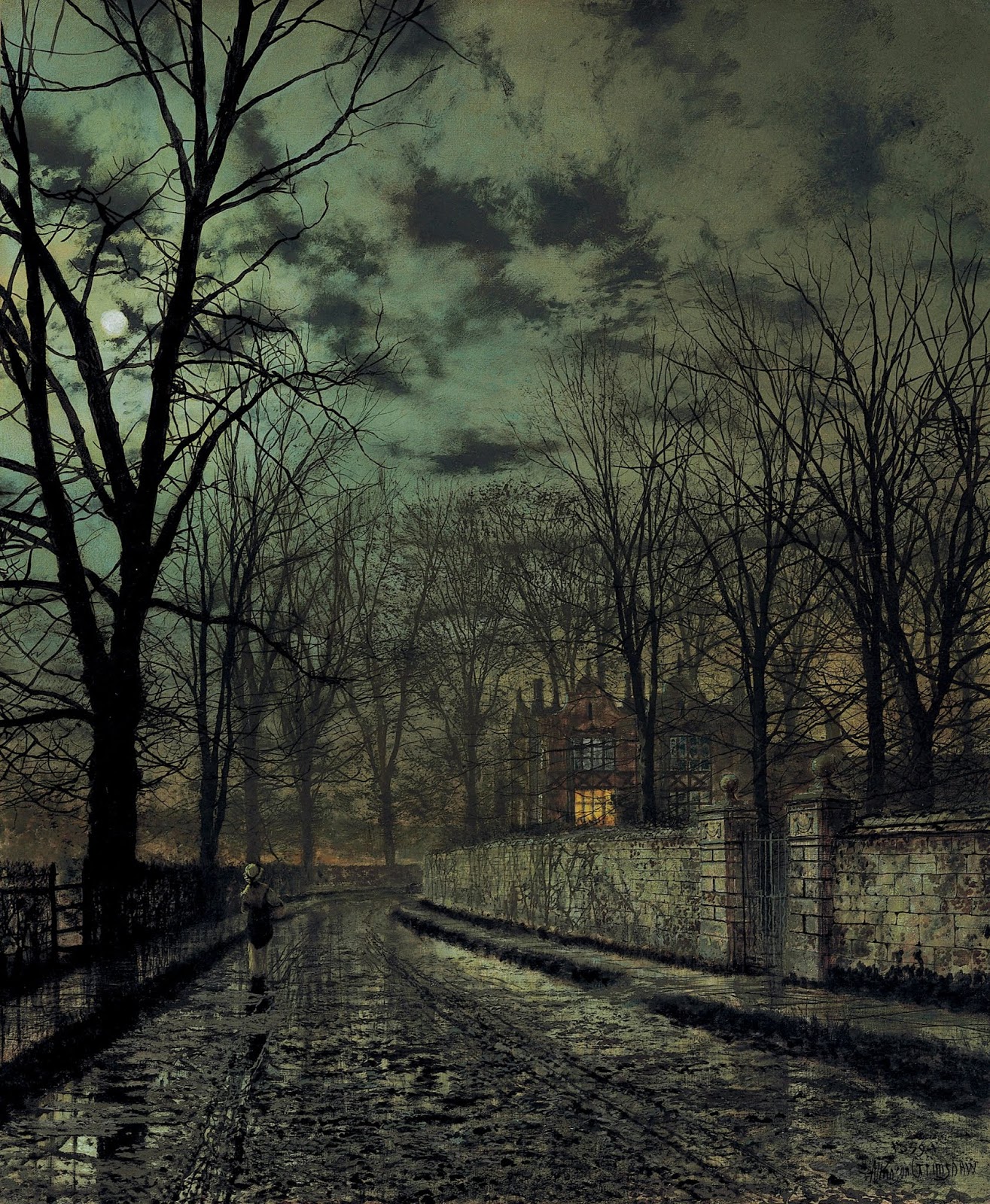


John Atkinson Grimshaw, November, 1879, oil on canvas, private collection

The range and nuance of the power of painting to depict things comes through in a technical virtuoso master of expression like Grimshaw. His incredible moonlit skies, varied light sources, and textured foregrounds are testimonials to the ability of oil paint to represent. 


One of the most diabolical aspects of modernism was the notion of autonomy [click for a post]. This is the false premise that art has no purpose other than to be art. That it exists in complete isolation from any function or expectation other than itself - paint on a surface, form in space, in a disconnected cultural space called art. Even after Postmodernism restored the idea that art represents things, it kept it locked in the stunted, self-referential discourse of "art" and focused on perverse "critiques" of the culture and history of the West.

On the surface, autonomy seems simply retarded, but we've come to realize a more diabolical purpose. Consider: the art of the West is purposeful, but the purpose is to express episteme - abstract truths that aren't obvious in the world around us.


Sanford Robinson Gifford, A Gorge in the Mountains (Kauterskill Clove), 1862, oil on canvas, Metropolitan Museum of Art 

This can be explicitly spiritual. But it can also be as basic as the truth of natural beauty shining from creation and the healthiness of man's place in it. Logos in a material sense.

Gifford, like Grimshaw above, made art that made us aware of the wonders of the world around us with ideal visions of what that could be. The beauty comes from the ordered perfection that is implicit in the natural world, but rarely seen directly. 


Carl Bloch, The Daughter of Jairius, 1863, oil on canvas, Statens Museum for Kunst, Copenhagen

A picture like this one wears its truths - faith, salvation, and the actual Logos - openly. Bloch depicts the moment before the miracle to capture the sorrow and loss. Jesus' arrival in the background is electrifying.


"Autonomy" eliminates all of this - even the logos-free allure of the Cabanal. It cuts art off from it's most essential cultural function - manifesting the True, the Beautiful. and the Good in visible, meaningful forms. Autonomy bars us from what has always been an essential vector for encoding wisdom, values, aesthetics, and discernment, and replaced it with hideous idiocy. Viewing art shifts from perceiving logos through phronesis to an act of humiliation - the self-abasement of capering around rooms filled with detritus while degenerate blurbs and audio guides tell you what to like. In other words, licking the globalist hand as it slaps away your fundamental identity.


Atrium of Daniel Libeskind's Museum of Contemporary Art in Milan.

Postmodern architectural darling designs a house of trash. 

Because Italy lacks decent art to look at...


Simply calling artistic autonomy retarded sells this way short. It is evil. Pure satanic inversion of the bedrock identity of the art of the West. Representation, communication - enculturation - are not aspects of art, they're fundamentals. The reason for its existence. Without this purpose, there is no art.


Julius Klever, Winter Evening in the Forest, 1897, private collection, oil on canvas

Like the connection between people and the land by a Russian artist. Globalist filth deny the reality culture in order to transform people into fungible units of debt and consumption. A painting that communicates the logos of a unique identity based on shared experience opposes that. 

That's why globalists are evil - they're satanic liars who invert what it true for personal gain.


Jean Auguste Dominique Ingres, Oedipus and the Sphinx, 1808, oil on canvas, Louvre Museum

Or the civilizing message of the triumph of reason over animal savagery that's the subject of this mythic scene by an academic painter. The Sphinx is a murderous beast with a perverse nature signified by her hybrid form. Contrasted with the well-formed Oedipus, she embodies the violation of distinctions and boarders that reduces life-preserving civilization to primordial chaos.

Globalists wish to invert the logos of civilization and reduce us to manipulable pink slime - it's clear in their endless attacks on clear definitions and differentiation. A painting that reiterates reasoned clarity and distinction over bestial emotion and whim opposes this.  


The art of the West is the opposite of autonomous - if it were autonomous, it would cease to be the art of the West. Which is what has happened in the sham "art world" of today. The irony is that modernists decry the so-called arbitrary standards of the past while dishonestly promoting the most arbitrary perspective of all - a meaningless bubble filled with talentless hacks, self-promoting sociopathic liars, and money-launderers trying to outdo each other in praise of garbage. It's hard to imagine something more purposelessly arbitrary than that.

Its no surprise that the wicked invert reality, then project that inversion on the targets of their wickedness...


William Blake, Eve Tempted by the Serpent, 1799-1800,  tempera and gold on copper, Victoria and Albert Museum

...they learned from their master. 


In reality, artistic forms are culturally arbitrary, but the purpose is not. Art communicates truth visually by showing us things that we can't see in everyday life. But because of the modernist assault on our heritage and identity, many don't know how to see the communications. They don't know how to read or hear what art has to say. And worse than that, they're so turned off of art in general by the modernist-globalist-luciferian garbage surrounding it that they'll never look closely enough to figure it out.

The pretension, moral ugliness, and dishonesty of the modern art "scene" and the self-abasement needed to subscribe to its nonsense make it a non-starter for most. Healthy people tend to avoid weird creeps and liars. Then the historical art that actually is appealing gets buried under the discursive blather from the same. And things like this go unnoticed:


Johan Christian Dahl, View of Dresden by Moonlight, 1839, oil on canvas, Staatliche Kunstsammlungen Dresden
Imagine if the art appreciation types really put the full scope of the beauty of the West against the Modernist hacks?


This site was the first hit on a duckduckgo "art appreciation" search. Notice how talentless modern garbage predominates on their landing page. They're typical for the way the conventional modern institutional definition of art is simply taken at face value and presented as fact. Great works and trash are put side by side as if they share anything beyond designation by anti-human globalist freaks. There's no mention of the True, the Beautiful, and the Good. There's no consideration of the relationship between art, culture, and values. Just the mindless parroting of the atavists, poseurs, and frauds that choke our institutions like the plaque in a diseased artery. We aren't singling them out for criticism - they're simply an example of what passes for "art appreciation" in the cultural cesspool that is Art! 

Here's a question:


The answer is obviously that you can't. Which is why you'll get nonsense descriptions of movements and the importance of technical terminology and nothing about communication. How artworks encode logos in appealing visual forms that can make the soul soar. Nothing about how those techniques arrange that wisdom for emphasis and reliability. Nothing about the interplay of the old Aristotelian terms of dialectic and rhetoric, or pathos, logos, and ethos in lines and colors. In short, nothing to let you connect with the real artistic heritage of the West and let it show you what we are, where we came from, and where we need to go.

The Band came together to fight back against the lies. Since then, it's become apparent that reconnecting people with their artistic and cultural heritage is a major component. This is a big project - what is peddled as "art" needs to be completely reconsidered in light of logos. Modern history needs to be scrapped altogether and a reality-facing alternative set up in its place. How to look at, understand, and yes, appreciate art needs to be built from the ground up.


Jonas Lie, The Old Ships Draw to Home Again, around 1920, oil on canvas, Brooklyn Museum

A history where 20th century art actually relates to the life, people, and culture of the time rather than theoretical nonsense and talentless hackery.


Aleksandr Averin, Walk #3, around 2017, oil on canvas

And contemporary art is distinguished by mastery of techne and the logos of beauty - of both nature and human nature. 


This isn't going to happen overnight, or through the work of one small site. But we can start.

With that in mind, this post will look closely at two pictures as a demonstration of what art says and how it says it. It won't be the systematic, ground-up, "how to read a picture" that needs to happen - that's a project that will unfold over time, and will involve other platforms as well. But it is a start. And once you start thinking about what art says, you become empowered to read other pictures, make your own judgments, reject the cultural emasculation of the liars and globalists, and begin to wake up to the incredible heritage that you're part of.

A new dawn. Sort of like this:


Frederic Edwin Church, Coast Scene, Mount Desert (Sunrise off the Maine Coast), 1863, oil on canvas, Wadsworth Atheneum Museum of Art, Hartford, CT


The two pictures that we're going to look at are an uncommon pair. One came from the daily paintings that the Band posts elsewhere and the other was contributed by an ally and associate. Both were popular, but come from different periods and address very different subjects. They share Slavic origins but it is unlikely that they have any direct connection beyond that. But this is the difference between reading paintings and building histories of style or defining movements - the direct connections matter much less than the logos that shines through them. Once you can see that, the entirety of Western art opens up to you.

What they do do is communicate opposite messages in similar ways.


Gavriil Pavlovich Kondratenko, Moonlit Winter Evening with Solitary Figure, 1903

Pre-Communist Russian painting is fascinating. It shows some influence of European movements like Romanticism and Impressionism, but had a unique quality that we can call fantastical realism. That is, realistic art with a fantastical quality. 

It is especially good at capturing the feel of the land and the relationship of the people with it. See the Klever painting up above for another example. Not surprising, considering the size of the rugged Russian landscape, but other places were quicker to toss their heritages for modernist lies. 

This painting is impressionistic in its grainy blurry quality but doesn't share the Impressionist interest in making images out of color dots. What it does is capture the feel and beauty of a bright moonlit snowy night where the noises are muffled and edges blurry. The light in the church is the point of warmth that draws the traveler forward. 


Our second picture is an untitled piece often called the Valley of Death or of the Dead by a Polish master of surrealistic hellscapes. The dimensions of the painting are such that we can't fit a large version with text beside it given Blogger's format constraints, so we'll introduce it, then blow it up into a larger view after.


Zdzislaw Beksinski, Unntitled, 1972

The Band generally dislikes Beksinski's work. He's a skilled technician, but wallows in horror and depravity in the nihilistic "moral vacuity of modern life" cliche that isn't so much wrong as a dead end. Endlessly pointing out how vile the contemporary world is quickly crosses over into debasement porn without starting to show a way forward. At the same time, he did live through the Communist system and was knifed to death by a teenage "friend" looking for money, so it is possible that his hellish visions were true to his inner life. But this isn't that. 

Untitled is an excellent depiction of hope and resolve in a dark world. The monstrous figures loom but don't threaten, leaving a clear path without a clear beginning or end. Crows circle, but the figure moved forward, guided by the brightest light in the scene. 


Here is the large-scale view for comparison with the Kondratenko. Note the lighting - it also only illuminates vague forms, but it is more monochrome and has no obvious source. Just a grim haze that recalls distant fires reflecting off an ashen sky. It's the light of pyres or hell - the opposite of the pure light of  the moon on fresh snow.

We should note that Beksinski denies giving meaning to his works: "Meaning is meaningless to me. I do not care for symbolism and I paint what I paint without medating on a story." But art expresses the world that it is drawn from. If the artist wishes to include explicit meanings, that's great. But it isn't necessary for insight to be communicated to us.


So why look at these together? What makes them jump out? First, look at the overall compositions. Both feature solitary walkers, single points of light, and diagonal pathways through uncertain terrain. Composition or arrangement is how the paintings are put together. Not the materials used, but how the elements in the picture are arranged or composed. It's like music or writing that way. There are many ways to organize a scene, and how the artist does so determines not only what it looks like aesthetically, but how you will understand it conceptually.


Rembrandt, Aristotle Contemplating a Bust of Homer, 1653, oil on canvas, Metropolitan Museum of Art

Here, Rembrandt obscures the background to push your attention onto the figure and the bust. The diagonal light connects them and especially illuminate's Aristotle's face to enhance the impression that the great mind is deep in thought. Dressing the philosopher in 17th-century clothing made him more accessible to Rembrandt's contemporary audience. 

Composition is a huge part of a meaning - a reflection on the legacy of the classical tradition that the West was built on.


Consider two versions of the same scene from eminent academic painters. They depict the moment when the great Roman poet Virgil was reading his masterpiece to the Emperor Augustus and his family and referenced the death of the emperor's nephew Marcellus. Augustus' sister Octavia, Marcellus' mother who was devastated by the death of her son, faints at his mention. The emperor's second wife Livia was married to him for over 50 years but they had no children. She was accused of having Marcellus killed so her children from her first marriage would become heirs to the throne, though the rumors were never proven.


Angelica Kauffman, Virgil reading the Aeneid to Augustus and Octavia, 1788, oil on canvas, Hermitage Museum 

Kauffman was a rare female history painter and a founding member of the British Royal Academy whose art is defined by Neolassical clarity. 

She depicts a moment of dramatic action, rushing to the aid of fainting Octavia, while Livia looks reproachfully at the somewhat worried poet. 

Jean-Auguste-Dominique Ingres, Virgil Reading from the Aeneid, 1864, oil on canvas, private collection

Ingres was president of the French Academy and combined Classical and Romantic themes on the way to becoming the preeminent artist of his day. 

He downplays the physical action to focus on the psychological intensity of the scene. Augustus locks eyes on Virgil and commands him to stop while to advisors communicate nervously behind him. The focus in on the poet and emperor while between them Livia sits unconcerned beneath the statue of Marcellus, emphasizing the crux of the drama. The lighting ratchets up the emotional tension, while Kauffman uses more natural illumination to create a more realistic scene. 


This is how composition determines the nature of the story you're seeing. The position and interaction of the figures, the expressions and gestures, the light and color, even their locations in space all shape the viewer's experience. Both pictures depict the same moment and are carefully structured with figures locking together into integrated groups. This allows both to show this as a Classical ideal rather than a random snapshot - you can see the conscious thought that went into the planning. But one opts for action, the other for psychological nuance, with the result that your impression of the scene is completely different.

When reading a painting, it is important to focus on the subject. But it's just as important to focus on the composition and be attentive to how the subject is put together.  The similarities - the solitary walkers, single points of light, and diagonal pathways through uncertain terrain - indicates that the paintings might be presenting information in comparable ways. So we look closer.

Start with the figures, because it is human nature to focus on the figures in paintings that include them. We don't necessarily see ourselves in them, but they do give us something we can relate to as an access point.


Two things jump out:

1. The are going in opposite directions. Kondratenko's is moving inwards - away from us - and Beksinski's is heading out.

2. The relationship to the warm light source is different. Beksinski's carries his like a torch while Kondratenko's is moves towards his. One lights his own way and the other is drawn to the light.


These differences are significant, especially when taken together. One follows the light inward, towards something known. The other has to light his own path and is moving out towards the unknown. Which poses the next questions - where are they coming from and where are they going?


Kondratenko's destination is a church. Where he is coming from is unclear, but this is unimportant, given where he is going.

He follows a light that he doesn't have yet, but will soon reach. His journey is from the exterior world to the Logos, to the Christian community and salvation that is the only antidote to the chaos and evil of a fallen world. We can see his destination because it is a destination - the endpoint of wandering in the wilderness. Just as it was for Dante in his dark wood.


Beksinski's comes from the mysterious depths of the scene and his destination is unknown. The lurid light darkens ahead of him, suggesting that he is finding his way out of the hellscape he knew, but the future is uncertain. There is no light to guide him other than his own - his wisdom, discernment, resolve.

If there is a refuge of faith and Logos, he can't see it yet. It's a secular, material world, where fallen man is on his own.


Bringing us to the next question - where are they?


Kondratenko's world is cold and obscured, but natural. There is a bright moon and harsh beauty.

The perspective funnels our - and the wanderer's - attention to the warm light from the church, and the alignment with the moon tells us that this light is natural in its own way - the natural culmination of a journey through the metaphorical wilderness of the spirit.

The wander will soon be home.


There is nothing natural about Beksinski's. This is an artificial hell, a man-made one. The path isn't through nature, but between monstrous, anthropomorphic forms. The lighting is not a natural source like the moon, but a dirty glow. The way forward vanishes into darkness, rather than culminating in a house of Logos. And the only direction is the figure's own tiny light.


Taken together, the opposites are complementary inverses. The inversion point being the presence of Logos in the represented world. Beksinski's is the monstrous secular hell of materialist tyranny. Where there is no clear path of righteousness, just lurid depths where you're on your own. Survival demands some kind of escape but the light of your own powers promises nothing. Kondratenko reminds us that Logos restores the natural human condition, and that with it, we are never alone. We don't have to bear the overwhelmingly daunting task of navigating the valley of death that is the fallen world because the pathway through is assured.

Look at them together.


One is the promise of globalism - the tyrannical collective lie that crushes the spirit and stacks the bodies. There is no logos here - just a road into darkness that goes as far as your own spirit can take you and where you can't even see the sky. The other is the natural order of man in creation. A world where beauty prefigures spiritual wholeness. It's possible to imagine them as the same path - a journey out of the evils of vanity and inversion and into the light.

When we read these paintings, we see why the art of the West is purposeful. Although some 70 years apart, they describe mirror-image conditions that in the modern world must consider. And they don't just explain them like our narration - the show you them in a real visceral way. You can feel the oppressive gloom and the menace of one and the warm hope and promise of the other. You can see the difference between trying to light your own path through darkness and death and seeking your place in the Light. Between standing alone against the hopelessness of a fallen world and taking your rightful place as part of something bigger, no matter how what the world around you is like.


Caspar David Friedrich, Winter Landscape with Church, 1811, oil on canvas, Museum für Kunst und Kulturgeschichte, Dortmund


This is the cultural heritage that the satanic globalists would steal from you.

We think otherwise.


Sunday, 1 March 2020

Divine Kings and Noble Parasites... How Could that Go Wrong?


If you are new to the Band, this post is an introduction and overview of the point of this blog that needs updating. Older posts are in the archive on the right. Shorter occult posts and reflections on reality and knowledge have menu pages above.
Comments are welcome, but moderated for obvious reasons. If you don't see it right away, don't worry. We check a couple times a day and it will be up there.


The last roots of the arts of the West post made an unorthodox claim about the Gothic period. We charged it with being the beginning of a path that led to the cultural brownfield of the present day because it collapsed the distinction between sacred and secular in a way that hadn't happened before. This post will make that case more strongly. This is not to say that the two weren't blurry from the start. Constantine essentially fused the old Imperial cult of the Empire with the Church and the Byzantine emperors claimed to be its head.


Christ crowns Romanos II and Eudoxie, 945-949, ivory, Bibliothèque Nationale de France, Paris

There was some disagreement over the identity of this imperial Byzantine couple. It's now thought to show Emperor Romanus II (938-963) and his wife Bertha of Italy who changed her name to Eudoxie. Their wedding was between 944 and 949, giving the date for the piece.

The art shows the Emperor as the direct proxy for Jesus, with an authority that comes from God alone. This would be the dream scenario for Western rulers - many of whom claimed to be authorized by God. But attempts to be head of the Church never gained much traction, Henry VIII's absurdity notwithstanding. 


In the West, the popes emerged as spiritual authorities, but as heads of a man-made organization - the Church - conflict and confusion with secular power was inevitable. This became particularly acute around the turn of the 11th century with the clash over privileges and control of resources known as the Investiture Controversy, and continued until the turn of the 14th with the so-called Papal Monarchy. It is important to note that it wasn't just the- monarchs pulling sacred authority closer to them. The papacy was also aggressively encroaching on the secular.


Emperor Frederick II is excommunicated by pope Innocent IV, from the Summa de dignitatibus et virtutibus clericorum et laicorum, second quarter 14th century, Bodleian Library MS. Laud Misc. 632 f. 45r

Excommunication - expelling from the Church and therefore salvation - was a common way for medieval popes to try and force obedience. Here the emperor loses crown and scepter. 


Using religious sanctions as coercion blurred the lines between sacred and secular influence. This was by design - the popes were trying to flex secular muscles - but it gradually dragged them into political disputes and undermined the moral authority that comes with being above the fray.


Chroniques de Saint-Denis, between 1332 and 1350, British Library Royal 16 G VI f. 374v.

Illuminations depict Pope Innocent III excommunicating the Albigensians (left) and a massacre of Albigensians by crusaders (right). The Albigensans are better known as the Cathars - a gnostic luciferian sect that Innocent preached crusade against. 

The Church understood that heresy was intolerable, but this crusade was more political than spiritual. While Catharism was wiped out, the French motivation was to bring the independent Languedoc region under control of the French crown. The horrific massacres were also done by secular nobles commanding the crusading forces. 

Whatever Innocent's motivations, and the anti-clerical blather of later historians, the secular and sacred are blurred to the point of being indistinguishable. The illuminations capture this with the pope gesturing, then armored knights attacking.


The Albigensian Crusade was nominally a success, but the papacy's reliance on the French crown bound it more closely to the king of France. When the secular - sacred conflict came to a final head in the early 14th century, this tie was a likely factor in the relocation of the papacy to Avignon in the south of France.


Arnolfo di Cambio, Pope Bonifacius VIII, around 1298, Opera del Duomo Museum, Florence

Boniface VIII (1294-1303) took the idea that the papacy was the supreme power in Christendom to an extreme. His bull Unam Sanctam of 1302 asserted that the pope was head of a single unified Church and that therefore all else was subordinate to him. This caused a festering conflict with French King Philip IV to break out into the open and French clergy sided with Philip to reject the bull. Boniface excommunicated the king and Philip had charges of heresy, idolatry, murder, sexual impropriety and other crimes drawn against the pope. 

The charges were supported by Boniface's unusual practice of erecting statues of himself in various churches as symbol and reminder of his power. Like this one. 


The loyalty of the French clergy to the king over the pope is an excellent example of how national identity and politics complicated the older sacred-secular split. In political matters, the French clergy were French first. The situation came to a head when Philip sent armed mercenaries to attack and capture the pope.


Pope Boniface being arrested at Anagni by King Philip IV’s men, 14th century, from Giovanni Villani’s Nuova Cronica, Biblioteca Apostolica Vaticano, Chigiano L VIII 296, fo. 176r.

Boniface was rescued when the townspeople counterattacked, but he had been treated roughly. He died a month after returning to Rome. 


Boniface's successor lived less than a year and the conclave to choose a new pope was bitterly split between French and Italian factions. The eventual choice, the French Clement V was essentially a marionette of the king - rolling back claims of papal supremacy, suppressing the Templars on Philip's behalf, then moving the papacy itself to Avignon in 1309.

The career of this sorry puppet is as clear an illustration of the breakdown of fundamental secular-sacred distictions in the Gothic period. As a reminder - Suger was renovating Saint-Denis in the 1140s, and Chartres Cathedral was pretty much complete by 1220. The huge papal palace built in Avignon in the middle of the 14th century is Gothic in style.


Palais des Papes, 1330's-1364, Avignon


We're generalizing - it's inevitable with big historical patterns - but what was different about the later Middle Ages is the increasing blurring of the sacred-secular split. Nobles had been pushed into the Church from the beginning and the papacy was always subject to Roman politics, but there is a change as the Middle Ages progresses. One big factor came up in the Boniface VIII/Philip IV example - the emergence and strengthening of national interests and identities. Although as we will see, the "national" didn't have much of a chance before it was jacked by aristocratic elite interests. And these had little interest in the nation beyond a parasite for its host.

Early medieval Europe was dominated by a huge Frankish empire - first the Merovingians, then the Carolingians. Italy and the British Isles were outside its direct control and Spain was under Mohammedan rule, but the bulk of the continent was controlled by the Franks. Regional differences existed, and various nobles held sway over their areas, but there was only one overarching government.


Frankish Empire from the Merovingian roots to the height of the Carolingians.


In a situation like this, division into secular and sacred authorities makes the most sense. But the dissolution of the Carolingian Empire paved the way for the eventual rise of the European nation-state. Regions declared themselves kingdoms, principalities, counties, and so forth, and the rise of the Ottonians only ensnared part of the old Frankish realm. Powerful kingdoms like France began to form, and while borders were fluid, there wouldn't be a return to the old united Europe. In this context, secular and sacred became differing relations between papacy and various monarchies, with the monarchies vying for influence over the popes.

The situation was exacerbated by the pope's own claims to secular power.


Rome was the capital of a small territory called the Church or Papal States, making the pope a petty noble as well as supreme spiritual leader and engaging him in Caesar's business as well as Gods. This emerged as the popes gradually assumed rulership of the old Byzantine Duchy of Rome

Papal control over the territory was strengthened through negotiation with the Lombards who conquered Byzantine north Italy. It was codified by the Franks who crushed the Lombards with the encouragement of the popes. This alliance reached its height when Pope Leo III crowned Charlemagne emperor.


A fragmented political landscape brings new ideological concerns, especially involving legitimacy. The Franks had migrated into Europe along with other Germanic tribes at the end of the ancient world. They didn't attack Rome like the Huns or Goths, but are part of the demographic shift known as the Migration Period. Their supremacy was the result of several factors:


E. Crété, Charles Martel à la bataille de Poitiers (732), color lithograph in H. Grobet, Histoire de France, Paris: Emile Guérin, 1902.


* The Ostrogoths were wiped out by the Byzantines.

* The Vandals and Visigoths were wiped out by the Mohammedans.

* The Anglo-Saxons and Danes were in remote areas.

* The Franks under Charles Martel stopped the Mohammedan advance, leaving them dominant in Europe.

* After they allied with the papacy and crushed the Lombards, there was no one to challenge them.


The Carolingians ruled by strength of arms - by right of conquest - but argued that their rule was sanctioned by God. The reality was that they had seized power from the Merovingian Dynasty is what was pretty much a coup. All the more reason to shore up their claim to the throne. This likely played into Charlemagne's agreement with the pope's decision to crown him Emperor of the West. The pope was looking for a counterweight / replacement to the Byzantine Emperor, and Charlemagne got to reactivate a claim to the old Roman imperium. But there was a larger issue re. secular and sacred power.

If the pope crowns the emperor, where does imperial authority come from?


Friedrich Kaulbach, The Coronation of Charlemagne, by 1903, oil on canvas, Maximilianeum, Munich

Charlemagne didn't care for the answer.


But the Carolingian Empire didn't last a century, leading to a new territorial map and new monarchs with even less legitimacy than Charlemagne had. This gave us fake histories, like the one expressed at the necropolis at Saint-Denis - with Capetian and later kings claiming Merovingian descent. But it also gave us clearer national identities.

Dagobert the Merovingian's tomb is in Saint-Denis, but he wasn't French. Louis IX and Abbot Suger were. They were claiming Frankish royal legitimacy in a new national landscape. The very notion of rulers from different dynasties and backgrounds somehow forming a proto-French monarchy is rewriting history along nationalist lines.


Tomb of Dagobert, 1263-64, Saint-Denis, Paris

Dagobert was king of the Franks from 629 to 639 and is considered the founder of Saint-Denis. He was also the first king buried there. His Gothic tomb was only added in the 1260s and fits him into the lineage of unrelated Capetian French kings. 

The idea was to manufacture a national royal history that rewrote the past to support the present. The idea of creating this specifically "French" lineage is a good sign of the new national identity. 


National identity created another axis alongside the old secular/sacred split. You can see it at the Royal Abbey - literally the two in one. French Church + French monarch = French order. The same French Church that will back Philip IV against the pope and move the papacy to Avignon. And since this order rested on the a French crown that didn't even exist a few centuries earlier divine sanction was all the more important.

The notion of sacred kingship is as old as human civilization, and would later develop into the European ideology of the explicit divine right of kings. What we're seeing in Gothic France is king, church, and nation bound together into a sort of conceptual unity. Like the royal west end and ecclesiastic east end in Suger's renovated basilica of Saint-Denis.


Clothar II leads the Franks in battle against the Saxons, from the Grandes Chroniques de France de Charles V, 1375-80, Bibliothèque nationale de France, f.63r.

Or in the French fleur-de-lys. The lily was connected to Clovis and the Merovingian Frankish kings as a symbol of purity celebrating his conversion and the ampulla that held the oil used to anoint him. That is, a symbol of his divine right to rule. Later French monarchs revived the fleur-de-lys to show their connection to the Frankish past and own divine right to rule. 

Not surprisingly, the old Frankish kings start getting depicted in the new French heraldry. Like Merovingian King of the Franks Clothar II who ruled from 595-613. Over 700 years before this image in the Grand Chronicle of a French king.


Albrecht Dürer, Charlemagne, oil on wood, 1512, Germanisches Nationalmuseum, Nuremberg

Charlemagne's empire spanned France and Germany. Both nations would claim him as a forerunner. Note that this was painted 700 years after his death and includes contemporary French and German symbols.

The orb and cross became a common symbol of European royalty and their essentially religious status. It's hard to find a more succinct, and easily overlooked symbol of this blurring of secular and sacred in national kingships.


As secular and sacred authority blur together in national kingdoms, Gothic art visualizes these changes. And not just in direct references to the spheres overlapping. We saw in the last post how Suger conceptualized the beauty of the Church in terms of number of gems and total weight in gold and silver - the sort of accounting for lucre that seems more appropriate to a monarch.

We also neglected to mention that Suger was also a Cluniac abbot, which puts his dispute with St. Bernard in clearer context. It isn't just that he was promoting a royal treasury concept of religious beauty - he was doing so at a time when the obsession with worldly luxury in his order was coming under attack from the new austere Cistercians. The worldly focus becomes more conscious and deliberate when there is a clear alternative.


Extensive treasure uncovered at the Abbey of Cluny.


The point here is not to declare the Gothic impious. Who can know the hearts of those is the distant past? The soaring vaults and stained glass light of the great cathedrals were offered to the glory of God, and it is hard to imagine more perfect statements of collective faith.


Cologne Cathedral, started 13th century, completed 19th century
The rib vaulted ceiling looks like its floating on a sea of glass. Entering a Gothic cathedral feels like walking into a miracle. Which was the point - the experience was intended give the impression of drawing closer to heaven. All the better for putting you in a spiritual frame of mind.


The point is to see how the art of the West moved away the formula we worked out using ancient Greek terms earlier in the Roots of the West journey. How it lost sight of episteme. And since art is an expression of society, we need to consider how the artistic aspects of society also lost sight of it. Or more accurately, how the nature of the episteme informing art changed.

First a quick recap of the Greek-derived terms. If you are interested in their derivation and development, click for a link to the post this graphic was pulled from. We found three terms that fit together to make a pretty good working definition of art. Not to say that this is the ultimate definition, but that so far it's proven solid. The terms are techne, episteme, and phronesis - they have accents as well, but since those are annoying to type and we're anglicizing things, they're being left out. The concepts still stand.


Techne is skilled craft. It’s material-level on the ontological hierarchy, and follows culturally-specific customs rather than universal rules. The key is that it is skilled. Art isn't easy - it's talent refined to mastery. Otherwise you get the modernism where a perverse "art world" anoints talentless dyscivic garbage. 

Episteme refers to higher abstract principles - the metaphysical ideals that a culture holds most important and that are immaterial. Truth, Beauty and the Good. These don't change.  

Phronesis is the coming together of the two - techne guided by, serving, and expressing episteme in artistic form. This is the art of the West. Technical skill to express abstract values. 


The mistake to define art as either the making or the ideals - it is the coming together of the two. It is different from "craft" or "skilled labor" because it's main purpose is to communicate episteme in material terms, whereas craft objects can require refined skill and be aesthetically pleasing but have a primary functional purpose other than purely communicating episteme in some way. That's not to say that the art of the West is "autonomous" - that's modernist jibber jabber intended to exclude meaning and skill. Click for a post on that toxic nonsense. The art of the West is purposeful, but the purpose is to express episteme - abstract truths that aren't obvious in the world around us.

The formula:


The earlier posts on this showed how these terms align with our ontological hierarchy. Techne at the material level, Episteme as abstract or ultimate reality, and phronesis where they meet. Episteme then is that which is True, and Truth (with the capital T) is only knowable by faith. But we can express truth at the level we can grasp - in material form - turning techne into art. Remember - the True and the Beautiful are essentially the same thing - we like to say Beauty is what Truth looks like, which works if we remember that we're looking at metaphysical absolutes and not anything we can see optically. So small-t truth expressed through techne is small-b beautiful.


Daniel Gerhartz, Drift off to Dream, oil on canvas, 2006

Painting by a contemporary artist that captures timeless truths about human bonds and relations in a technically skilled and pleasing matter. It is beautiful because it conveys something beyond the painter's techne. It reaches for episteme, and achieves phronesis.


Real art marries technical skill to higher truth to create beauty, and it is the allegiance to Truth that keeps it from going off the rails. It doesn't have to be pleasant. Many truths are miserable. But the miserable truths are miserable because of their negative judgment in episteme. Without the lighthouse of Truth as a guide, the best art can shoot for is allure, and allure is subjective. It's just technique. Without a higher principle to serve, it's merely a material thing. And material things are malleable. They're easily changed, denatured, and hollowed out. 

The soul-stirring beauty of Gothic art comes from the application of highly refined technical skill to the glory of God - or top-level techne to Truth in its purest form. Like Sens Cathedral 


North transept and rose window of Sens Cathedral (Cathédrale Saint-Étienne de Sens), 1135-1534, rose window, 1516.

The date puts it in the last stage of Gothic design called the Flamboyant because the details resemble flames instead of the usual Gothic geometries. The window is stunning - a paradise of angels over the story of the Archangel Gabriel.


Applying technical skill to the glory of kings disconnects it from Truth and redirects it to human vanity. Tecnhe and opinion rather than techne and episteme, leading to allure at best. Like Richard II of England and the Wilton Diptych.


The Wilton Diptych, 1395-99, egg tempera on oak panel, National Gallery, London
Exquisite International Gothic piece depicting King Richard II of England with saints venerating the Madonna. 


The least attractive thing about the Wilton Diptych is the king - a a great patron of the arts, but ham-handed ruler who bungled his way into being deposed and murdered. The best thing you can say about his rule is that he wasn't as bad as Shakespeare made him out to be. But the odds that he was singled out by Jesus are minimal.


The national kingdoms of the later middle ages open the door to subordinating Truth to national ideologies embodied in a dude.


And then there's the aristocracy...


Detail from a tapestry with scenes of a boar and bear hunt, probably from Arras or Tournai, Netherlands, 1425-30, Victoria and Albert Museum, London

How could society function without them?


... or more accurately, the nobility. Because when it comes to the secularization of art, Suger's proto-churchianity is just a twinkle compared to the full-blown parasite class that develops towards the end of the Middle Ages.


But this group also has deep roots that take time and socio-cultural change to blossom.

The origins of the European nobility are foggy because we just don't have the records to really trace where they come from. And the detailed information that we do have shows that there is a lot of regional variation during the early Middle Ages - say 6th -8th centuries. In general, they seem to have roots in both the old Roman and new Germanic socio-political orders, but the specifics play out differently in different places.


Pierre Olivier Joseph Coomans, Roman Banquet, 1876, oil on canvas, private collection

Some Roman aristocrats with extensive land holdings maintained influence well after the fall of the empire, and slowly merged with the Frankish elites.


A good look at the state of scholarship is the book Nobles and Nobility in Medieval Europe: Concepts, Origins, Transformations, edited by Anne Duggan. A good piece of the early chapters are available online. In general, the early nobility show some combination of militatry skill, proximity to ruler, and heredity membership in a noble bloodline, although this is very loose.


Emmanuel Fremiet, King Merovech's Victory over the Armies of Attila the Hun at the Battle of the Catalaunian Field in 451, 1867, silvered bronze mount of an armoire, Metropolitan Museum of Art, New York

Merovech, the legendary founder of the Merovingian Dynasty may not have existed, but this 19th century relief captures the martial nature of early Frankish nobility.


Among the Franks, we see an imperfectly defined elite that tends to involve family lineages, but could also be open to newcomers who distinguished themselves in some ways. These noble families had different forms that reflected the Franks own recent migratory history - some sort of clout in the area they settled in mixed with long-distance alliances and connections. Close family ties were favored, but broad networks could be drawn upon when needed.


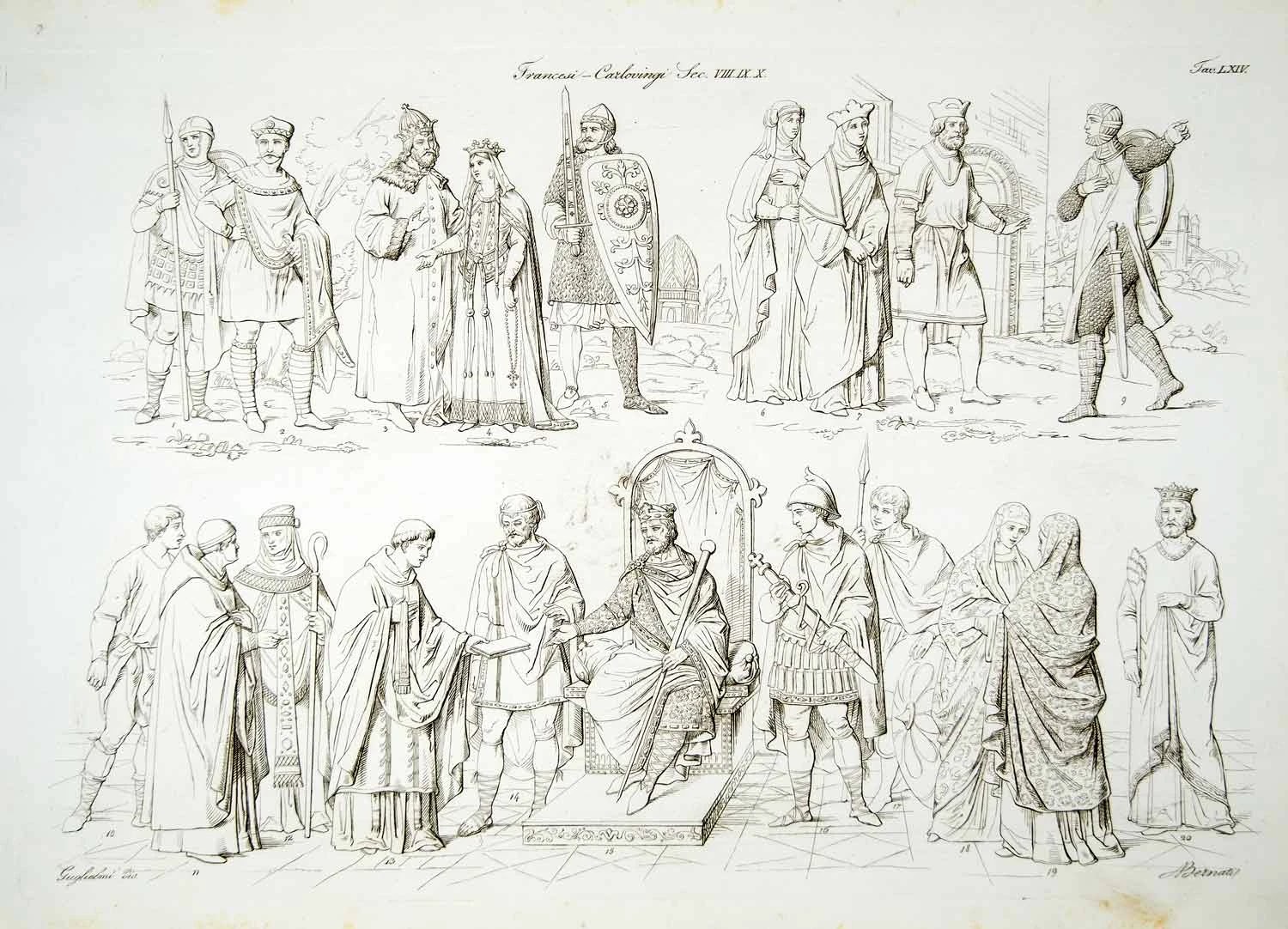
Carolingian Nobles Dress, 1834, copper engraving 


The Carolingian rulers tried to shape this loose nobility into a ruling aristocracy, and were somewhat successful in promoting exogamous marriage and encouraging alliances. This was successful, to the extent that the various lords, officials, and high clergy in the empire mostly came from high-status families. Again, there were exceptions, especially in the Church, where there was some potential for upward mobility. The idea was to stabilize his empire with a defined noble leadership class with regional bases. This is consistent with Charlemagne's other empire-building initiatives, like Christianization, subduing bordering enemies, and developing arts and learning in central schools.


Jean-Victor Schnetz, Alcuin and other clerics present manuscripts to Charlemagne in the Palace of Aachen, before his court, 1830, 1830, Louvre, Paris

Any empire will develop a network of courtiers. The Carolingian version was pieced together from this eclectic scattering of noble families.


It is notable that the network of magnates established by the Carolingians outlasted them - the petty kings that claimed regional power after the empire crumbled came from this class. Look at the maps.


Europe in 900

You can see how the Carolingian Empire fragments into smaller kingdoms. East and West Francia are the kernels of modern France and Germany, and the seeds of Eastern European nations are visible.

Fragmentation seems to have been the order of the 10th century - England is a cluster of tiny kingdoms and even the Caliphate in North Africa broke up along tribal lines.


Jump forward a century and the Ottonian Dynasty has laid the foundations of the Holy Roman Empire. But it is much smaller than the Carolingian Empire, and Eastern nations are forming. 

England has also coalesced into a country, along with rival France.


Tracking the development of the European nobility is complicated historically by the fact that the early law codes - neither the Roman Codex Theodosianus of 312 nor Clovis' Salic Law of around 500 - don't mention nobles as a legal class. We know they existed in practical terms, but weren't formally defined at the beginning of the Middle Ages. We do know that different regional legal codes developed in the Frankish empire that were focused mainly on protecting property rights, but varied locally. This suggests that the development of laws probably reflected differences in the nature of the nobility in different regions. Because one thing that becomes clearer over time is the connection between nobility and land.

Over the 9th and 10th centuries, the formerly wide-ranging aristocratic families become more connected to a single place, with hereditary inheritance becoming the norm. Land was given to nobles by the king and a reward for past service and an obligation of future support.


The Gravensteen (Castle of the Counts), from 1180,  restored over 1893–1903, Ghent, East Flanders, Belgium. The site was first fortified around 1000 but burned around 1176 and was replaced by this castle. Details added during the 19th century restoration like the flat roofs and the windows of the eastern outbuilding, are not believed to be historically accurate.


And the gatehouse. This was the residence of the Counts of Flanders until 1353 and a great illustration of how the establishment of noble estates became the basis for their military and economic power.


Noble landholding opened the way for the feudal system - a network of obligations and alliences that tied lesser nobles to greater ones and to the common folk who worked the lands. Initially appearing as a sort of mutually-beneficial protection system, feudalism brought considerable wealth to those who were landholders.


The whole system was based on land ownership and martial service. The king essentially owned the country and gave parcels to vassals who become nobility and they or the king did the same to lesser retainers or knights. These nobles served their lords with military force and/or money. The peasants or serfs at the bottom worked the estates of every level but owned nothing. 

This diagram captures the basics, but isn't to scale. About 90% of the population were bottom tier. 


In theory, the the peasants at the bottom benefited from protection and got to keep some of what they produced off their lord's lands. In practice, this was minimal, considering the "protection" component dwindled as strong nations with central armies formed, and the lords determined what portion they kept. Peasants or serfs were also tied to their lands - more chattel than slaves - without any freedom of movement. The enormous inequity, where a handful of increasingly practically useless parasites vacuumed up enormous resources gave us the later medieval aristocrats of the International Gothic period.

Related to the noble was the knight - a highly trained aristocratic warrior who fought from horseback and was master of several weapons. Not all nobles were knights, but they came from similar roots in military service and considerable wealth. Knights could be awarded land of their own and serve as essentially petty nobility.


Count Albrecht von Heigerloch and knights attack a tower, from the Codex Manesse, 1305-1340, illumination on parchment, Heidelberg University Library, Cod. Pal. germ. 848, f. 42r

Well-armed and armored, knights were formidable in advantageous circumstances. The adoption of the stirrup starting in the late 9th century opened the way for heavy cavalry charges. Not all heavy cavalry were knights - some were men-at-arms, but all knights were heavy cavalry. 

Count Albrecht II of Hohenburg and Haigerloch fell in the battle against Otto III in 1298. 


The knight has loose roots in the Roman equestrian class, or equites, since cavalry was expensive and soldiers able to maintain a horse were by necessity of the upper classes. But the direct ancestor was the Frankish cavalry that developed during the Carolingian period. The early Frankish armies tended to fight on foot with elite infantry traveling on horseback, but over time this developed into a proper mounted cavalry. The mobility offered by horse was essential for covering the vast distances of the empire.


Wayne Reynolds, Carolingian cavalry attack on Viking warriors, late 9th century, in David Nicolle, Carolingian Cavalryman AD 768–987, Osprey Publishing, 2005

Viking raiders were increasingly successful as the Carolingian Empire collapsed into infighting and fragmented. But they had to employ evasive tactics against the armored cavalry because even the fearsome Norsemen were slaughtered in open-field fights against this foe.


In the later Carolingian period, these fighters were rewarded with land and status, and this was really cemented with the collapse of the empire. Without the central authority, defense against threats was more localized and strong local lords were important. Enter feudalism.


Knight and Castle Wallpaper


It was only in the 12th century - the Gothic era - that we see a clear social distinction between Knights proper and non-knightly mounted cavalry known as men-at-arms. But the training of a knight had been established well before that. What the new status brought were social class and Christianization - the idea of chivalry based on a romanticized notion of the Crusades. Then over the 12th and 13th centuries this gets turned into fictional codes - the idealized obligations that the Christian knight was expected to abide by.

And this is where things begin to go off the rails.


Alphonse Mucha, Heraldic Chivalry, oil on canvas, late 19th century

Modern images of the "chivalrous" Middle Ages are fictional. Like the ridiculousness of a knight in full tournament regalia and 15th century plate armor riding alone with a damsel in court gown through a wilderness. This is D & D, not medieval history.


There are three different things to consider.

Number one is the historical reality of the mounted fighter going back to Roman times that we've considered here. While this was varied, certain values like bravery, skill, and service were valued. The Crusades brought this into a Christian context - the notion that the knight fights to defend the Church. The truth was that many knights were terrible people and that Crusaders had a range of motivations.


The Templars were the most formidable of the Crusaders and famous for their and discipline and religious devotion. They became the model for fictional depictions of holy knights.  

The Arthurian Red Cross Knight is an anachronism - the fiction that idealized Templars could be found in the aftermath of the fall of Rome.


Which brings us to number two.

The common notion of knightly chivalry was high medieval fiction from the fantasy of the day. That is, courtly literature written by gamma troubadors for the parasite class of aristocrats - none of whom knew anything about a battlefield - that made up "knightly codes" out of whole cloth. These were about as real as the Jedi in Star Wars, but captured the imagination of a nobility that was drifting further from actual combat. Consider the stories of King Arthur. In modern times, many people can't distinguish between this imaginary "chivalry" and the historical reality of the armored warrior.


Eugène Delacroix, Amadis Delivers Princess Olga from Galpan's Castle, 1860, oil on canvas, Virginia Museum of Fine Arts

Or Amadis of Gaul. It's hard to imagine a less accurate account of warfare and tactics in the Middle Ages. 

The stories of "knighthood" were being written centuries after the heyday of the armored warrior. 


Part of this is due to a change in the aristocracy. As national armies grew larger and professional soldiers played larger roles, the nature of warfare changed. And new weapons and tactics made the armored heavy cavalry increasingly obsolete. Of course the nobility kept their land, wealth, and privilege - they just didn't have to personally fight anymore. So they could enjoy fake tales about what knights were while feasting and screwing around.

The most famous, and most historically nonsensical aspect of this literary chivalry was the knight's devotion to the lady. This is connected to the contemporary courtly love tradition - the idea that pining endlessly over an unattainable woman was somehow ennobling. The chivalry version is that the knight is dedicated to the service of women or a woman in a chastely obsessive way. Not surprisingly, this was promoted by morally bankrupt minstrels under female aristocratic patronage.


Miniature from the Codex Manesse, 1305-1340, illumination on parchment, Heidelberg University Library, Cod. Pal. germ. 848, f. 82v

It's hard to imagine something less consistent with the warrior ideal dating back from the Carolingian cavalry, let alone the fierce dedication to Christian virtue that defined the Templars. 

The cucked moral weakling of the chivalric romance tradition is a prototype attack on the masculine qualities needed to secure and protect a society. In this case, actual warrior ethos was inimical to pampered parasite aristocrats and the rising financial and legalistic powers of the new merchant and banking class. 


The kernel of this nonsense  comes from a culture where aristocratic marriages were arranged for political or dynastic purposes, and rarely had any actual affection. If a couple were in love, it was purely coincidental and very rare. Infidelity was common as a pressure valve, but lip service had to be paid to Christian morality. When the Band points to the Gothic period as opening the path to modern degradation and cultural atavism, the notion of sleazy adulterer Lancelot as a "hero" is a fine place to start. Basically the nobility perverts marriage as Biblical helpmate into tool of parasitic privilege, then doubles up by perverting "love" into lying, sneaking, and breaking oaths to God.


Edmund Leighton, The End of The Song, 1902, oil on canvas, private collection

Like this scuzzy creep in Leighton's famous picture. The courtly love-chivalry axis was pure inversion - the ennobling lies and transforming deceit into a plus, because it's titillating. Then planting this pustulent rot in the heart of the aristocratic ethos that would set the path for art and culture.


The same pattern reverberates in our modern elites - pay lip service to what passes for contemporary morality while privately lusting for power and feeding base appetites. All the while using art and culture to degrade that morality in their own debased image.

Number three is an extension of number two - the courtly slime of the 13th and 14th century carried forward into the Renaissance - when actual knights were purely historical artifacts. This would be the 15th century nonsense like Malory's Le Mort Darthur - an elaboration of the inane Arthur cycle that served as a template for centuries of misrepresentations of the Middle Ages - and the nonsensical jousts and tournaments of the Burgundian court. By this point, the knight had been militarily obsolete for ages, so nobles put on elaborate mock fights. Like prize fighters with weapons or SCA with skill.


How Lancelot fought the six knights of Chastel d'Uter to save the knight of the badly-cut coat, illumination from Tristan in Prose,1479-1480, Chantilly, Musée Condé, 0645 (0315) f.222

Nobody in 6th century Britain looked or fought like this. Neither did anyone in 15th century France. 

This is imaginary combat based on Renaissance tournaments and troubadour tales and has less to do with real history and combat as an Errol Flynn movie, because there is a chance that the Errol Flynn movie got some costumes more or less right. 


But the movie parallel holds in another way - the "fight" scenes in these chivalric romances are just tournament jousts projected into a facsimile of the outside world. The same way that movie fights are just choreographed versions martial arts or boxing matches. A soft, coddled pleasure-seeking audience has no idea what a real fight looks like, let alone one to the death with hand-to-hand weapons. Instead a sport-entertainment substitute is offered up as the real thing, where ludicrous "codes" like chivalry or whatever bullshido supposedly motivated the modern martial arts hero version. You only get this when the audience is protected from any real conflict.

Put another way, it didn't resemble a stylized tournament when the arrows were raining down at Agincourt.


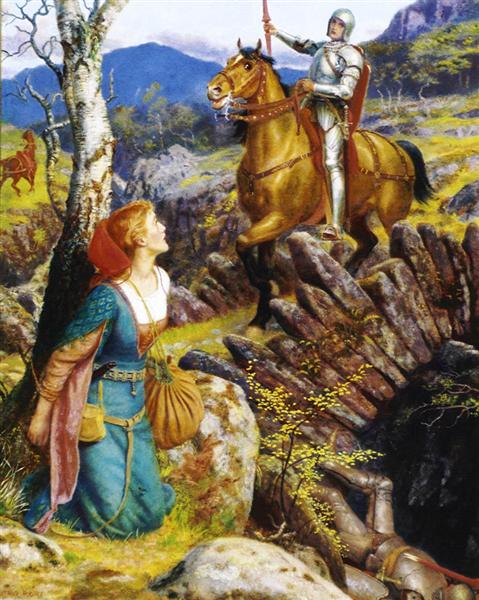
Arthur Hughes, Overthrowing of the Rusty Knight (also known as Gareth Helps Lyonorr and Overthrows the Red Knight), 1894-1908, oil on panel, private collection

This is the version that was picked up by emasculated 19th century Romantic pussies like the poet Tennyson and the pre-Raphaelite painters. We would be less harsh if it had been simply acknowledged as fantasy from the jump. Instead it led to this retarded idea of an "Age of Chivalry" as something to get back to. A more honest appraisal of human nature would have been preferable and more socially productive. Bullshit about female nature has done grievous harm to the West.  


So by the end of the Middle Ages, whatever martial value the nobility may have provided was replaced with parasitic, pleasure-seeking, elites peddling lies about their supposed virtues. Imaginary fake knighthood took the place of actual service in a court world that contributed nothing but consumption. And when their land holdings were insufficient to preserve their bloated lifestyles, they turned to the new economy that was emerging at the end of the Middle Ages - merchants and bankers. People often wonder how the bankers gained such power over our world. The answer is that this started centuries ago, when the parasitic aristocrats of the late Middle Ages borrowed huge sums of money to fund profligacy and warfare at the expense of their own people. Professional armies were expensive.


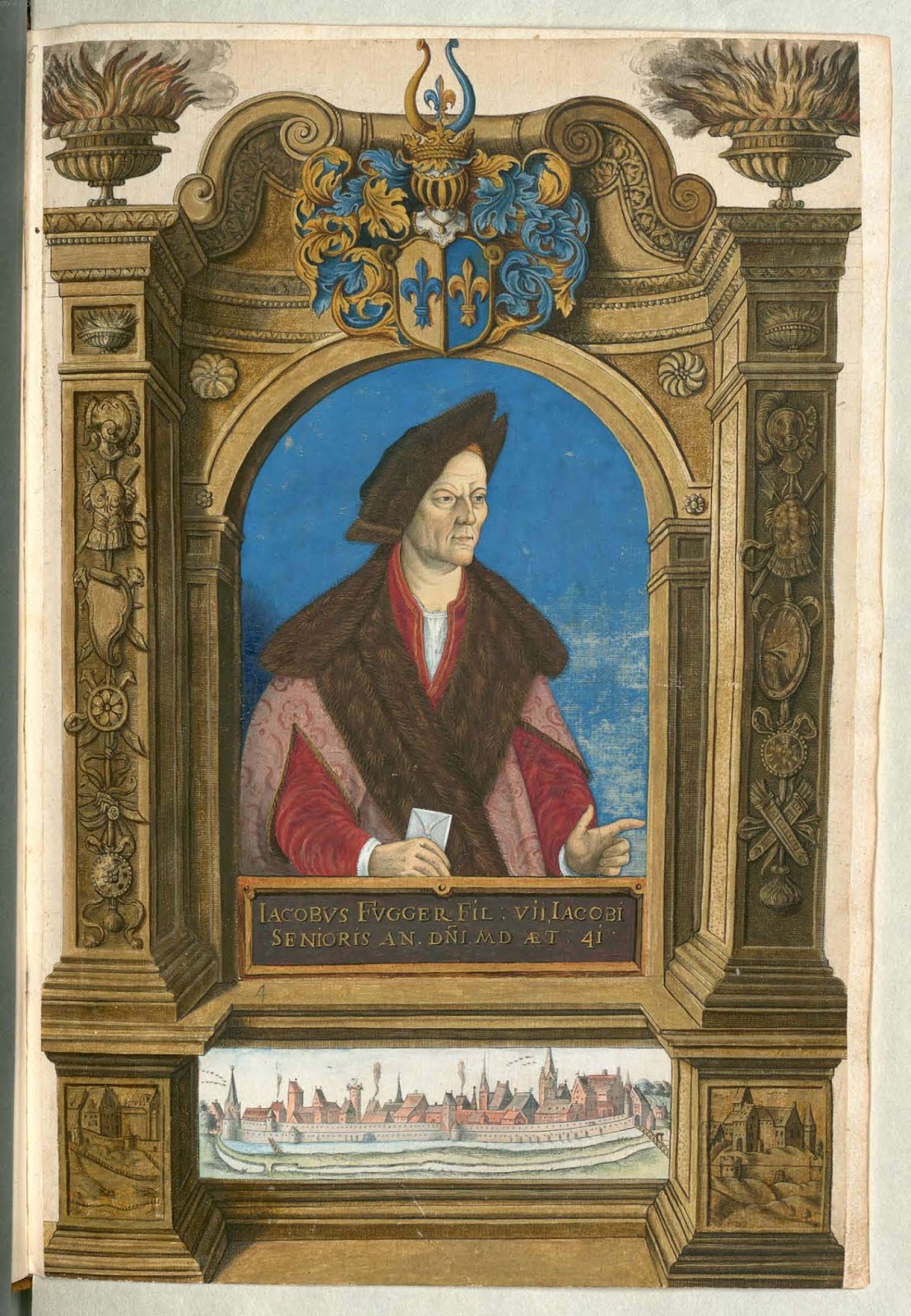
Dominicus Custos, Jakob Fugger the Rich, colored copperplate engraving from Fuggerorum et Fuggerarum imagines, commissioned by Philipp Eduard Fugger, Augsburg, 1588, colored copy from 1618, Bavarian State Library , BSB-Hss Cod.icon. 380

The Fuggers were Augsburg bankers, merchants and miners that dominated the European economy in the 15th and 16th centuries, eventually buying their way into the nobility - like the Medici that came before them and the Rothschilds afterwards. Jakob the Rich seen here made an Imperial Count by Emperor Maximilian I in 1514 

Fugger money bankrolled Charles V's election as Holy Roman Emperor in 1519.  


Carl Becker, Emperor Charles V with Jakob Fugger, 1866, oil on canvas, Alte Nationalgalerie, Berlin

This picture shows Jakob Fugger, near the end of his life, voluntarily burning Charles V's promissory notes. This was a favor to the emperor as well as a demonstration of just how wealthy he was.  


Because, as we've noted, the aristocrats didn't see the common folk as their people. The parasite class of late medieval aristocrat didn't fight or even raise and inspire levies that did. They had no contact with the people working under them. Ditto for the high clergy. They truly became a separate culture - with more in common with their peers in other nations than their own co-nationals.

Professional soldiers like the German Landsknechts and Spanish tercios, with new weapons and tactics like massed pikemen and firearms transformed warfare. Both the mounted knight and peasant levy disappeared into obsolescence, though the night was reborn as a romantic figment.


Bernard of Orley and William Dermoyen, Imperial Army Advance and Attack on the French led by Francis I, first of seven tapestries representing the Battle of Pavia, between 1528 and 1531, wool, silk, silver and gold, National Museum of Capodimonte  


What is important to notice about this is how the nobility essentially jacks the emerging nation-state before it even really gets off the ground. The Carolingian Empire breaks up into the forerunners of distinct countries, but the aristocratic nature of the rulership coalesces into a a more international-minded elite culturally that is divided and generally hostile to the peoples it rules over. There never was a golden age of national unity - the nobility was developing in parallel to the nations. What we noted at the beginning as national interests complicating the secular sacred split were actually elite ones.

The players have changed, but the problem of the elites and the inherent cultural conflict that results is something any new form of organic nationalism will have to attend to.


The split between proto-globalist elites and people is easy to see in the religious sphere. Historians have long pointed out that the late Middle Ages was a time of intensifying public piety. Consider:


Gothic Reliquary of the Virgin and Saints, late 13th century, gilt copper set with mother of pearl, rubies, rock crystal, turquoise, and other gems, Walters Art Museum  


The cults of saints, relics, and pilgrimages to go see them...


Shrine of the Virgin, around 1300 from the Rhine Valley, oak, linen covering, polychromy, gilding, gesso, Metropolitan Museum of Art


...the growing cult of Virgin Mary...


Priest Carrying the Host in a Monstrance, detail from a Missal, Franciscan use, in Latin France, Angers ca. 1427 The Morgan Library & Museum; MS M.146, fol. 141v


... and devotion to the Eucharist and the feast of the Corpus Christi all took off in the later Middle Ages.


Maestro del San Francesco Bardi, St. Francis of Assisi altarpiece, first half  of 13th century, Santa Croce, FlorenceSt. Clare of Assisi altarpiece, 1280s, tempera on panel, Santa Chiara, Assisi

Clare was one of Francis' first followers and founder of the Poor Clares, the women's version of the Franciscans. 

Immensely popular saints like Francis of Assisi and Dominic launched influential religious movements and new forms of art like the altarpiece were invented to depict them.


Miracle Windows depicting St. Thomas a Beckett, late 12th century, Trinity Chapel, Canterbury Cathedral

Scenes of the miracles attributed to the martyred Archbishop of Canterbury that turned the cathedral into a major pilgrimage destination.

The Gothic flooded Christendom with stunning buildings and new forms of devotional art.


We could go on, but this should at least give a sense the late medieval intensification of popular piety that we mentioned.

And all the while, the aristocracy was intensifying their love of money and luxury. Of course there were some legitimately pious aristocrats, but they were a small minority. And as the new merchant and banking elites came into their own, it was Team Parasite-style luxury living that they aspired to.


Limbourg brothers, September, between 1412 and 1416, painting on vellum from the Très Riches Heures du duc de Berry f. 9v, Condé Museum  

A depiction of peasantry outside the Château de Saumur.

Perhaps the most stunning manuscript of the International Gothic, this was made for the brother of the King of France.  The scenes are idealized in their depiction of a happy productive countryside, but the contrast between host and parasite couldn't be clearer. 


So divine kings and parasitic nobility. How could that go wrong? Consider that this was the structure that ushered in the modern world and it's not hard to see how a landed, alien, profligate gentry gradually ceding real power to the new money class doomed it from the start.

This is a good place to break. We'll take up the art more systematically next time. Until then, let's late a look at the aristocrats using the land, while the serfs take a swim.


Limbourg brothers, August, between 1412 and 1416, painting on vellum from the Très Riches Heures du duc de Berry f. 9v, Condé Museum  

A depiction of falconry outside the Château d'Étampes.


Most Popular Posts